
An AY-ST-V3.0 folding and vehicle fit trial should cover empty-chair preparation, loading, cargo securing, unloading, and reassembly. Each step needs a repeatable method. Measure the actual equipment and vehicle together. Cargo volume alone cannot answer that question.
This trial covers empty equipment carried as cargo. It does not establish suitability for occupied wheelchair transport or crash restraint. The AY-ST-V3.0 folding beach wheelchair has a folding frame and removable assemblies shown in its manual. Those features still require a vehicle-specific check.
Images are AI-generated illustrations based on product references. They do not document an actual inspection, factory visit, or project.
1. Which vehicle and cargo arrangement will be tested?
Record vehicle make, model, body version, and seating arrangement. Include cargo liners, partitions, storage boxes, and equipment normally carried. A fit established with an empty boot may fail when an operator adds routine luggage or reinstalls a passenger seat.
Name the loading door and parking arrangement. Access from a rear hatch differs from a side door, especially beside kerbs or other vehicles. Conduct the stationary check where doors can open fully and staff have adequate working space.
- Record vehicle identity and interior arrangement.
- Photograph normal cargo and fixed obstructions.
- Name the door used for loading.
- Identify surfaces used for staging removed parts.
Vehicle fit belongs to a specific configuration. Mark any seats folded or removed during the trial. Operators comparing models across the beach wheelchair range should repeat this record for each chair; one successful fit cannot represent every product.
Vehicle identity record
| Item | Record during trial | Repeat trial when |
|---|---|---|
| Vehicle version | Body and interior configuration | Vehicle changes |
| Seating | Seats installed, folded, or removed | Passenger arrangement changes |
| Cargo equipment | Boxes, liner, partition | Storage layout changes |
| Loading access | Door and parking position | Different access method is planned |
2. How should the empty chair be prepared for measurement?
Use the current V3.0 manual for permitted folding and disassembly steps. The document shows a folding frame, flip-up foot supports, and removable wheel assemblies. Do not remove additional components solely to make cargo space appear sufficient.
Photograph the starting condition, then list every removed item. Keep hardware with its corresponding assembly in a suitable container. Record whether carrying wheels separately changes the number of handling operations.
- Empty seating and accessory storage.
- Follow documented folding steps.
- Identify all loose components.
- Keep fabric and controls clear of closing joints.
The measured package must match routine practice. If staff normally leave certain assemblies attached, measure that arrangement as well. A compact demonstration requiring unplanned disassembly may be unsuitable for frequent trips. Stop when instructions do not explain a necessary step and obtain clarification before proceeding.
Equipment configuration options
| Arrangement | Measure | Operational question |
|---|---|---|
| Fully assembled | Complete outer envelope | Can it pass through access and be secured? |
| Folded as instructed | Folded frame with retained parts | Is preparation practical each trip? |
| Documented disassembly | Frame and every separate assembly | Where will each component travel? |
| Different accessory set | Revised envelope and loose pieces | Does earlier fit evidence still apply? |
3. Which equipment measurements matter?
Measure maximum length, width, and height in the chosen cargo orientation. Include protruding knobs, brackets, and retained components. State measurement units and identify your measuring points so another reviewer can reproduce the result.
Keep frame measurements separate from loose wheel or accessory envelopes. The largest piece may determine door clearance, while all pieces together determine cargo occupancy. A package carton measurement does not represent folded equipment dimensions.
- Measure each cargo piece independently.
- Record protrusions and orientation.
- Photograph tape position where clearances are close.
- Include protective containers in final measurements.
Separate-piece measurements must add up to a loadable set. Use wheel information only for product identification; measure the fitted assemblies themselves. Record awkward shapes that need extra room during rotation, even when their resting footprint appears small.
Equipment measurement sheet
| Piece | Dimensions to record | Additional observation |
|---|---|---|
| Folded frame | Maximum length, width, height | Exposed projections |
| Removed wheel assemblies | Each packed envelope | Stacking method if permitted |
| Hardware container | Closed container dimensions | Access during reassembly |
| Protective covering | Final covered envelope | Added thickness and grip access |
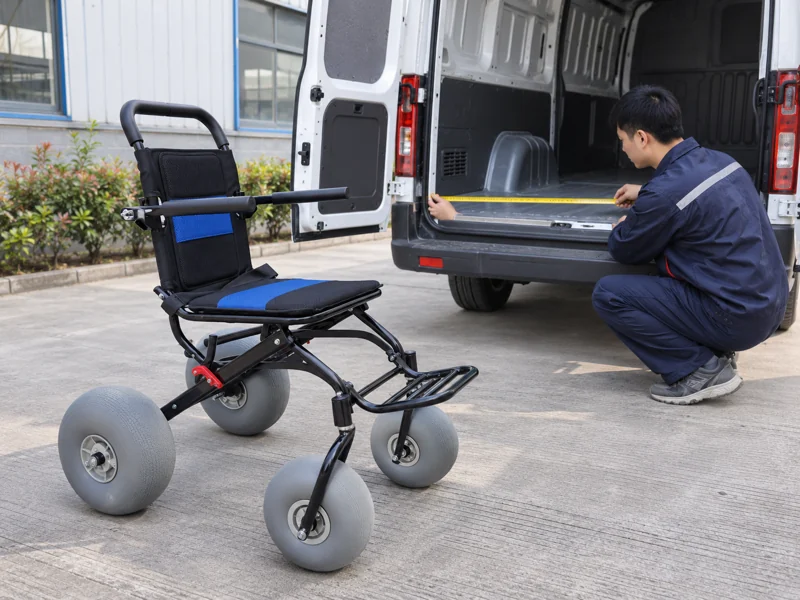
4. How should door clearance and internal space be measured?
Measure the usable opening at its narrowest relevant points. Trim, hinges, weather seals, and a sloping hatch can restrict entry before cargo reaches the floor. Measure sill height and the space needed for staff to change grip without trapping hands.
Inside, record usable width, depth, and height with normal cargo present. Check whether this chair must rotate after passing the door. A load can fit at rest yet remain impossible to manoeuvre through a narrow entrance.
- Measure door width and height at restrictions.
- Record sill height and floor level.
- Check interior turns and overhead trim.
- Reserve space for other routine equipment.
An entry path can be tighter than interior storage space. Compare actual measurements with the equipment envelope before lifting. For portable beach-access applications, repeat this check with the normal trip load. Do not force a component past interior trim to demonstrate a nominal fit.
Match dimensions with constraints
| Vehicle measurement | Compare against | Failure signal |
|---|---|---|
| Door opening | Piece orientation during entry | Contact or forced compression |
| Cargo floor width | Stored equipment footprint | Interference with fixed fittings |
| Interior height | Equipment plus protection | Contact with hatch or roof |
| Turning space | Movement needed after entry | No workable rotation path |
5. What should a stationary loading trial reveal?
Plan who handles each piece and where it will rest before beginning. Use appropriate handling equipment and a locally assessed method. The chair’s product weight alone cannot determine a suitable staffing arrangement or lifting technique.
Observe reach, grip changes, sill crossing, and component placement. Stop if staff must lift through an awkward posture or grasp fabric, controls, or unapproved attachments. Record the obstacle rather than forcing a successful-looking result.
- Identify approved handling points.
- Assign roles before movement starts.
- Keep the staging area clear.
- Note every grip change or intermediate rest.
A repeatable loading method needs working room for people. Include that space when evaluating vehicle suitability. Check the manual library for current instructions and send unresolved handling questions to your supplier. Repeat only after correcting the cause of an awkward or uncontrolled movement.
Loading observations
| Stage | Observe | Response if unsuitable |
|---|---|---|
| Ground pickup | Grip access and posture | Revise handling method |
| Sill crossing | Reach and clearance | Consider suitable loading aid or vehicle |
| Interior placement | Control during rotation | Change orientation or reject fit |
| Loose-part loading | Container access and space | Revise packing sequence |
6. How should cargo securing be reviewed?
Establish a cargo-securing arrangement using applicable vehicle guidance and product advice. Confirm vehicle anchor points and the permitted way to secure empty equipment. Do not assume a convenient chair tube, handle, or seating belt is an approved cargo attachment.
Secure loose assemblies and hardware containers as separate cargo where required. Protection should prevent rubbing without hiding movement or placing pressure on vulnerable parts. Record which cargo-securing equipment and attachment arrangement were reviewed.
- Identify vehicle anchors from vehicle instructions.
- Confirm permitted equipment contact or attachment areas.
- Restrain loose pieces under the chosen cargo method.
- Check closure and access after securing.
An equipment fit remains incomplete until cargo securing is resolved. Request written clarification where attachment suitability is unknown. This assessment addresses empty cargo only. It supplies no crash-test result or authorization for someone to remain seated during vehicle travel.
Cargo-securing questions
| Area | Required answer | Trial remains open if |
|---|---|---|
| Vehicle anchors | Which points are permitted? | Identification is uncertain |
| Chair contact | Where may securing loads be applied? | Attachment is improvised |
| Loose wheels | How are assemblies contained? | Pieces can move freely |
| Fabric and controls | How are they protected? | Straps compress vulnerable components |
7. What protection and access checks follow loading?
Close doors gently after confirming clearance. Check that equipment does not obstruct vehicle controls, visibility, required exits, or access to emergency items. Evaluate any other cargo that could shift against the chair.
Look at contact points on fabric, valves, wheels, and painted surfaces. Protection should stay in place through the intended cargo arrangement. Record what must be removed first during unloading, especially when the chair sits beneath other equipment.
- Confirm door closure without pressure on cargo.
- Keep required vehicle access unobstructed.
- Identify rubbing and sharp contact points.
- Photograph the final secured arrangement.
The final cargo photograph should show an operable vehicle. Include normal trip items rather than presenting an unrealistically empty load space. Use beach-access project planning to identify operational needs, then validate those needs against the actual vehicle arrangement.
Loaded-vehicle review
| Check | Acceptable record | Reason to revise arrangement |
|---|---|---|
| Door closure | Clearance confirmed | Door presses on equipment |
| Vehicle access | Required areas available | Cargo blocks access |
| Component protection | Contact points identified | Rubbing or crushing risk unresolved |
| Unloading order | Pieces accessible in planned sequence | Required item trapped underneath |
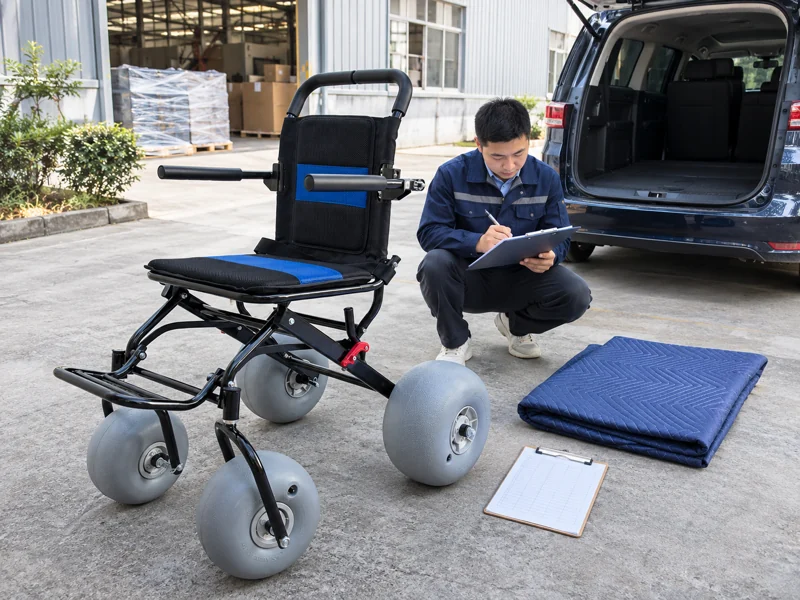
8. What should unloading and reassembly demonstrate?
Unload at a location representative of the destination. Parking surface, available space, and distance to storage can differ from the loading site. Review those conditions before repeating handling steps.
Rebuild the empty chair using its instructions, then complete affected checks. Confirm wheel retention, folding lock engagement, seating condition, and movement. Keep tools and small parts accounted for throughout.
- Reverse the documented loading sequence.
- Use a clear component staging area.
- Refit removed assemblies as instructed.
- Check operation before making equipment available.
Successful arrival includes a correctly rebuilt chair. Record missing tools, awkward access, or uncertain reassembly as transport-workflow findings. If product clarification is needed, send annotated photographs through Ary Beach contact. Evaluate unloading and reassembly after confirming departure arrangements.
Destination checks
| Stage | What to verify | Record |
|---|---|---|
| Unloading | Handling space and planned sequence | Site differences |
| Parts reconciliation | Every removed component present | Missing or damaged items |
| Reassembly | All affected connections restored | Checker and instructions used |
| Functional check | Movement and relevant locks | Pass or unresolved finding |
9. What would invalidate an earlier vehicle-fit result?
Repeat relevant checks after changes to the vehicle interior, chair configuration, cargo-securing method, or routine trip load. A different wheel assembly or protective container can change the envelope. A changed passenger arrangement can remove previously available cargo space.
Seasonal operations can also alter unloading conditions. Record whether destination access changes during crowded periods or when surface conditions deteriorate. The fit report should state its boundaries clearly enough for dispatch staff to recognize a mismatch.
- List approved vehicle and chair configurations.
- Record normal cargo and seating assumptions.
- Define changes that require another check.
- Keep photographs with the measurement record.
A fit result applies only while its assumptions remain true. Compare each planned deployment with the accepted record. If a material difference appears, assess that changed part of the workflow before relying on previous findings.
Changes and required rechecks
| Change | Recheck |
|---|---|
| Different vehicle or seating layout | Door, cargo space, handling, securing |
| Changed wheel or accessory set | Equipment envelope and component storage |
| New cargo restraints | Anchor suitability, contact, protection |
| Different unloading site | Working space, surface, staging, handling |
| Additional routine luggage | Clearances, access, securing, unloading order |
10. What should the vehicle-fit decision say?
Record fit accepted, revision required, or unsuitable for the proposed arrangement. State empty-equipment scope, vehicle identity, chair configuration, measurements, handling method, securing arrangement, and destination reassembly result.
List unresolved actions beside their owners. A chair that enters cargo space but lacks an agreed securing method has an incomplete transport arrangement. A trial requiring a different vehicle or loading aid should say so before purchasing or dispatch commitments.
- Attach measured dimensions and photographs.
- Describe the accepted preparation sequence.
- Record operating assumptions and recheck triggers.
- Name the reviewer and completion date.
Dispatch instructions should reproduce the accepted trial. Turn the final record into a short loading sheet with component locations and reassembly checks. Repeat the workflow when equipment or vehicle arrangements change.
Q1: Does this trial approve occupied wheelchair transport?
This trial covers an empty AY-ST-V3.0 carried as cargo. Occupied transport requires a separate, appropriately supported assessment.
Q2: Can the shipping carton size prove vehicle fit?
Cartons may contain disassembled equipment. Measure the actual prepared chair and every separate cargo piece.
Q3: Can wheels be deflated to squeeze through a door?
Do not improvise configuration changes. Use only a documented preparation method and confirm inflation requirements before any subsequent use.
Q4: What if the chair fits only with passenger seats folded?
Record that seating arrangement explicitly. Fit evidence does not apply when those seats are returned to passenger use.
Q5: Must the destination be included in the trial?
Unloading space, component staging, and reassembly can determine whether a transport arrangement works in routine service.