
An AY-ST-V2.0 high back beach wheelchair route trial should test the complete land route, including storage access, setup, surfaces, turning, stopping, and return. Record where assistance changes and where movement becomes unsuitable. A brief photograph on sand cannot establish a workable municipal service.
The AY-ST-V2.0 all-terrain model has four wheels, a high backrest, and adjustable leg support. Plan the trial around that configuration and current instructions. Keep water entry outside this land-route assessment.
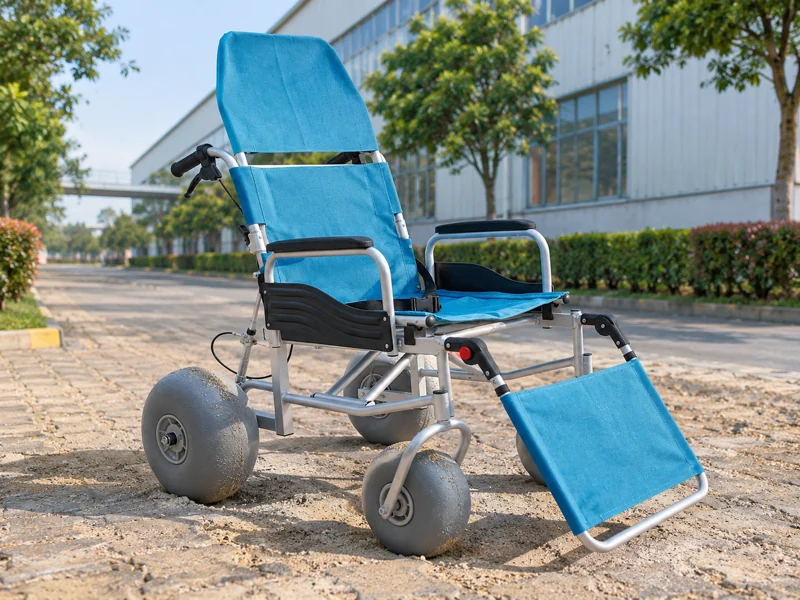
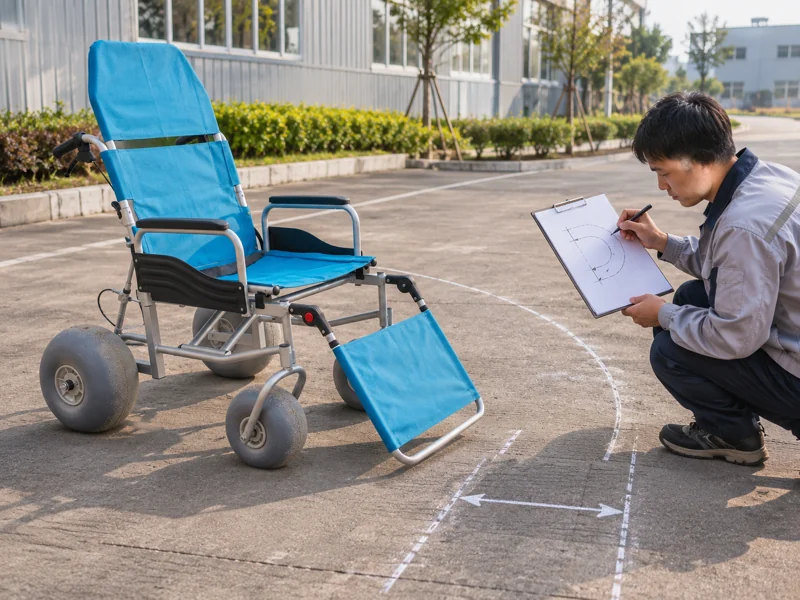
Images are AI-generated illustrations based on product references. They do not document an actual inspection, factory visit, or project.
1. What route and service will the trial evaluate?
Name the start, destination, return path, and intended operating arrangement. Include every door, gate, ramp, boardwalk edge, sand section, and turning point between storage and destination. Draw a simple route map with segment identifiers.
Record the service you intend to offer. Staff-assisted scheduled use, equipment collection, and a staffed rental station create different handover requirements. Use one defined service during the trial so staffing observations have a clear meaning.
- Mark route start and turnaround point.
- Identify public access and shared-path sections.
- List proposed staff responsibilities.
- State excluded surfaces and conditions.
A trial should follow your actual service route. Use beach-access application contexts to describe the program, then replace general terms with local locations. A route labelled “beach access” needs more detail before equipment can be evaluated.
Route definition sheet
| Segment | Record before testing | Decision sought |
|---|---|---|
| Storage exit | Door, threshold, working space | Can staff deploy the chair? |
| Approach path | Surface, width, obstructions | Can movement remain controlled? |
| Beach segment | Sand condition and boundaries | Does the planned route work? |
| Return and storage | Turnaround, cleaning, access | Can service finish reliably? |
2. What does the current V2.0 configuration require?
Match your sample with the current AY-ST-V2.0 manual. It identifies a folding carbon-steel frame, inflatable PU wheels, a removable high-back component, reclining backrest, and adjustable leg support. Confirm the supplied configuration before route work.
Record seat, backrest, and leg-support positions used during testing. An adjustment can change equipment clearance or the assistance needed. Do not compare runs with different settings without noting that difference.
- Photograph assembled configuration from several sides.
- Record relevant adjustment positions.
- Identify removed or added accessories.
- Confirm instructions match the supplied chair.
Configuration changes can change route results. Resolve unexplained substitutions before movement begins. Evaluate a compact alternative such as the V3.0 folding wheelchair separately, with its own configuration and trial record.
Configuration record for repeatable trials
| Component | Record | Why it matters |
|---|---|---|
| Wheel assemblies | Supplied version and position | Rolling and attachment checks |
| Backrest | Installed parts and selected position | Clearance and setup consistency |
| Leg support | Installed assembly and position | Front clearance and turning envelope |
| Accessories | Items present during trial | Total occupied space and handling |
3. Which mechanical checks come before route movement?
Inspect frame, seating, wheel retention, controls, and adjustment mechanisms on firm, level ground. Complete setup according to instructions. Hold the sample if any structural or assembly question remains unresolved.
Check wheel condition and inflation against the current manual and supplied components. Use a gauge suitable for the applicable range. Product descriptions on the beach wheel page do not replace model-specific settings or attachment checks.
- Confirm all assembly connections are complete.
- Inspect fabric, supports, and accessible edges.
- Check wheel movement and retention.
- Verify relevant control and locking functions.
A route trial should begin with a mechanically checked chair. Record pre-trial condition so later findings can be compared with a baseline. Do not explain away a loose connection as a sand-handling issue. Correct it through approved procedures and repeat affected checks before proceeding.
Pre-trial mechanical record
| Area | Baseline observation | Stop condition |
|---|---|---|
| Frame | Alignment and visible condition | Crack, bend, or insecure connection |
| Wheels | Attachment, inflation, movement | Unresolved retention or rolling fault |
| Seating | Fabric and attachment condition | Damaged support or fitting |
| Adjustments | Engagement at selected settings | Unintended movement or uncertain function |
4. How should the route be measured before a participant trial?
Walk the route without a participant and measure its limiting points. Record usable width, abrupt level changes, gradients where relevant, surface condition, and turning space. Identify which measurements need comparison with product instructions or local access requirements.
Do not convert a measured slope into an approved operating limit without the relevant basis. A measurement describes a site; it does not certify safety. Mark uncertain sections for review before equipment proceeds.
- Measure narrow gates and fixed obstructions.
- Identify cross-slope and abrupt transitions.
- Record soft patches and sand accumulation.
- Mark places for stopping and turning back.
A route measurement should lead to a local decision. Widen a staging area, alter a path, or exclude a segment where appropriate review supports that choice. Municipal teams reviewing beach-access project examples should collect their own measurements; another location’s appearance provides no clearance evidence.
Measurements and resulting questions
| Observation | Record | Question before trial |
|---|---|---|
| Narrow access | Usable width and protrusions | Does the configured chair clear it? |
| Threshold or edge | Height, shape, approach | Is an approved crossing method available? |
| Gradient or cross-slope | Measurement and direction | Is operation permitted here? |
| Turnaround space | Usable area and obstructions | Can staff turn without improvised lifting? |
5. How should seating and transfer arrangements be reviewed?
Confirm the intended seating position and adjustment method before any participant stage. Check backrest and leg-support engagement while following current instructions. A high backrest does not establish clinical suitability for a particular person.
Select a stable transfer location with adequate space and appropriate assistance. Transfer arrangements should follow the participant’s needs and competent local guidance. This route trial should not invent a universal transfer technique.
- Identify the transfer location and access.
- Record selected seating and support positions.
- Confirm who supervises participant preparation.
- Define how discomfort or concern ends a trial.
Participant fit must be resolved before route performance is judged. Obtain the appropriate assessment when support needs are uncertain. Use the manual library for model instructions and keep individual assessment information separate from public purchasing reports.
Seating and transfer readiness
| Topic | Required decision | Record boundary |
|---|---|---|
| Seating position | Suitable setting and secure engagement | Record configuration, avoid medical promises |
| Transfer area | Stable location and adequate space | Describe local arrangement |
| Assistance | Competent roles agreed | Do not infer from a product photograph |
| Participant concern | Clear pause and exit procedure | Keep personal details private |
6. How should movement across different surfaces be observed?
Begin with a clear firm-ground segment after mechanical checks. Progress only through sections permitted by current instructions and the approved trial plan. Observe starts, turns, stops, and changes in control at each surface transition.
Record conditions precisely: dry loose sand, damp compacted sand, deposited sand on paving, or another observed surface. Avoid reducing all findings to “works on sand.” Note weather and recent site changes that could affect repeatability.
- Record segment and surface condition.
- Note changes in assistance or control.
- Identify wheel drag, rutting, and contact points.
- Stop when agreed operating limits are reached.
Each surface change deserves its own observation. A manageable firm-sand section cannot clear an untested loose-sand section. Compare alternatives from the beach wheelchair range only under appropriately controlled, recorded conditions. Do not publish performance rankings from unlike trials.
Surface observations with practical consequences
| Surface finding | Record | Possible next step |
|---|---|---|
| Sand builds at a hard edge | Location and effect on movement | Maintain or alter the transition |
| Deep wheel tracks | Segment and surface condition | Review route or operating scope |
| Turning becomes difficult | Space and assistance used | Change turnaround location |
| Movement remains controlled | Configuration and conditions | Retain as evidence for that segment |
7. What should staff roles and effort records show?
Name an operator, observer, and decision lead where the trial plan requires those roles. Agree clear communication before starting movement. An observer should be able to call a stop without confusion about who controls equipment.
Record actual assistance and reasons for changes. Avoid declaring a universal staff number from one run. Equipment condition, route, participant needs, and local procedures can all affect staffing.
- Assign roles and stop communication.
- Record who assists on each segment.
- Note pauses and changes in handling.
- Observe the return leg as carefully as departure.
The return route can expose a staffing gap. A team may reach a destination yet lack a workable return arrangement under the same conditions. Stop before fatigue or control problems escalate. Rework the route or staffing plan instead of asking staff to compensate indefinitely.
Staff observation record
| Trial event | Record | Operational implication |
|---|---|---|
| Assistance changes | Location and reason | Review segment staffing |
| Unplanned pause | Cause and duration if useful | Add planned stopping point or shorten route |
| Communication unclear | Missed or conflicting instruction | Revise roles and signals |
| Return effort differs | Conditions and staff observation | Review full-route feasibility |
8. Which events should stop the trial immediately?
Stop for a mechanical fault, uncertain control, slipping adjustment, participant concern, unsafe site change, or a condition outside the agreed plan. State those boundaries during the briefing so an observer does not have to debate them mid-trial.
Keep route stops separate from equipment holds. A blocked path may require postponement with a mechanically sound chair. A loose wheel requires equipment isolation even after the route becomes clear.
- Identify equipment faults requiring withdrawal.
- Agree participant-led pause signals.
- Name weather and site conditions requiring review.
- Maintain a clear return or exit arrangement.
A stopped trial still produces useful evidence. Record the stopping location and cause, then resolve it before any repeat. Send equipment-specific findings through Ary Beach support; route-management issues belong with the local operating team.
Stop event and responsible follow-up
| Event | Immediate status | Follow-up owner |
|---|---|---|
| Wheel or connection fault | Chair held | Technical or maintenance lead |
| Route obstruction | Segment closed or trial paused | Site manager |
| Participant concern | Participant stage stopped | Appropriate support lead |
| Conditions change | Trial paused for reassessment | Trial decision lead |
9. What should the post-trial inspection and report contain?
Compare the chair with its pre-trial record. Inspect attachments, wheels, seating, adjustment positions, and visible condition. Record any new noise, looseness, damage, or contamination. Follow current cleaning and maintenance guidance before storage.
Build the report around route segments rather than a single pass/fail impression. Include setup, conditions, observations, stopped segments, required changes, and untested areas. Keep photographs tied to locations and equipment ID.
- Compare pre-trial and post-trial condition.
- Record completed cleaning and any service action.
- Separate observed results from proposed improvements.
- List segments requiring repeat testing.
Untested sections should remain visible in the report. Do not turn a partial run into approval for the whole route. If an adjustment or replacement follows the trial, record that change and determine which observations must be repeated.
Report entries that support a decision
| Report entry | Required detail | Decision supported |
|---|---|---|
| Configuration | Chair ID and selected settings | Repeatability |
| Route conditions | Segment-specific surface and access | Scope of findings |
| Observed difficulty | Location, action, assistance | Route or staffing changes |
| Post-trial condition | New findings and correction | Equipment release |
| Untested area | Reason and next step | Limits of approval |
10. How should municipal buyers turn results into a decision?
Approve a defined combination of equipment configuration, route, conditions, and operating arrangement only after consequential findings are closed. Record whether your route is accepted, requires modification and retesting, or remains unsuitable for the proposed service.
Define conditions that trigger future review. Storm deposits, erosion, changed access works, staffing changes, and replacement components can affect earlier findings. A routine pre-use check remains necessary after a successful procurement trial.
- State the accepted route and excluded segments.
- Attach configuration and staffing records.
- Close equipment and route corrections.
- Name conditions that require another assessment.
A purchasing recommendation should state exactly what this trial supports. Give operations staff a route map, setup reference, stop rules, and repeat-review triggers. Keep untested claims out of public service descriptions until appropriate evidence supports them.
Q1: Does the V2.0 route trial include floating or water entry?
This evaluation covers land-based access only. Floating-chair operating decisions require their own model, instructions, and site plan.
Q2: Can an empty-chair roll replace the participant stage?
It can screen mechanical and clearance issues. It does not establish individual suitability or every aspect of assisted operation.
Q3: Should the backrest be reclined during every test?
Use a permitted configuration appropriate for the planned trial. Record settings and assess changed configurations separately when needed.
Q4: Is one successful dry-weather trial enough for every season?
Keep approval within recorded conditions and define reassessment after material route, weather, staffing, or equipment changes.
Q5: What if only one sand section proves unsuitable?
Record its location and cause. Review an alternative route or local change, then repeat affected checks before extending approval.