
At Nice’s Handiplages, reaching the concrete platform and moving from that platform towards the water are two different parts of the visit. A French municipal team considering a similar arrangement should identify who can provide each part, what changes when the removable mat comes up, and what the reception point can still offer.
The City of Nice’s rules for Carras and Centenaire, marked effective on 17 April 2024, describe a ramp and pathway leading to a concrete slab. Article 3 says the Handiplagistes lay a mat between the slab and the water and can remove it when a potential danger arises. It separately assigns general beach surveillance and first-aid intervention to the nearby rescue post. This is a documented local division of work at two sites. Check the municipality’s latest arrangements before planning a visit. Ville de Nice, Handiplages de Carras et du Centenaire, Article 3
Start the design at the slab
Identify exactly where the permanent route ends. On the plan, show the ramp arrival, usable space on the slab, the first mobile section and the area where a visitor can wait or turn. Verify which of those spaces remain usable when the mat is withdrawn. An operator describing the route only as “access to the sea” cannot tell a visitor whether a land-based outing is still available.
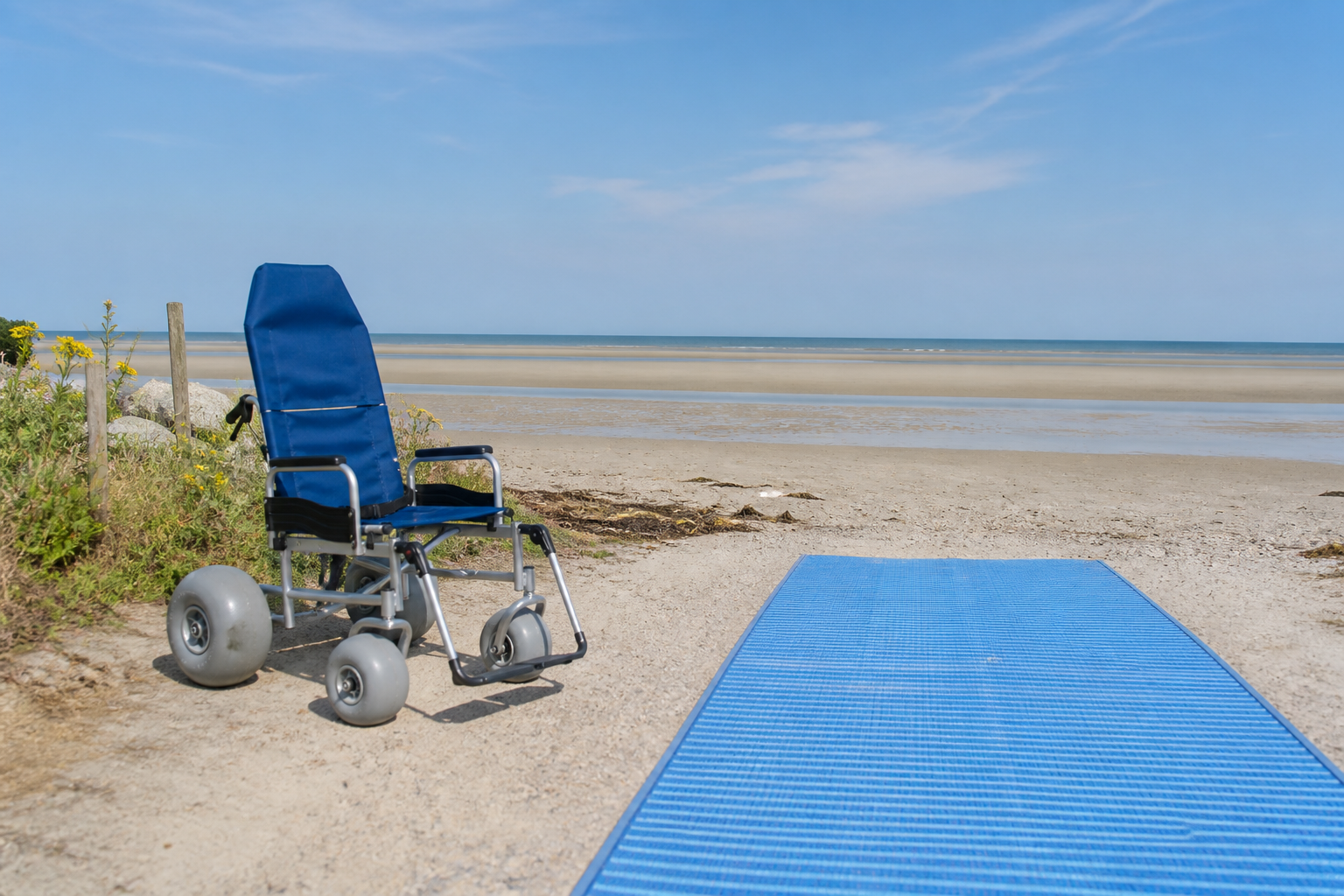
Ask the supplier to identify the proposed mat construction, installed coverage, edge treatment and the junction with the slab. An approved technical reviewer needs the finished level and support on both sides of that junction. Changes in the pebble or sand profile may leave the same section differently supported after removal and replacement. The drawing should identify where staff inspect on each deployment. Mat connections at ramps and hard landings
Assign access, assistance and rescue to named roles
Nice’s rules describe seasonal staff assisting people during entry and exit. They also provide for restricting assistance when conditions warrant. The local duty team needs to know who can accept a visitor at the land endpoint, who may provide an assisted-water activity, and who handles emergencies under the site’s procedure. The presence of a rescue post supplies neither a mat installation crew nor an individual equipment allocation.
For another municipality or concession, agree the division of work locally. Preserve the visitor’s opportunity to choose a land destination if water assistance cannot go ahead. If an amphibious chair is offered, identify its actual model, current instructions and the trained operator responsible for it. Keep the person’s normal mobility equipment available for the agreed return.
Write a notice for the day the mat is removed
A practical desk exercise starts with a potential danger reported at the water end. The responsible lead follows the local procedure, considers anyone already beyond the platform, controls new departures and changes the status of the affected leg. The desk checks which parts of the approach and platform remain useable. It then tells the visitor precisely where the journey can end and whom to ask about the next update.
A short example in English is, “The water-side mat is withdrawn. Ask at the reception point which land area is available today.” Prepare the actual notice in clear French and any other formats the service uses. Coordinate it with the field team so an earlier message about assisted bathing does not remain visible after the mat has been removed.
Price this work when defining a comparable mat project: access to storage, the approved installation and removal method, lifting arrangements, component identification, daily checks and the person authorised to return the run to use. Use the neutral procurement brief for dimensions and supplier submittals. The Nice example supplies the additional operating question: can the team shorten the route and still give a truthful, supported welcome? Beach mat project specification