
A chair in the store can be mechanically ready while the water service is closed. A confirmed guest can arrive and choose a land visit after the shore conditions change. A dashboard that counts both as completed water service gives the manager little basis for a staffing or equipment decision. Start each measure with a unit, a time period and an event the shift team can record.
Define the unit before calculating a percentage
Use site-hours for opening time, chair-hours for equipment readiness and individual confirmed appointments for booking outcomes. Keep water appointments separate from land visits. Define when each day starts, how partial hours are recorded and which status closes an appointment. Freeze the planned service window before the reporting period so a closure does not quietly shorten the denominator.
| Management question | Numerator | Denominator |
|---|---|---|
| How often was the approved water service available? | Site-hours open for the full planned water service | Scheduled water-service site-hours in the period |
| How often was assigned equipment mechanically serviceable? | Mechanically serviceable, released chair-hours within the assignment, whether in use or idle | Scheduled chair-hours of those assigned units, including equipment holds |
| How many confirmed water visits took place as booked? | Confirmed appointments completed as water visits | All confirmed water appointments for the period, each counted once |
| What did staffing those completed water visits cost in time? | Staff-hours allocated to the defined service, including opening, waiting and closeout where included | Completed water visits in the same period |
If the denominator is zero, report “no scheduled hours” or “no completed water visits,” as applicable. Keep staff hours visible even when the per-visit measure cannot be calculated. Round only the final displayed result. Record planned closures outside the announced operating window separately from unplanned closures inside it.
Rebuild a worked week from the shift records
Suppose one site schedules 20 water-service hours and closes for 5 of them. It had a verified water service for 15 of 20 hours, or 75%. If 3 closed hours were due to sea conditions and 2 to missing trained cover, record one primary cause for each interval and any contributing issue separately. That keeps the weekly closure total at 5 hours.
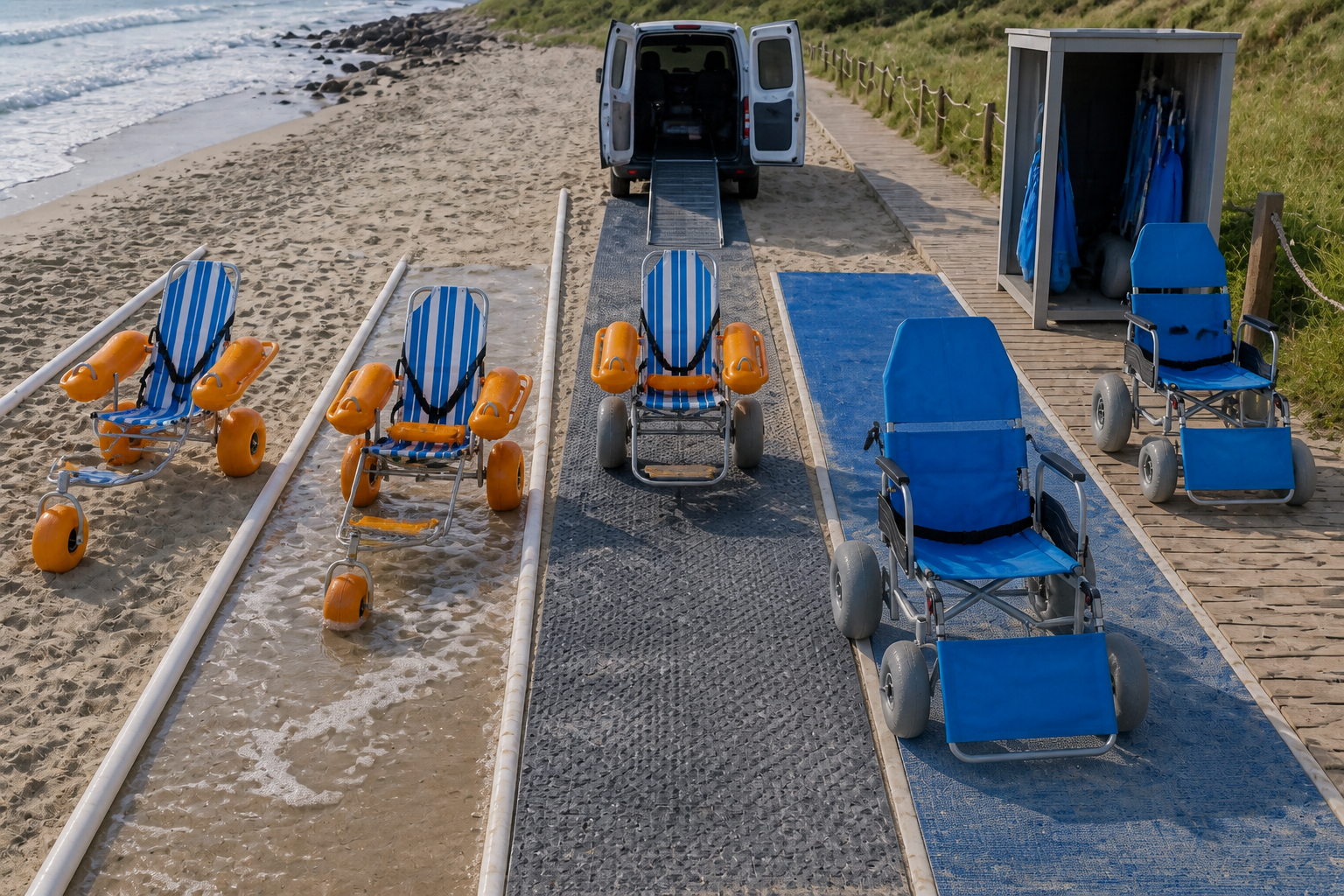
Two AY-ST-V1.0 units are each assigned for the same 20 hours. One is held for 4 hours while its inflatable armrest and fitting are checked. Assuming both units are otherwise mechanically serviceable and released, the result is 36 released chair-hours out of 40, or 90%, including time in use or idle. An immediately available chair must also be free of an active booking, reservation or other assignment at that time. Staff also check the other armrest and three inflatable wheels under the model manual. Ready equipment may overlap the 5 hours of site closure. Adding equipment and site downtime would mix different units and overstate lost service.
Of 12 confirmed water appointments, 7 were completed as booked, 3 changed to land visits, 1 was cancelled by the visitor and 1 was cancelled by the operator. The four categories account for all 12. Water completion is 7/12, approximately 58%. The three land visits can be reported as a separate outcome. If the defined service used 21 staff-hours, that is 3 staff-hours per completed water visit under this accounting definition.
Give the manager a decision beside the number
A high mechanical serviceability percentage alongside staff-related closures points to the shift coverage record. Repeated equipment holds on the same unit point to its inspection and repair history. Conditions at the shore remain a separate release decision for trained staff supervising calm-water use with reliable footing. Avoid setting a completion target that pressures the duty lead to open an unsuitable activity.
Show one line per site before aggregating. Add the raw numerators and denominators, then divide. An unweighted average of two site percentages gives a quiet site the same influence as a much busier one. Keep source dates, definitions and any correction with the published figures. A supervisor should be able to recover the minutes, unit IDs and booking outcomes behind a result without opening a visitor’s private assessment notes.