
Floating beach wheelchair quotation documents should let a buyer identify what arrives, what it costs, and which questions remain open. A usable package combines an itemized offer, configuration sheet, current manual, packing details, support terms, and written clarifications.
For an Ary floating beach wheelchair, keep product identity separate from a general claim about water access. An attractive price becomes comparable only when competing offers cover equivalent equipment and services. The following review ends with a clarified quotation ready for a purchasing decision.
Images are AI-generated illustrations based on product references. They do not document an actual inspection, factory visit, or project.
1. What must appear on the quotation itself?
Request a dated quotation reference, supplier identity, exact model, quantity, currency, unit price, and extended total. Each charge should have a clear basis. Freight quoted for a named destination cannot be compared directly with equipment collected at a factory.
Identify validity and exclusions beside pricing. Ask whether optional items are included, separately priced, or unavailable. A blank accessory line should remain a question until the supplier answers it.
- Give each model or configuration its own line.
- Distinguish unit prices from shipment charges.
- Name delivery destination and trade term.
- State quotation validity and revision.
Price comparison begins with matching supply scope. Use the beach wheelchair range to identify categories before requesting offers. Keep floating and land-only equipment on separate comparison rows. Return a quotation for clarification when its description could cover several materially different products.
Minimum commercial identification
| Quotation field | Buyer check | Clarification needed when |
|---|---|---|
| Model and quantity | Matches requested equipment | Only a generic product name appears |
| Unit and total price | Arithmetic and pricing unit agree | Accessories share an unexplained total |
| Currency | Explicit for every priced line | Currency symbol is ambiguous |
| Delivery basis | Named place and included services | Freight scope is unstated |
2. How should the offered configuration be recorded?
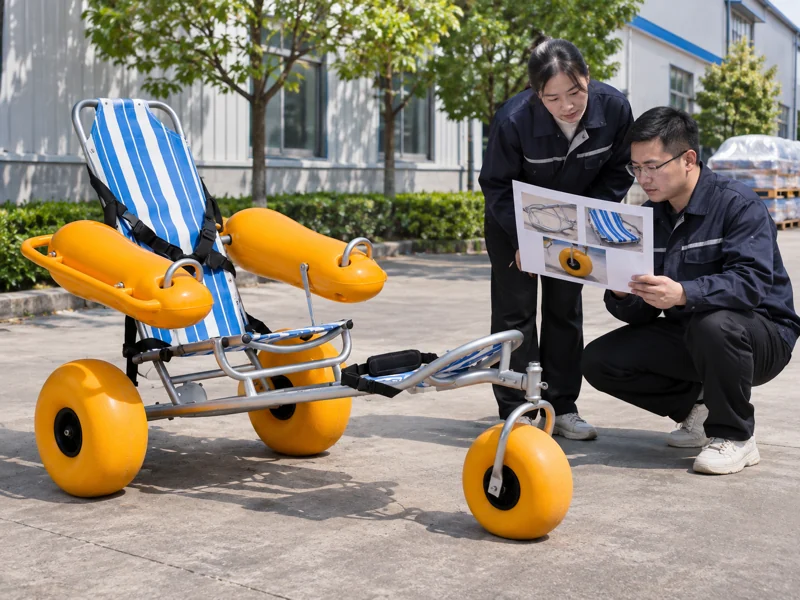
Attach a configuration sheet with photographs and named components. For AY-ST-V1.0, distinguish its three-wheel arrangement and floating armrests from other beach equipment. Specify which seating, support parts, and accessories are included in the offered unit.
Avoid ordering by colour photograph alone. Photos may show optional parts, while an older attachment can depict a previous configuration. Ask the supplier to identify differences between its offer and your requested arrangement.
- Match model name across quotation and attachments.
- List supplied components and optional accessories.
- Record colours only after configuration is clear.
- Identify accepted alternatives explicitly.
An attached photograph needs an agreed supply list. Compare our floating model presentation with your offered configuration. Mark any photograph used for identification with a filename or reference number. That gives receiving staff a stable comparison even if a website later changes.
Configuration choices that affect comparison
| Configuration item | Record in offer | Why a difference matters |
|---|---|---|
| Wheels | Front and rear assemblies supplied | Replacement and packing requirements |
| Floating armrests | Included pair and attachment design | Water-use configuration |
| Seating and supports | Supplied parts and adjustments | Setup and user assessment |
| Optional equipment | Separate description and price | Prevents hidden scope differences |
3. Which technical files answer product questions?
Request the current model manual, specification sheet, assembly information, and any drawings needed for receiving or storage planning. These technical files describe equipment. Keep commercial promises such as warranty duration in the offer, where they can be accepted explicitly.
The V1.0 manual identifies product materials and components and illustrates assembly. Ask your supplier to confirm that the quoted configuration uses this revision. A manual alone does not establish every project requirement.
- Identify document title, date, and model coverage.
- Request missing operating or assembly explanations.
- Separate assembled size from package dimensions.
- Resolve inconsistent specifications before comparison.
Technical attachments should answer named buying questions. Ask “What assembled width should our storage entrance accommodate?” instead of requesting a vague technical pack. Record the response beside its supporting document. This makes missing information visible without burying buyers under unrelated files.
Match each file with its purpose
| File | Question it should answer | What it cannot establish alone |
|---|---|---|
| Model specification | What configuration and dimensions are offered? | Actual site fit |
| User manual | How should this model be assembled and operated? | Complete local operating plan |
| Assembly drawing | Which parts connect and how? | Unlisted substitutions |
| Product photographs | What does the quoted version look like? | Performance or certification |
4. How should buyers describe intended water use?
Explain the proposed location, entry route, supervision arrangements, and operating environment when requesting a quotation. Ask for applicable use restrictions and training material. A supplier cannot evaluate an unspecified “beach project” with the same precision as a defined operating proposal.
Ary’s floating product page describes supervised calm-water access. Treat that as a starting scope, then obtain model-specific instructions and local operational review. No quotation should be read as permission for unsupervised use, waves, currents, or rescue duties.
- Describe entry and return arrangements.
- Identify who will supervise sessions.
- State whether equipment stays on land or enters water.
- Ask which proposed conditions require clarification.
Planned use should travel with each pricing request. Use relevant application information to explain your service context. Keep your operating assumptions in an annex so the supplier can respond against each one.
Operating questions for a quotation annex
| Proposed use detail | Ask supplier for | Buyer responsibility |
|---|---|---|
| Water entry | Applicable model instructions | Local site authorization |
| Supervised sessions | Available handover material | Staff roles and competence |
| Mixed terrain route | Stated equipment limitations | Trial on actual surfaces |
| Public access program | Relevant support documentation | Operating and emergency arrangements |
5. What packing details are needed for freight planning?
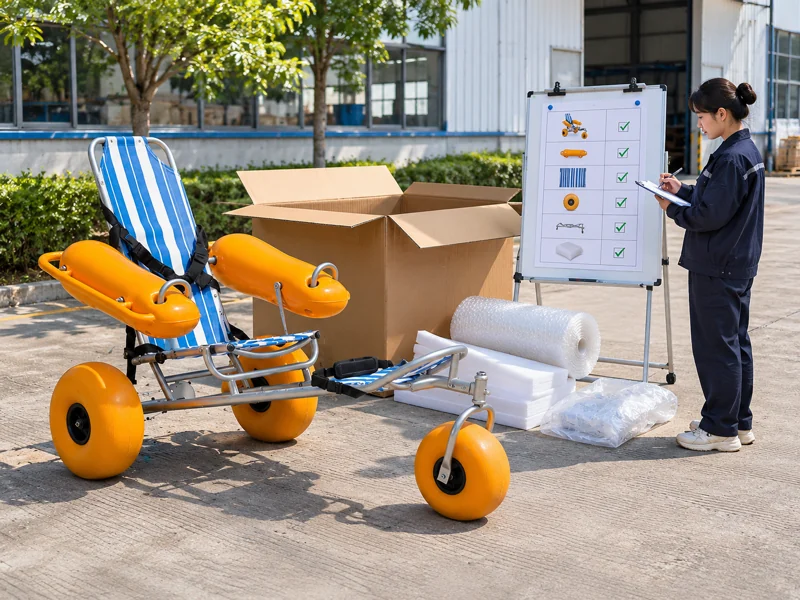
Request package count, dimensions, gross weight, and component allocation for the quoted configuration. Keep assembled equipment measurements separate from carton measurements. Freight planning needs packaged figures; storage and access planning may need both.
Ask how detached wheels, armrests, hardware, and fabric are protected. Request representative packing photographs where available and agree whether final shipment photographs form part of delivery documentation. Do not assume a photograph from another order describes your package.
- Identify each package and its contents.
- Separate net equipment weight from gross weight.
- Confirm whether accessories create extra packages.
- Record proposed protection and package markings.
A complete packing list prevents a partial freight comparison. A loose accessory carton can change handling and shipment cost. When planning several sites, review the distribution arrangement alongside beach-access project information. Ask for a revised packing basis whenever quantity or configuration changes.
Packing information by decision
| Information | Used for | Clarification trigger |
|---|---|---|
| Package count | Receiving and shipment reconciliation | Accessory allocation unclear |
| Gross dimensions | Freight and storage planning | Figures labelled only “size” |
| Gross weight | Handling and freight quotation | Net weight supplied instead |
| Contents per package | Missing-part checks | Components spread across unlabelled boxes |
6. Which spare-parts and support questions belong in the offer?
Ask for model-linked part identification, available replacement assemblies, ordering units, and service instructions. Record which tasks your staff may perform and which require further technical support. Do not assume every component is supplied separately.
A beach wheel listing can introduce available product categories, but physical similarity does not prove replacement compatibility. Ask for an explicit link between each proposed spare and the quoted wheelchair configuration.
- Request part numbers or another stable identifier.
- Confirm left/right or front/rear distinctions.
- Ask about order quantities and current supply terms.
- Identify the support route for faults.
Spare pricing needs a compatibility answer beside it. Request an initial parts proposal based on fleet size and intended usage. Keep suggested quantities separate from guaranteed consumption or service-life claims. Confirm current availability when placing a spare order; an old quotation cannot guarantee future stock.
Support items worth comparing
| Offer item | Required detail | Comparison question |
|---|---|---|
| Replacement wheel | Compatible model and position | Complete assembly or tyre only? |
| Armrest replacement | Side and attachment version | Supplied with required fittings? |
| Small hardware | Identifier and quantity unit | Individual part or matched kit? |
| Technical support | Contact route and scope | Who authorizes repair methods? |
7. How can commercial terms be compared fairly?
Use separate rows for equipment, optional spares, packing, freight, and other agreed services. Compare payment stages and delivery timing on their stated basis. A promised production interval may begin after deposit, configuration approval, or another defined event.
Write warranty and claim-handling terms in plain language. Ask what evidence a claim requires and who bears agreed shipment or service costs. General references to Ary’s sourcing approach do not replace the specific terms offered for an order.
- Identify the event that starts each lead time.
- Record what each payment stage releases.
- List exclusions and buyer-paid costs.
- Check validity after any requested revision.
A lower equipment price can carry a different service scope. Compare like-for-like totals before ranking offers. Leave unknown cost lines unresolved rather than entering zero. Request a corrected offer when terms remain dispersed across messages that contradict one another.
Commercial comparison fields
| Term | Capture exactly | Common comparison error |
|---|---|---|
| Lead time | Duration and starting event | Treating production time as arrival date |
| Payment | Amount, stage, trigger | Comparing percentages without milestones |
| Freight | Route, named place, included services | Assuming every offer reaches final site |
| Warranty | Scope, exclusions, claim procedure | Treating a headline as full coverage |
8. How should quotation revisions and deviations be controlled?
Keep a revision register showing what changed, who requested it, and whether pricing or delivery was affected. This serves a different purpose from collecting technical files: it establishes which commercial proposal remains under review.
A deviation describes an offered difference from a requested requirement. Record the original requirement and proposed alternative together. An omitted item remains open until it has an explicit answer.
- Retain previous versions as superseded records.
- Date every clarification and response.
- Identify affected price or configuration lines.
- Carry accepted deviations into the final offer.
A revised total needs a revised scope reference. Request the latest offer through Ary Beach’s quotation contact with your clarification register attached. A summary message saying “all agreed” should not replace an updated document when individual terms changed.
Classify changes before accepting them
| Change | Required update | Reviewer |
|---|---|---|
| Different component | Configuration and price where affected | Technical buyer |
| Added accessory | Supply list and packing basis | Purchasing and receiving |
| New destination | Freight scope and timing | Logistics |
| Accepted deviation | Final offer annex | Authorized decision owner |
9. What should the final comparison sheet show?
Build a sheet that distinguishes confirmed values, stated exclusions, and unanswered questions. Use one row per consequential requirement. Keep price visible, but place unresolved configuration or use questions beside it so a missing answer cannot disappear into a score.
Name document references in the comparison. The manual download page helps locate current material, while your saved version records what was reviewed. Keep received files with the quotation reference.
- Compare equivalent configuration and quantities.
- Separate confirmed inclusions from assumptions.
- Identify open questions that block selection.
- Record why an offer remains comparable or incomplete.
An incomplete offer should remain visibly incomplete. Assign a clarification deadline before final ranking. Where an alternative meets your needs differently, document that difference instead of forcing equal scores. Keep technical acceptance and commercial selection as separate recorded decisions.
Comparison status and next action
| Status | Meaning | Next action |
|---|---|---|
| Comparable | Scope and terms sufficiently defined | Evaluate commercial selection |
| Clarification required | Missing consequential answer | Return specific questions |
| Accepted alternative | Difference reviewed and agreed | Attach written disposition |
| Outside requirements | Offered scope does not meet need | Seek revision or decline |
10. What closes the quotation review?
Close review with one current offer and a short list of accepted attachments. Identify the model, configuration, quantities, packing basis, commercial terms, and accepted deviations. Retain outstanding non-blocking tasks with an owner and agreed completion point.
Send the supplier a precise clarification request if an answer still affects equipment choice, operating scope, price, or delivery. Do not mark that offer ready merely because a comparison deadline has arrived.
- List the final quotation reference and revision.
- Attach accepted configuration and deviation records.
- Confirm pricing arithmetic and delivery basis.
- Name the person authorized for purchasing approval.
The next step should be an explicit purchasing decision. Ask for a consolidated revised quotation, then compare it against the closed clarification register. Save both documents together before issuing any order.
Q1: Should a quotation include every possible spare?
Request compatible part identification and a relevant initial proposal. Price optional stock separately so it does not obscure equipment cost.
Q2: Is a product brochure enough for a floating-chair offer?
A brochure helps identify a category. Buyers still need model-specific scope, current instructions, packing details, and commercial terms.
Q3: Can carton dimensions be used as folded wheelchair dimensions?
Packaging can include removed components and protective material. Request the relevant equipment dimensions separately.
Q4: What if a supplier changes a wheel after quoting?
Request an updated configuration reference, compatibility explanation, and any affected pricing or packing information before accepting that change.
Q5: When should two quotations be treated as comparable?
When consequential differences are resolved or explicitly accepted, and each price covers a clearly defined supply and delivery scope.