
An AY-STZ1.0 beach walker sample evaluation should answer whether the supplied configuration can support your intended distribution and operating model. Check assembly, handle adjustment, braking, wheels, seat, storage basket, folding, and a defined land route. Record defects before deciding on an order.
The AY-STZ1.0 beach walker is a walking aid with a seat and hand controls. Evaluate walking and stationary-seat functions separately. A seat does not by itself authorize transporting someone while seated, and a successful trial cannot establish suitability for every user.
Images are AI-generated illustrations based on product references. They do not document an actual inspection, factory visit, or project.
1. What decision should the sample trial support?
Write down the intended buyer, route, service arrangement, and evaluation criteria before unpacking. A distributor supplying supervised resort use has different handover needs from a shop supplying individual customers. Both need clear product instructions.
Separate product findings from personal fit. A mechanical inspection can identify loose fittings, awkward assembly, or unclear instructions. A person’s ability to use a walking aid needs an appropriate individual assessment beyond this purchasing checklist.
- Define the proposed sales and support context.
- Name reviewers for assembly and operation.
- Select permitted surfaces and stopping points.
- Agree which defects prevent approval.
A sample needs a specific purchasing question. Use relevant beach mobility applications to describe that context. Ask reviewers to answer whether the sample meets those needs, rather than whether they generally like it. Keep marketing preferences separate from mechanical or instructional faults.
Trial scope before unpacking
| Review area | Decision sought | Boundary |
|---|---|---|
| Assembly | Can staff reproduce documented setup? | No improvised modification |
| Controls | Do adjustments and brakes function as instructed? | No performance guarantee from appearance |
| Route | Does this setup suit tested conditions? | Result applies only to recorded conditions |
| Handover | Can intended customers receive clear guidance? | Individual suitability assessed separately |
2. How should unpacking establish sample identity?
Photograph unopened packaging, then lay components out beside the packing information. Assign a sample ID even when only one unit has arrived. That ID should follow photographs, measurements, questions, and any returned component.
Compare model identification with the walker manual. Its illustrations show a four-wheel walker, adjustable handles, brake controls, seat, and storage basket. Ask for clarification when a label or instruction does not match the visible component.
- Count wheel and handle assemblies.
- Retain loose hardware in labelled groups.
- Record transit marks before assembly.
- Note omitted or unclear documentation.
The evaluation record begins before parts are mixed. Keep packaging until shipment condition and completeness are resolved. A missing fixing should be recorded as a shortage, not silently replaced from another sample. This preserves a useful account of what the supplier delivered.
Unpacking discrepancies
| Finding | Record | Treatment |
|---|---|---|
| Missing component | Packing reference and absent quantity | Hold affected assembly |
| Unidentified hardware | Photograph beside scale | Request identification |
| Transit damage | Package and component photographs | Raise shipment discrepancy |
| Unclear component label | Page and visible part | Request corrected explanation |
3. What should handle setup and adjustment reveal?
Observe handle installation and adjustment using the supplied sequence. Check that each fixing engages as intended and remains secure during permitted operation. Record adjustment positions without assuming they suit every user’s height or reach.
Watch cable routing while changing handle position. A cable should not be trapped or pulled into a new route through guesswork. If an adjustment requires unexplained force, stop and ask for instructions before continuing.
- Confirm both handle assemblies are identified.
- Check engagement at selected settings.
- Observe grip position and control access.
- Record cable movement during adjustment.
A useful adjustment must remain secure after setup. Have another trained reviewer repeat the sequence from written instructions. This exposes ambiguous steps without relying on memory from a supplier demonstration. If your portfolio also includes beach wheelchairs, keep their setup instructions out of this walker evaluation.
Handle evaluation notes
| Check | Observation to capture | Follow-up |
|---|---|---|
| Height setting | Position used and matching arrangement | Confirm permitted adjustment |
| Fixing engagement | Visible seating and unintended movement | Hold if insecure |
| Control reach | Reviewer or assessor observation | Individual fit review where needed |
| Cable routing | Pinch, snag, or tension during adjustment | Clarify routing before trial |
4. How should brakes be checked before a route trial?
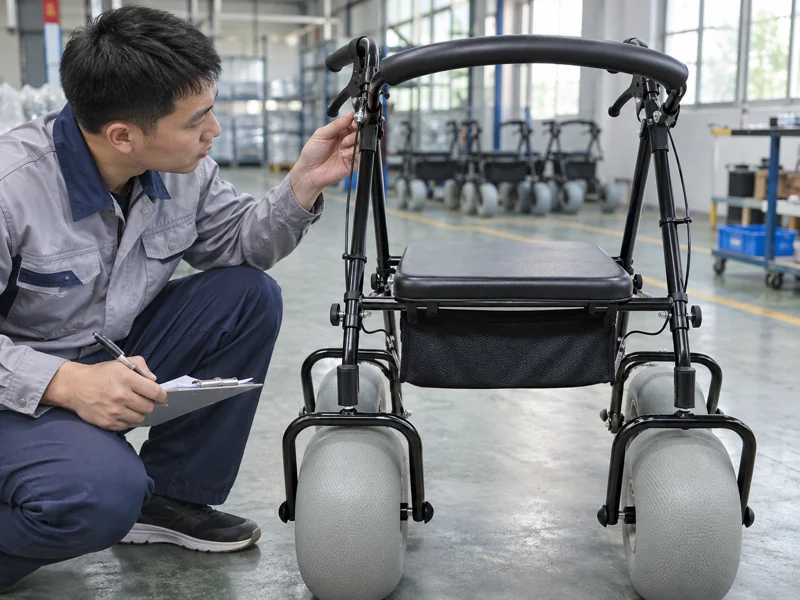
Begin with the empty walker on firm, level ground. Follow the supplied instructions for applying, holding, and releasing controls. Observe each side separately, then compare their response. Record uncertainty about parking and service functions rather than assigning functions from appearance.
Look at cables, their routing, and accessible connections. Check for obvious damage or snagging. Do not adjust unfamiliar brake parts simply to make a sample pass; request the approved procedure.
- Confirm control movement without sticking.
- Observe wheel response on each side.
- Check release after engagement.
- Note any difference after folding or adjustment.
Unequal response needs a cause before walking begins. Keep the sample out of a participant trial while control behaviour remains unresolved. Retrieve appropriate instructions from the Ary manual library and ask for missing control detail. A rolling demonstration on sand should never substitute for understanding braking operation.
Brake observations that need separate entries
| Observation | Detail to record | Decision |
|---|---|---|
| One side responds differently | Handle action and affected wheel | Hold for correction |
| Control does not return | Position and repeatability | Stop functional trial |
| Wheel drags after release | Side and surface | Investigate setup or fault |
| Instructions unclear | Exact operation lacking guidance | Obtain clarification |
5. What should distributors check on the wheel assemblies?
Confirm wheel positions against the sample documentation. Inspect tyre surfaces, hubs, axles, front forks, and retention hardware. Check movement without adding a load or using an unsupported test method.
The manual depicts inflatable beach wheels. Use current component instructions for inflation; generic beach balloon wheel information cannot establish this sample’s setting. Record actual readings where required and keep a suitable gauge with evaluation equipment.
- Inspect cuts, distortion, and valve condition.
- Observe straight rolling and turning.
- Check wheel retention after installation.
- Record rubbing, drag, or abnormal play.
Wheel size alone does not identify a replacement. Photograph attachment details for the future service file, but request supplier confirmation before treating parts as interchangeable. A distributor should know which complete assemblies can be ordered and whether replacement hardware is supplied with them.
Wheel checks and purchasing implications
| Finding | Evaluation response | Order implication |
|---|---|---|
| Retention unclear | Stop and obtain assembly detail | Require clearer instructions |
| Valve damage | Hold affected wheel | Resolve replacement responsibility |
| Rubbing during turns | Record position and movement | Correct assembly or defect |
| Replacement identity missing | Request part reference | Keep service provision open |
6. How should the seat and basket be evaluated?
Examine the seat, its attachments, and nearby frame connections. Check accessible surfaces for damage, sharp edges, or loose fittings. A resting seat requires clear operating instructions before a participant uses it.
Inspect the storage basket or bag separately. Confirm how it attaches and whether it interferes with folding, wheel movement, or controls. Do not infer a basket load limit from its size or describe it as a lifting point.
- Record seat surface and attachment condition.
- Confirm permitted stationary-seat use.
- Check basket mounting and clearances.
- Request separate load information where needed.
A basket and a seat serve different loads. Keep their instructions separate in distributor handover material. Compare proposed service arrangements with beach-access project contexts while assessing storage needs. Describe any missing limit as a supplier question; do not fill it with a plausible number.
Seat and storage evaluation
| Component | Buyer question | Hold or clarification trigger |
|---|---|---|
| Seat | What stationary-use procedure applies? | Instructions absent |
| Seat attachment | Are all specified connections secure? | Loose or damaged fitting |
| Basket | How is it attached and removed? | Snagging or uncertain mounting |
| Basket capacity | What load is permitted? | No model-specific limit supplied |
7. What should a fold-and-rebuild cycle demonstrate?
Fold and rebuild the empty walker using its documented sequence. Keep hands away from closing joints and avoid forcing a mechanism that does not move as described. Note whether staff must remove accessories or manage cables at any step.
After unfolding, repeat handle, brake, and wheel checks affected by the process. A compact folded shape does not prove that setup has returned correctly. Record loose parts and where they must be kept during transport.
- Photograph the configuration before folding.
- Track every component removed.
- Check cables and basket during movement.
- Confirm reassembly before another trial.
The cycle ends with a checked walker ready for use. Ask for clearer instructions if a reviewer cannot repeat it without coaching. When comparing portable equipment such as a folding beach wheelchair, evaluate each product separately; a familiar chair sequence may differ from this walker.
Fold-cycle findings
| Step | Record | Required response |
|---|---|---|
| Preparation | Accessories removed or repositioned | Add exact instruction if unclear |
| Folding | Interference or unexplained resistance | Stop and clarify |
| Storage | Loose-part container and footprint | Assign component locations |
| Rebuild | Lock, handle, and brake checks | Complete before further use |
8. What should a controlled land-route trial record?
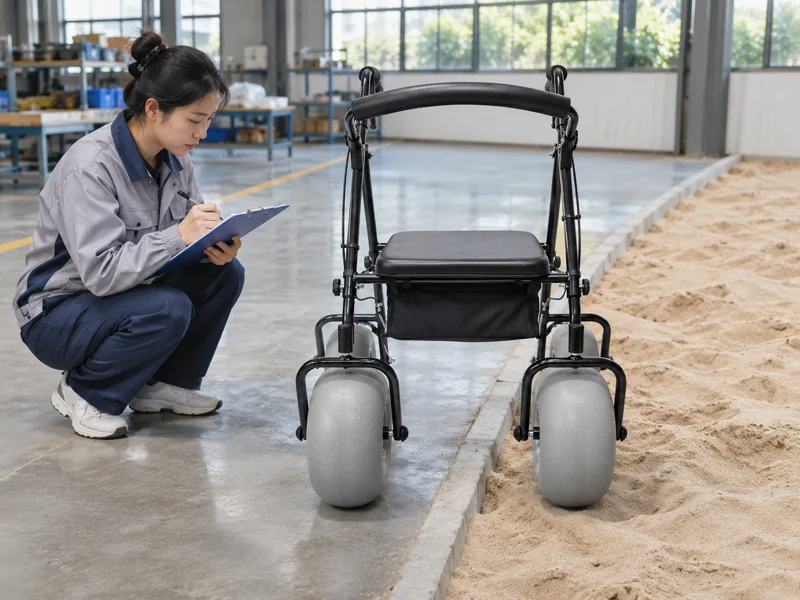
Walk the intended route without a participant before testing equipment. Identify soft patches, cross-slope, narrow gates, abrupt edges, and places where turning or resting would be difficult. Exclude water use from this land-route evaluation.
Complete mechanical checks before route work. Any participant stage needs suitable supervision, consent, individual assessment, and an agreed stopping procedure. Use current product instructions and local arrangements to decide whether that stage can proceed.
- Mark each surface change and stopping place.
- Record dry, damp, compacted, or loose sand.
- Note control access and turning difficulty.
- Stop before fatigue or loss of control escalates.
Route results belong to recorded conditions. A short successful segment on firm sand does not approve a longer loose-sand route. Record where staff changed direction, assisted, or ended the trial. Request configuration or instruction clarification through Ary Beach support before repeating an unresolved condition.
Route record by segment
| Segment | Record | Buying decision |
|---|---|---|
| Firm approach | Width, edges, control access | Is handover location workable? |
| Surface change | Step, lip, sand accumulation | Does route need alteration? |
| Sand section | Condition and observed difficulty | Is proposed use supported by this trial? |
| Rest and return | Turning room and return effort | Is a shorter route needed? |
9. How should defects be separated from preferences?
Classify findings before preparing the approval decision. Missing retention hardware, uncertain brake operation, and damaged structural parts require a different response from a preferred colour or basket style. Record each issue against its component and trial stage.
Describe each finding in concrete terms. “Hard to use” needs a location, action, and observed result. “Left control did not release during the level-ground check” supports a focused response. Do not infer a design cause when only a symptom was observed.
- Give each finding a unique reference.
- Attach photographs or short observation notes.
- Record requested correction and verification method.
- Separate commercial preferences from functional concerns.
A corrected sample needs the affected checks repeated. Keep original findings alongside the revision so later buyers can see what changed. If a replacement component changes configuration, update the sample record before comparing results.
Finding categories
| Category | Example | Closure requirement |
|---|---|---|
| Mechanical fault | Unsecured assembly | Corrected part and recheck |
| Instruction gap | Unclear brake operation | Written explanation and demonstration |
| Route mismatch | Unmanageable surface segment | Revised route or equipment decision |
| Preference | Requested colour | Commercial agreement |
10. What should a distributor approve or decline?
Issue a decision tied to one sample configuration and its evaluation record. Name approved uses, unresolved matters, corrections, and any evidence required before a production order. A favourable sample review should not silently authorize later component substitutions.
Retain photographs and accepted instructions as receiving references. If a supplier revises handles, brakes, wheels, or folding parts, decide which checks must repeat. Re-evaluation should follow the changed function.
- Identify the approved sample and attachments.
- Close consequential mechanical and instruction issues.
- State any route or operating restrictions.
- Define how future changes will be reviewed.
Order approval should preserve what the sample established. Send a written disposition and request matching configuration confirmation. Hold purchasing approval when unresolved control or assembly questions still prevent a reliable evaluation.
Q1: Should the walker seat be tested as a transport seat?
Do not assume that use. Obtain explicit model instructions for seated use and evaluate only the permitted stationary function.
Q2: Can the basket be used as a lifting point?
Use only approved handling points. Basket presence does not establish a lifting function or permitted load.
Q3: Can a distributor approve every sand surface after one trial?
Record the tested surfaces and conditions. Different routes or seasonal sand conditions may require another evaluation.
Q4: Should brake adjustments be made during unpacking?
Only through the approved procedure by a competent person. Record the original condition and repeat relevant checks after adjustment.
Q5: What should accompany a sample approval letter?
Attach sample identity, configuration photographs, findings, corrected instructions, trial conditions, and the agreed process for later component changes.