
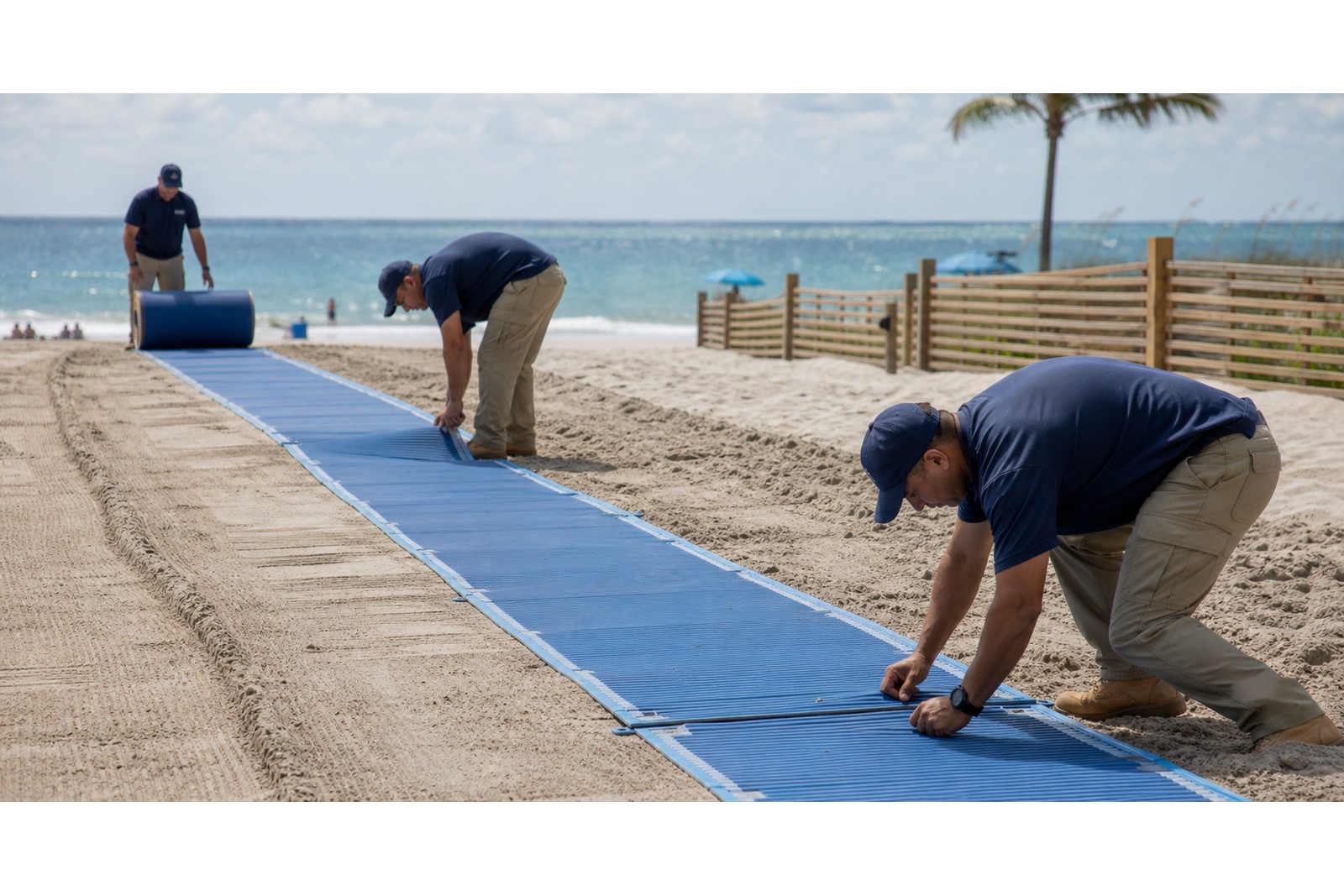
A team renewing a Brazilian beach route may have two requests on the same desk. Visitors need a reliable way to reach the beach service tent, and the crew wants to stop relaying the same stretch of mat. Before asking for a longer roll, mark where people actually leave the pavement, where they change direction and what they expect to find at the end. Those three points help a buyer decide which part of the existing installation to keep.
In Santos, the municipality documented a change of approach at Canal 3 on 28 December 2019. Its Praia Acessível programme received a walkway connecting the sidewalk with the sand and the programme tent. The city said the walkway replaced mats previously laid over the sand. It also reported the delivery of two amphibious chairs. The walkway provided access to the service point. A chair and its operation served the next part of the visit. The dated account does not give a current operating schedule or identify Ary Beach as a supplier. Santos municipal account of the Canal 3 works
Locate the problem before choosing the surface
Ask a visitor and a member of the crew to describe the same journey. A visitor might report that a wheel catches where pavement meets the sand. The crew may have recorded repeated clearance of drifted sand farther along the route. Mark both locations. A new junction detail could address the first issue while a removable section or a different seasonal alignment could still be worth testing at the second.
Take the same approach after rain or a change of beach level. Inspect the support under the transition, its exposed edge, the usable passage and the way back. Record who can inspect the public pavement and who has authority over the sand-side installation. A route can cross that responsibility boundary in a single wheel turn.
| Part of the visit | What to establish on site | What to ask the bidder or operator |
|---|---|---|
| Sidewalk to the first section | Level difference, direction of approach and the pavement owner | Who supplies the transition and who accepts its installation? |
| Crossing the sand | Changes in the underlying sand, clearing work and seasonal removal | Which sections can the crew lift, store and reinstall with the available equipment? |
| Arrival at the tent or viewing area | Turning space with furniture and people present, plus an available return route | What destination can the operator describe when the tent is closed? |
Put the retained sections on the renewal drawing
Give each retained mat section an identifier. Record which end meets the new work, what fitting is installed there and whether an extension from the proposed supplier will actually mate with it. Ask for a drawing of that junction and assign responsibility for both sides. A product photograph or a nominal width leaves the installer guessing about the installed level and the usable path at the edges. The beach mat procurement brief provides a place to record a bidder’s proposed detail and any deviation.
Price the parts of the route separately. The pavement work, walkway construction, removable sections, storage and routine clearing may have different owners and cost periods. If a bidder proposes replacing all existing mats, ask which observed problem that would solve and what would happen to reusable sections. The answer can change the order even when two bids cover the same total length. Comparing a mat and a boardwalk by route segment
Open the connection the crew has verified
Walk the completed route in both directions before updating public information. Have the receiving crew locate the first removable section and show how it reports an exposed joint. If the hard-surface route reaches the tent but the extension remains on hold, publish that shorter endpoint in Portuguese and tell the beach staff what they may offer there. Confirm any borrowing or assisted-bathing arrangement separately with the local operator.
Keep the former layout and the new drawing with dated observations. They let the municipality explain a later decision to repair a connector, move a seasonal reach or renew another length of walkway using evidence from that beach.