
A travel company selling a hotel stay with a beach excursion needs to specify where each piece of mobility equipment joins and leaves the itinerary. A chair offered at a hotel may have to stay on the property. A beach operator may provide a different chair at the shore. A passenger vehicle that accepts a booking may have no cargo room for an empty folded beach chair once luggage is aboard. Trace each leg before advertising equipment as included.
Build the equipment list around the traveler’s destination
Start with the guest journey. Ask whether the person wants to remain in their own device on a maintained path, use a land chair to reach beach seating or enquire about an assisted water activity. Discuss the assistance and individual assessment needed through the responsible provider. A package may involve more than one arrangement, and the traveler can choose which elements they want.
| Itinerary leg | What the travel planner needs confirmed | Who takes responsibility at the changeover? |
|---|---|---|
| Hotel to vehicle pickup | Reachable meeting point, normal mobility device arrangements and accessible passenger transport as booked | Hotel contact and transport provider confirm the actual pickup with the traveler. |
| Vehicle to beach staging | Which empty equipment travels as cargo, which unit is staged locally and how it will be checked before issue | Driver or cargo handler transfers the identified equipment to its trained local receiver. |
| Staging to the destination | Maintained path or mat endpoint, selected land equipment, available assistance and a workable return | Local operator accepts the booking and identifies the person supporting the return. |
| Optional water activity | A separately available floating chair, trained supervision, suitable calm water, reliable attendant footing and a supported exit | The local water operator confirms what it can book and makes the operating decision on the day. |
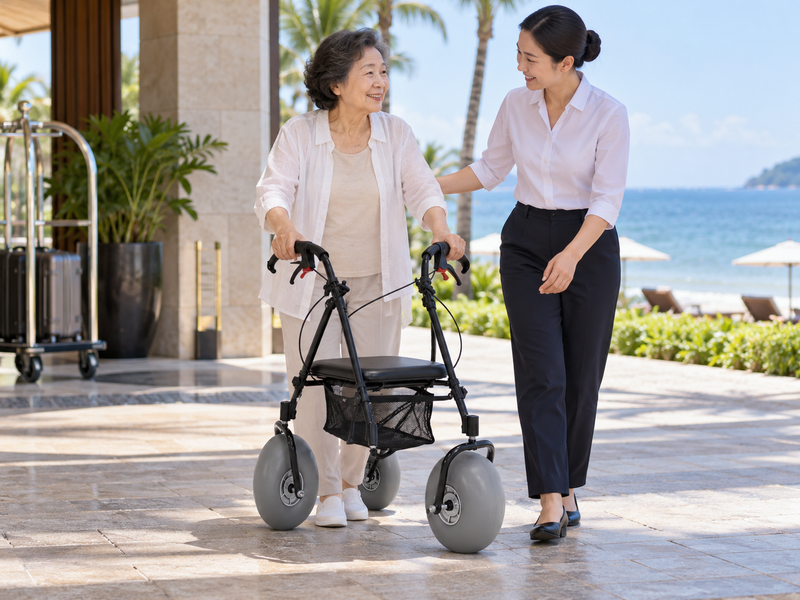
A beach walker can be considered when the traveler seeks support while walking and the model suits their assessed needs. It is a different booking from seated travel. A mat supplies a surface only as far as its verified endpoint. Record the actual equipment, service period and contacts rather than promising any of these from a photograph.
Check the empty AY-ST-V3.0 against the vehicle
The AY-ST-V3.0 is a folding four-wheel land wheelchair with flip-back armrests and flip-up pedals. The manufacturer lists an assembled size of 95 × 92 × 77 cm, net mass of 13 kg and a shipping carton of 55 × 35 × 81 cm. That carton is a factory packing reference. It does not give the size of the chair folded by the field crew with the chosen components attached. AY-ST-V3.0 manual, pages 2–3
Have the provider prepare the empty unit in the permitted transport configuration and measure it. Identify any parts kept separately and how staff will keep them with the correct chair. Measure the vehicle’s cargo opening, sill, space to turn the unit inside and remaining room with luggage in place. Agree suitable handling and secure stowage with the transport operator. Confirm the passenger’s own transport arrangements separately. The empty-chair fit check gives no approval for anyone to ride in the beach chair in the vehicle.
Price the handoffs and agree a failed connection
Ask for separate line items for equipment hire, delivery, setup or refitting, local assistance, collection and any reserve or cancellation terms. Determine who may authorize a replacement model and who explains that change to the traveler. A low daily hire price can omit a second collection vehicle or the staff needed for the return trip.
For example, if an operator’s vehicle change leaves insufficient space for the folded chair, check whether a locally staged, suitable unit can be confirmed for that traveler and time. Obtain the local operator’s acceptance and the traveler’s agreement before changing the package. If neither the original transport nor the alternative is confirmed, describe which part remains pending and adjust the sale. Give booking staff a written equipment-by-leg confirmation and a single coordinator who can follow changes through to the return from the beach.