
A beach wheelchair factory audit should show how a supplier controls repeat production. Follow a selected model from incoming components through assembly, inspection and shipment records. A showroom sample answers what one unit looks like; an audit asks whether production controls can repeatedly deliver the agreed configuration.
This beach wheelchair factory audit checklist gives importers a focused evidence trail. It does not report an audit already performed at Ary Beach or claim a certification. Use Ary Beach sourcing information to prepare supplier questions, then verify the offered site’s actual activities and records.
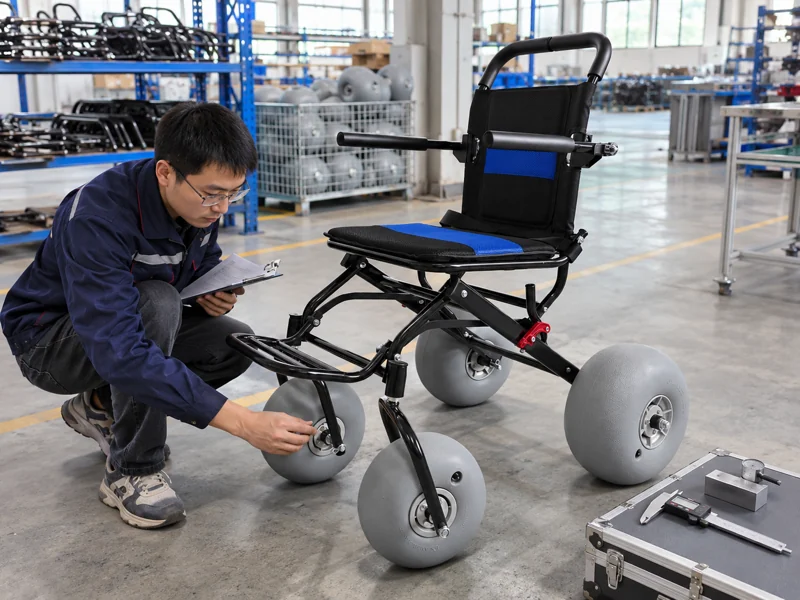
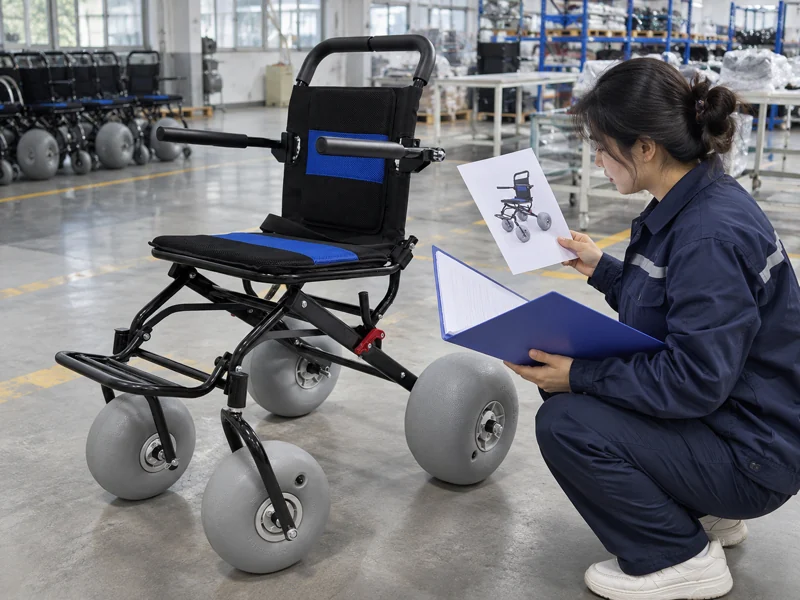
Images are AI-generated illustrations based on product references. They do not document an actual inspection, factory visit, or project.
1. What supplier and site scope should the audit establish?
Identify your contracting company, manufacturing site, product families and processes covered by the visit. Ask which operations occur at that location and which are outsourced. Receiving, assembly and packing can be controlled at one site while other components arrive from specialist suppliers.
Put your proposed purchase model in the audit scope. A tour of unrelated products offers limited evidence for the beach wheelchair configuration under consideration. Record its site address and responsible contacts against the purchase file.
Request an agenda that allows time for records and shop-floor observations. If the relevant model is not in production, document what can be reviewed from previous batch records and what remains unobserved. Do not describe a staged demonstration as normal production evidence.
- Match contracting entity and visited site.
- Identify outsourced operations and supplied assemblies.
- State models and records selected for review.
Audit activities that support the proposed order. Agree scope and evidence availability before booking the visit.
Scope record
| Item | Evidence to inspect | Finding to record |
|---|---|---|
| Contracting entity | Supplier commercial documents | Name matches proposed order |
| Manufacturing location | Site identity and observed work | Activities present at this site |
| Product coverage | Model and production records | Relevant configuration included |
| Outsourcing | Supplier/process list | Responsibility for external work |
2. How should certificates and product claims be reviewed?
List each claim the supplier makes and request its supporting document. Record issuer, holder, site, scope, dates and model coverage where applicable. Check validity through the issuer or an appropriate verification route.
ISO explains that certification is performed by external certification bodies and provides routes for checking accredited certification. A certificate must be read for what it covers. A management-system certificate should not be treated as a complete test record for a particular wheelchair.
Keep market classification and applicable requirements in a separate review with a qualified responsible person. Do not assume every recreational beach product is a certified medical device. A floating chair enquiry needs its own intended-use and product-document assessment.
- Record the exact claim being checked.
- Match document scope with offered activity.
- Separate certification, test reports and declarations.
Read document scope before accepting the claim. Mark unsupported claims as open audit findings and keep them out of purchasing conclusions.
Document applicability review
| Document | Check | Cannot establish by itself |
|---|---|---|
| System certificate | Holder, site, scope and validity | Every product’s performance |
| Product test report | Specimen, revision and test conditions | Uncovered configurations |
| Supplier declaration | Author, product and stated basis | Independent test completion |
| Market assessment | Intended use and applicable route | Other markets automatically |
3. What should incoming component control look like?
Select a relevant incoming lot and follow its records. For a wheel assembly, request purchase identity, receiving record, inspection criteria and release status. Compare markings or packaging identifiers with its part listing in the current bill of materials.
Inspect how accepted, awaiting-inspection and rejected stock are distinguished. Ask staff how they prevent an unapproved substitute entering an order. The answer should identify a practical control such as a location, label and system status.
For a lightweight beach chair, sample components relevant to its offered configuration. Do not presume that a process used for another frame or material applies. Record missing evidence precisely rather than concluding that every supplier control has failed.
- Select a component that appears in the chosen model.
- Compare received identity with purchasing requirements.
- Follow disposition of an actual rejected or held item where available.
Incoming release should leave a trace into production. Record component and lot references needed for the next audit step.
Incoming-part evidence
| Selected item | Follow this trail | Potential finding |
|---|---|---|
| Wheel assembly | Purchase line, receipt, inspection, release | Revision not matched |
| Seating component | Approved specification and received identity | Substitute lacks approval |
| Retaining hardware | Part identity and stock segregation | Mixed unidentified stock |
4. How should an auditor examine assembly control?
Observe work against the current model instruction. Compare component selection, assembly sequence and checks with what the operator does. Ask the operator to show how they identify a wrong part or stop work when something does not fit.
Choose operations relevant to that model. A folding configuration may need evidence around its folding and locking assembly where fitted. A fixed frame requires the checks relevant to its own design. Do not write welding or adhesive controls into an audit merely because another model uses those processes.
An audit covering a beach walker should have a separate instruction sample. Shared staff or workspaces do not make different products identical. Record workstation document revisions and compare them with the approved master.
- Check parts against the selected model.
- Observe the defined verification points.
- Ask how operators escalate abnormal conditions.
A procedure should describe the work being performed. Record any difference between instruction and practice with a specific operation and evidence reference.
Assembly-control sample
| Operation | Observe | Record |
|---|---|---|
| Component selection | Model-specific parts issued | Part and revision match |
| Attachment or locking | Approved method followed | Instruction and observed result |
| In-process check | Defined check completed | Result and responsible operator |
| Abnormal condition | Stop and escalation process | Actual method or sampled record |
5. What makes measurement records credible?
Select a measured feature from an inspection record and identify the instrument used. Check whether its range and resolution suit the stated requirement. Review calibration or verification status under the supplier’s system, including any applicable limitations.
A current sticker cannot explain how a result was obtained. Ask an inspector to show the measurement method, reference points and recorded units. Where flexible components are measured, confirm the specified condition so pressure or contact force does not make readings incomparable.
For beach wheel assemblies, hub geometry provides a useful audit trail. Identify the requirement, measuring tool, result and release decision without inventing an Ary tolerance.
- Link measured results with instrument identity.
- Confirm units and reference points.
- Review action after an instrument is found unsuitable.
Trace a result back to both method and instrument. Record the affected inspection scope if either cannot be established.
Measurement evidence chain
| Element | Question | Useful evidence |
|---|---|---|
| Requirement | What dimension and tolerance apply? | Controlled drawing |
| Method | Where and under what condition? | Work instruction |
| Instrument | Which tool produced the value? | Equipment ID and status |
| Result | What was measured and decided? | Dated inspection record |
6. How should final inspection and packing be sampled?
Select a completed unit or finished batch record and compare it with the agreed configuration. Review the supplier’s final checks for identity, assembly, operation and supplied items. Functional checks must follow relevant instructions rather than improvised demonstrations.
Inspect how a failed final check changes release status. Ask who can authorise rework and who verifies completion. A signed form is weak evidence if a rejected unit remains physically available for packing.
Then inspect component allocation and protection in the packaging specification. Removable wheels, retainers and instructions should have defined locations where applicable. Compare carton or crate identification with the finished-unit record.
- Review final results for the chosen model.
- Trace any recheck following rework.
- Match packaged components with the packing list.
Final release should agree with physical packing status. Select a packed item and reconcile its identity, contents and release record.
Final-release sample
| Area | Evidence | Audit question |
|---|---|---|
| Configuration | Final checklist and model record | Correct version completed? |
| Function | Required checks and results | Any unresolved failures? |
| Packing | Component list and protection method | Required items included? |
| Release | Authorised disposition | Does packed stock match? |
7. How can one unit expose gaps in traceability?
Choose an identified finished unit and ask staff to retrieve its production trail. Follow its configuration revision, relevant component batches, assembly checks, final inspection and shipment identity. Record which links are unit-specific and which operate at batch level.
Use a hypothetical wheel issue to test retrieval: if a specified incoming wheel batch required review, which finished units might be affected? This is an audit exercise, not a claim that such a defect has occurred. Ask for the system’s actual answer and note uncertainty in affected scope.
Include instructions and labels in that trace. Our manual collection helps identify requested files, while a supplier must show which revision accompanied the selected shipment.
- Trace one unit backward through production.
- Trace one component lot forward into finished stock.
- Record gaps and uncertain affected quantities.
Traceability needs an answer in both directions. Keep exact record references so supplier staff can reproduce the trail after your visit.
Connected traceability example
| Starting point | Requested link | Evidence boundary |
|---|---|---|
| Finished unit ID | Production and inspection record | Unit or batch basis stated |
| Wheel lot | Receiving and release record | Actual linked lot only |
| Production batch | Shipment allocation | Known affected destinations |
| Manual revision | Packing record | Version supplied with shipment |
8. How should nonconformities and corrective actions be assessed?
Sample a real completed issue, where available. Review what failed, immediate containment, investigation, corrective action and subsequent verification. Record each of those steps separately. Replacing one damaged component closes a repair task; it may not address a recurring cause.
Ask how staff determine affected scope. A wrong part in one assembly can prompt a review of neighbouring stock or related production records. The appropriate scope depends on evidence; do not assume an entire factory is affected or that one repaired unit settles everything.
Use specific findings in the audit report. “Quality control poor” gives little direction. “Selected final-inspection record lacks a disposition for the recorded retention fault” identifies a reviewable gap.
- Separate containment from longer-term corrective work.
- Ask what evidence supports the proposed cause.
- Check whether later records demonstrate effectiveness.
A closed action needs evidence that its intended correction worked. Agree required closure evidence with the responsible supplier contact.
Corrective-action review
| Stage | Look for | Weak closure example |
|---|---|---|
| Containment | Affected stock identified and controlled | Only the displayed unit isolated |
| Investigation | Evidence supporting cause | Unchecked assumption |
| Correction | Defined change and owner | Verbal reminder only |
| Effectiveness | Relevant later verification | Signature without results |
9. What changes should require supplier notification?
Identify changes that could affect the agreed product: materials, components, dimensions, assembly method, relevant suppliers, labels, instructions and packing. Define notification and approval requirements in the purchasing agreement rather than relying on an informal promise.
Ask the supplier to show a completed change record. Compare old and new revisions, reason, review, implementation point and affected stock. Inspect how obsolete instructions are removed from use.
For a chair order, a wheel-hub change may require fit review even when tire diameter stays the same. A packaging change can require a separate receiving or protection assessment. These are review examples, not statements that Ary has made such changes.
- Define changes requiring advance notice.
- Record effective batch or implementation date.
- Preserve identification of earlier stock.
A revision needs a clear point of entry into production. Put agreed notification terms and decision responsibilities into the supply file.
Change-control sample
| Change type | Review focus | Implementation evidence |
|---|---|---|
| Wheel or hardware | Compatibility and approved configuration | New part revision and affected batch |
| Assembly method | Relevant process and inspection controls | Updated instruction and staff briefing |
| Manual or label | Product and market applicability | Released document version |
| Packing | Contents and protection | Approved packing revision |
10. How should the audit decision guide purchasing?
Issue an audit report with scope, sampled evidence, findings, limitations and follow-up actions. Distinguish observed facts from conclusions. A supplier may be suitable for a defined model while another product or outsourced process remains outside the reviewed scope.
Assign each finding an owner, closure evidence and due date. Use significance and potential product impact to prioritise actions. Avoid an unsupported numerical score that hides a serious unresolved control gap.
Keep supplier qualification separate from sample approval and shipment acceptance. Each answers a different purchasing question. Send model-specific follow-up through Ary Beach’s contact page and retain responses with the audit record.
- State qualified activities and any restrictions.
- Identify findings that block the proposed order.
- Schedule verification of agreed corrective actions.
Close the audit with a scoped supplier decision. Release purchasing only when the authorised buyer has reviewed relevant findings and required closure evidence.
Q1: Is a factory audit the same as sample approval?
An audit reviews production controls and supplier capability within scope. Sample approval assesses an identified configuration against agreed requirements.
Q2: Does an ISO certificate prove every chair is approved?
Read which activities its scope covers. A system certificate does not replace the product evidence and market assessment required for a particular purchase.
Q3: What if the ordered model is not being produced during the visit?
Review available records and comparable controls, then state the observation limit. Arrange follow-up evidence for unobserved model-specific operations.
Q4: Must every audit inspect welding?
Only when relevant to the offered product and manufacturing scope. Audit actual processes instead of copying another model’s checklist.
Q5: What should happen after a significant traceability gap?
Define affected scope, containment and closure evidence with the supplier. Keep purchasing restricted until an authorised buyer accepts the resolution.