
A beach wheelchair sample approval process should produce a controlled reference for purchasing. Identify the exact sample, compare it with agreed requirements, resolve deviations and record what production may reproduce. A favourable impression during a demonstration leaves too much undefined.
Sample approval concerns one configuration. Supplier qualification reviews production controls, while shipment acceptance checks delivered goods. Keep these decisions linked but separately recorded. Use Ary Beach sourcing discussion to prepare a sample brief, then confirm the scope in writing before evaluation begins.
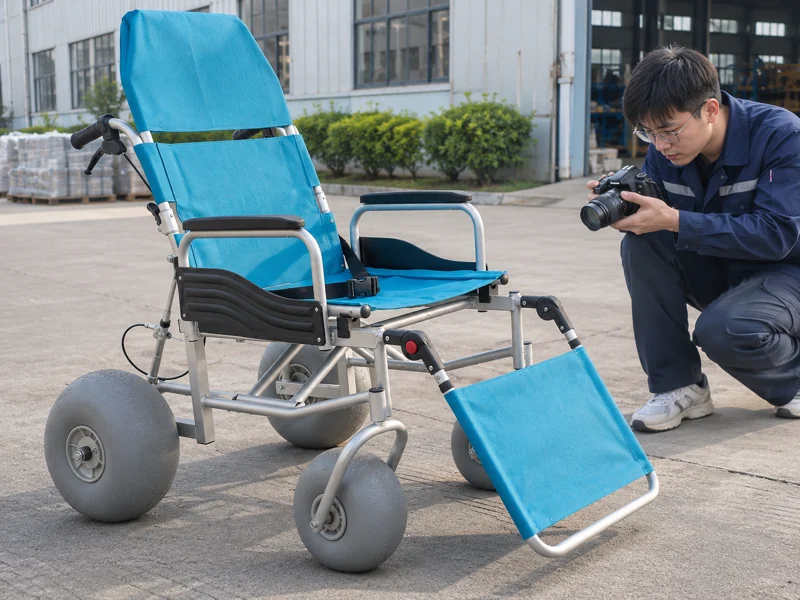
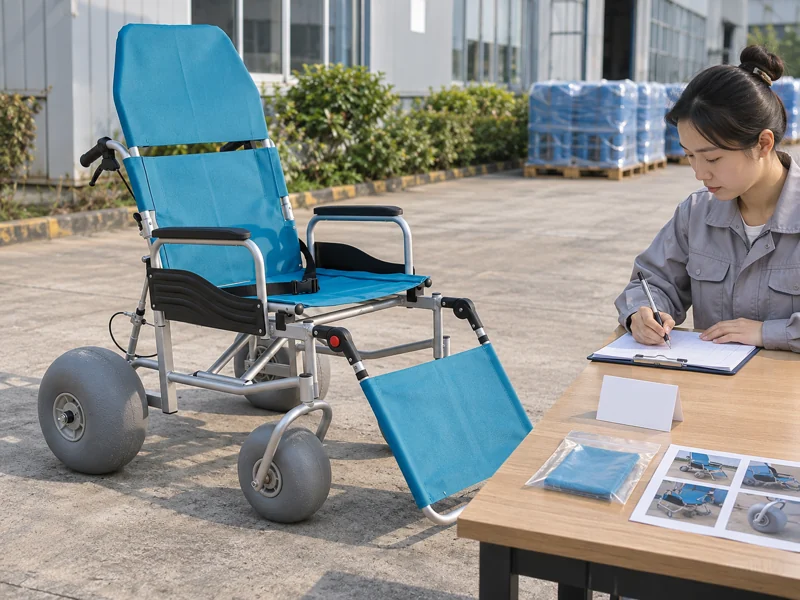
Images are AI-generated illustrations based on product references. They do not document an actual inspection, factory visit, or project.
1. What decision should the sample evaluation answer?
Write a short approval question: does this identified configuration meet the buyer’s agreed product and operating requirements? Name intended use, relevant users, planned route, assistance arrangements and excluded activities. Define acceptance criteria before inspecting the sample.
Avoid approving a broad product family from one unit. The beach wheelchair range contains distinct configurations. A folding chair, high-back chair and floating chair need their own relevant evaluation scope.
List which checks the buyer will perform and which require supplier or specialist evidence. Separate practical handling checks from formal test requirements. A warehouse demonstration does not establish performance under every service condition.
- State the proposed equipment role.
- List measurable or observable acceptance criteria.
- Assign responsibility for checks outside buyer capability.
The approval question should name a configuration and a use. Send your evaluation brief to the supplier before sample shipment.
Evaluation brief
| Field | Required decision | Example of useful wording |
|---|---|---|
| Model scope | Which exact configuration? | Model plus drawing revision |
| Intended role | What will it do? | Named land-access service |
| Evaluation | Which checks will be performed? | Agreed fit and function checklist |
| Exclusions | What remains outside approval? | Unassessed routes or uses |
2. How should the sample be identified on arrival?
Assign a unique evaluation ID and record supplier model, revision and any serial number. Photograph the assembled sample, identification marks, supplied components and packaging. Link those images with the arrival date and packing list.
Record its origin as stated by the supplier: production unit, pre-production unit or another identified category. Do not call every sample representative of normal production without evidence. Ask whether any parts differ from the proposed bulk configuration.
Keep a custody record during evaluation. If a component is removed, repaired or substituted, log who performed the work and when. A sample that changes midway through testing can otherwise produce a confusing approval record.
- Label the physical unit and its file.
- Identify supplied versus missing items.
- Preserve arrival condition before assembly or handling.
Your approved reference must remain identifiable after the meeting. Assign one custodian responsible for sample location and configuration history.
Sample identity fields
| Field | Record | Why it matters |
|---|---|---|
| Evaluation ID | Unique buyer code | Connects all results |
| Supplier identity | Model, revision and serial where present | Defines offered unit |
| Sample category | Supplier’s stated origin | Clarifies production representativeness |
| Arrival condition | Photos and receiving notes | Separates transport findings |
| Custody | Location and responsible person | Controls later changes |
3. Which configuration details should become the reference?
Build a configuration sheet around the supplied model. List frame assembly, wheel assemblies, seating, supports and accessories actually included. Use part numbers or drawing references where available. Photographs help identify appearance but should sit beside technical descriptions.
For a floating chair sample, distinguish its supplied components and approved intended use. Do not infer buoyancy performance from a photograph or extend a land-based evaluation into water permission.
For current high-back product enquiries, use AY-ST-V2.0 as the model identity. Confirm the offered configuration against current supplier documents. Keep colour choices separate from technical revision so a cosmetic option cannot conceal a component substitution.
- Identify each supplied assembly.
- Record accessories included and excluded.
- Link every accepted deviation with this sheet.
Approve a parts configuration that production can identify. Ask buyer and supplier to review the same sheet before functional testing starts.
Configuration reference
| Assembly | Identify with | Approval detail |
|---|---|---|
| Frame | Drawing and model revision | Supplied construction |
| Wheels | Assembly part numbers | Size, interface and position |
| Seating and supports | Component references | Actual supplied arrangement |
| Accessories | Itemised list | Included or excluded |
| Finish | Agreed colour or reference sample | Cosmetic acceptance basis |
4. How should dimensions and practical fit be checked?
Choose dimensions that affect the intended service: equipment envelope, storage fit, transport handling or interface with other approved equipment. Record the requirement, method, observed result and acceptance decision. Avoid measuring everything merely to create a long inspection report.
For a lightweight beach chair, a vehicle-loading assessment should concern the unoccupied equipment and its authorised transport configuration. Do not treat a successful load-in as approval for occupied vehicle transport.
Document each measurement’s specific setup conditions. A folded measurement needs a defined folding state; a removable-wheel configuration needs a complete component list. Photograph the limiting opening or storage location alongside measured dimensions. Any real vehicle or storage trial remains specific to that site and configuration.
- Select dimensions tied to a buyer requirement.
- Use agreed reference points and units.
- Record handling tasks separately from dimensions.
A fit result needs its setup and location. Attach measured values and photographs to the requirement they support.
Dimensional acceptance record
| Requirement | Evidence | Approval limit |
|---|---|---|
| Storage fit | Equipment and opening measurements | Named storage location |
| Unoccupied transport | Approved configuration and loading trial | Evaluated vehicle arrangement |
| Service envelope | Defined dimensions and conditions | Tested configuration |
| Handling | Observed tasks and staff feedback | Agreed local procedure |
5. Which functional checks belong in sample evaluation?
Follow current model instructions for assembly, rolling, turning, controls, adjustments and folding where applicable. Begin with prescribed unloaded checks. Any loaded evaluation needs an approved method and suitable supervision; sample review should not become improvised stress testing.
Write results against individual requirements. “Operates well” leaves the supplier guessing which functions were checked. Record the movement, setup, observed result and any interruption. Photograph a visible issue and identify its location.
If a beach walker is part of the same purchasing project, evaluate it separately. Its controls and intended role cannot be approved through a wheelchair sample report.
- Mark functions not fitted as not applicable with a reason.
- Record unsuccessful checks before corrective work.
- Repeat affected checks after an approved correction.
Each function needs its own result. Stop evaluation when a condition prevents the agreed procedure from being followed.
Functional result sheet
| Check | Record | If unsuccessful |
|---|---|---|
| Assembly | Instruction and completed steps | Identify incorrect or missing component |
| Rolling and turning | Setup and observations | Inspect relevant assembly |
| Controls where fitted | Individual result | Hold affected use |
| Folding or adjustment | Positions and locking checks | Record conflict and request correction |
6. How should workmanship and wheel findings be judged?
Define visible acceptance criteria with written descriptions or agreed reference photographs. Inspect contact edges, joints, fabric condition, hardware seating and finish as applicable to the actual sample. Keep cosmetic findings separate from conditions affecting function or safe use.
Avoid vague grades such as “premium finish.” A useful entry states location, observed condition, requirement and proposed disposition. For example, a hypothetical finish mark can be described by its location and photograph without claiming that it changes structural performance.
For wheel assemblies, record identity, installed hardware and any observed rubbing or abnormal operation. Exact pressure, fit and retention criteria must come from the approved model documentation.
- Identify the component and location.
- Distinguish appearance from functional effect.
- Retain photographs before rework.
A deviation should describe something another inspector can find. Agree its disposition against the stated requirement instead of negotiating adjectives.
Workmanship finding record
| Finding class | Useful description | Decision basis |
|---|---|---|
| Cosmetic | Location and visible condition | Agreed appearance reference |
| Fit or assembly | Component, position and interference | Drawing or assembly instruction |
| Functional | Observed failure during named check | Acceptance criterion |
| Uncertain significance | Evidence plus unresolved question | Technical review before approval |
7. What documents and packing should accompany approval?
Compare the sample’s instruction set, parts information and packing list with its actual configuration. Use the manual collection to identify requested documents, then confirm current model coverage and revision.
Review packing as a separate approval item. Record component allocation, protection, package identification and reassembly information. If the sample arrived in temporary packaging, state that production packing remains unapproved. Photographs of packaging do not prove shipment durability under conditions that were never evaluated.
Review claimed product or market documents for applicability with the responsible specialist. Sample approval does not establish that every beach product is medically certified. Likewise, ISO distinguishes external certification from its role developing standards; do not treat an ISO name as a product approval.
- Match instructions with sample components.
- Identify missing production packing evidence.
- Keep compliance review conclusions separately recorded.
Approve the delivered package, including its instructions. List every document and packing item still required before production release.
Supporting-file checklist
| File or item | Match against | Open issue example |
|---|---|---|
| User instructions | Actual model and functions | Wrong revision |
| Parts list | Supplied assemblies | Unidentified replacement part |
| Packing specification | Production shipment proposal | Temporary sample packing only |
| Market evidence | Intended use, product and destination | Applicability unresolved |
8. How should deviations and retests be managed?
Create a deviation register as findings arise. Give each entry an ID, requirement, observed result, proposed correction, owner and status. Link photographs and correspondence to that ID. Do not bury approval conditions in scattered messages.
When a correction changes a component, update the sample configuration history. Then define which checks need repetition. A revised wheel assembly can affect fitting, retention and clearance; a corrected instruction may require a different review. Required retest scope follows the change and its possible effects.
Use model-specific supplier support for technical responses, while retaining decision authority within the agreed approval team. Keep rejected proposals in the record so they cannot be mistaken for accepted options later.
- Record the original finding before correction.
- Identify affected requirements and retests.
- Close each deviation with evidence and authority.
A correction changes the evidence you are approving. Review your revised sample and its record together before closing the finding.
Deviation and retest register
| Field | Entry | Purpose |
|---|---|---|
| Deviation ID | Unique issue reference | Connects correspondence |
| Requirement/result | Expected versus observed | Defines the gap |
| Correction | Proposed and performed work | Shows what changed |
| Retest scope | Affected checks | Confirms revised result |
| Closure | Evidence, date and approver | Records accepted resolution |
9. What should the approval decision state?
Record one clear outcome: approved, approved within defined conditions, held pending evidence or rejected. State the exact sample ID, configuration revision, evaluated scope and referenced records. Identify who has authority to make the decision.
Conditional approval needs a precise boundary. It might permit a limited next step while a specified noncritical document remains open. It should never disguise an unresolved issue that prevents the intended use or agreed acceptance requirement. If a condition is unclear, hold the decision.
Identify which physical sample and digital records will serve as production references. Agree their custody and access. Calling something a “golden sample” adds no control unless both parties know its identity, revision and accepted deviations.
- Record the decision and permitted next step.
- List accepted deviations explicitly.
- Identify the controlled reference sample and file set.
Approval must say exactly what may proceed. Have authorised buyer and supplier representatives acknowledge the same decision record.
Approval disposition
| Outcome | Meaning | Required record |
|---|---|---|
| Approved | Defined requirements accepted | Sample, revision and evidence |
| Conditional | Only stated next step permitted | Conditions, limits and owners |
| Hold | Decision awaits resolution | Open items and required evidence |
| Reject | Sample not accepted for stated scope | Reasons and next proposal route |
10. How should approval control later production changes?
Attach your approved configuration, deviation dispositions and relevant files to the purchase agreement. Define changes requiring notification and review before implementation. Include components, dimensions, materials, instructions and packing where they affect the agreed reference.
Separate later change approval from the original sample decision. Record a proposed change’s reason and affected requirements. Decide whether evaluation needs a new sample or targeted retest. Identify which production batch or date introduces the accepted revision.
Keep shipment inspection criteria aligned with the latest approved configuration. An older reference unit should remain identifiable as superseded when necessary. Preserve its record without allowing staff to use it accidentally for a new order.
- Require agreed advance notification of relevant changes.
- Define evidence for review and retesting.
- Identify implementation point and affected orders.
The approved sample becomes a reference only through change control. Send your signed reference package with the purchase order and require acknowledgement before production starts.
Q1: Does approving a sample approve every later shipment?
Shipment acceptance still checks delivered goods against the current agreed configuration and inspection requirements.
Q2: Can a pre-production sample become the reference?
Yes, if its status and differences are explicit and accepted. Define any production-representative evidence still required.
Q3: What makes a golden sample controlled?
A unique identity, configuration revision, accepted deviations, supporting records and assigned custody make the reference usable.
Q4: Must the whole evaluation restart after every change?
Choose retests from the affected requirements and possible consequences. Record the rationale and responsible technical decision.
Q5: What should happen if production differs from the approved sample?
Identify the difference and affected stock, then request a formal disposition. Do not treat unrecorded substitution as automatic acceptance.