
A folded AY-STZ1.0 and its loose components must all pass through the vehicle opening, travel securely and be ready for reassembly at the destination. Measure the walker as staff will actually carry it. The manufacturer lists a net product weight of 13.5 kg and a 53 × 28 × 79 cm shipping package. That package measurement describes the carton. A walker folded between outings, with different parts still attached and a bag for loose fittings, needs its own measurement. AY-STZ1.0 manual, pages 2, 4 and 5
Decide which parts travel together
Place the empty walker on firm ground. Empty the storage bag and identify the unit before preparing it according to the supplied instructions. The four-wheel model has adjustable handles with brake controls, a folding frame, front forks and larger rear wheels. The installation drawings show how its wheel assemblies and handles relate to the frame. Only remove parts that staff are authorised and able to refit under the applicable instructions.
Record the chosen configuration on the travel bag or loading sheet. If the front assemblies travel separately, keep their specified retainers with that unit. Protect brake cables, levers and attachment points from being trapped among the frame members or crushed by luggage. Ask the supplier for permitted support and securing points if these are unclear. For the passenger, agree with the operator how they will reach a vehicle seat and the receiving point while their walking aid is packed.
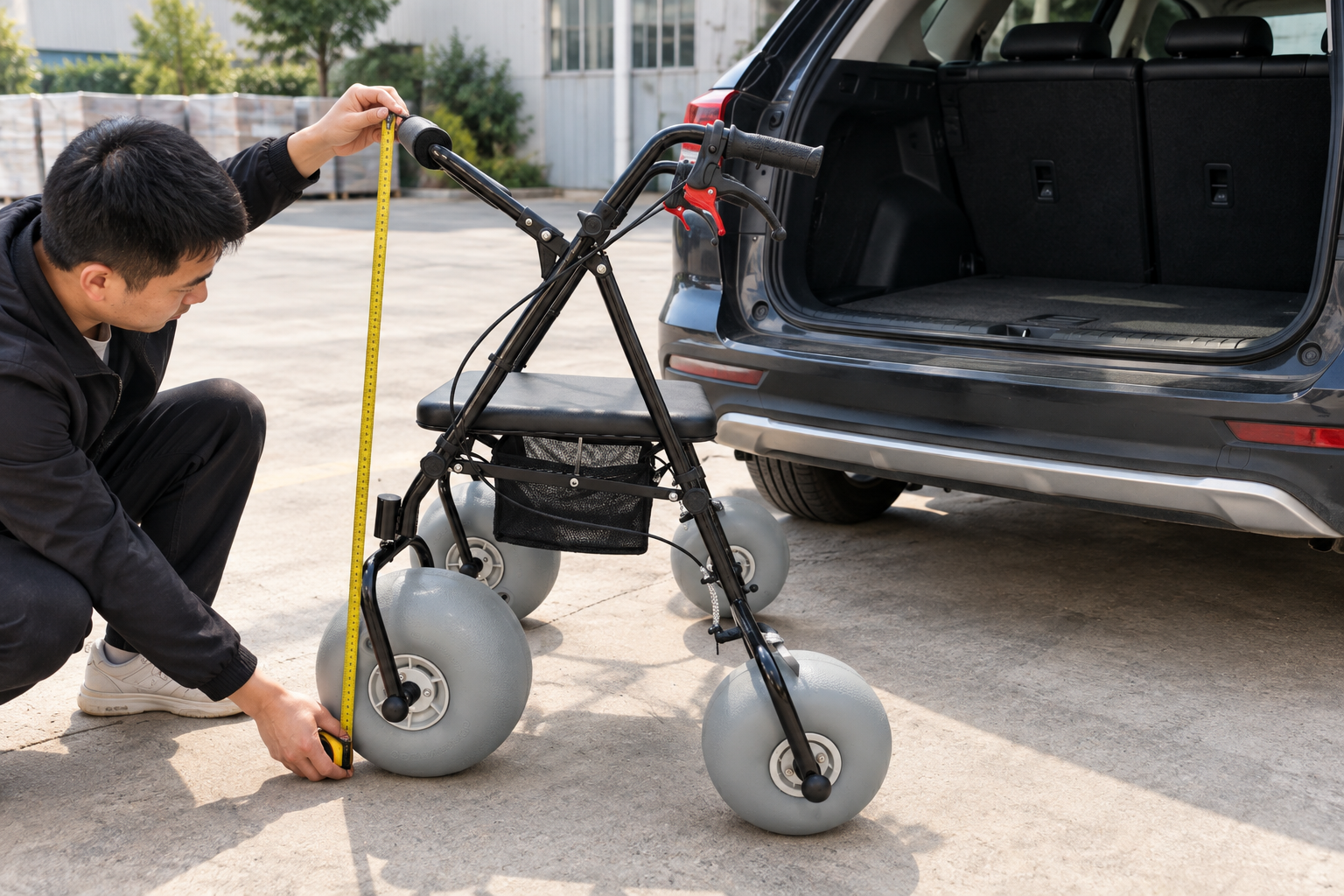
Check the opening as well as the load space
Measure the widest and tallest parts in the direction they will pass through the vehicle opening. Include the containers for any removed pieces. At the vehicle, measure the opening at its narrowest point, the lift-over height, the usable depth with passenger seats in position and the space to turn the frame without loading a cable or lever. A long cargo floor can still be reached only through a narrow opening.
Try loading and unloading the empty equipment with the normal luggage present and the staff and handling aids intended for the trip. A lifting assessment must cover the actual reach, grip and carrying distance. Secure the walker and its separate pieces under the vehicle’s cargo guidance and the equipment instructions. Never transport a passenger seated on the walker. Manual handling considerations for the task, load and workplace
Rebuild before the user needs it
Arrange a clear assembly area at the destination. Match the unit and component bag, rebuild it under the manual, and return the adjustable handles to the setting agreed for the user. Identify both front and both rear wheel assemblies, check the fittings disturbed by transport and confirm that the brake cables follow their permitted route. Run the applicable empty-equipment checks before returning the walker to the user. Beach walker pre-use inspection
For example, if one brake drags after unpacking, keep the walker at the handover point, describe the side and symptom to the equipment lead and arrange another suitable aid or assistance. Forcing the walker to move or adjusting a cable without service instructions could obscure the transport fault. Let the visitor know when their equipment is ready and who will take responsibility for repacking it at the end of the outing.