
A ramp contractor can finish at the last board and a mat installer can start at the sand below it, leaving a gap neither party priced. Inspect the handover between surfaces before accepting either package. At each connection, identify what supports both sides, how they meet when installed and who will correct a change in level or alignment after the beach moves.
Make a drawing for each kind of connection
Map parking, pavement, ramps, boardwalks, mat sections, sand and route ends. Give each connection a location that two people can find, such as “west ramp, first blue section, seaward side.” Mark the expected direction of outward and return travel. A photograph looking down the route can hide a lip that a caster encounters on the way back.
For a modular system, request the drawing for the actual mating ends, interlocking features, edge treatment and fixing arrangement. For a product supplied in rolls, ask how adjacent roll ends are joined and kept in their approved position. The word roll describes the form of the product. The supplier still needs to identify how the joint works. Comparing mat materials and finished joints
| Connection | Inspect on site | Bring back to the designer or installer |
|---|---|---|
| Hard approach to first section | Full landing width, finished levels, support below the entry edge, direction of approach | A section through the two surfaces and the specified transition part, if one is required |
| Section to section | Correct parts and orientation, complete engagement, surface alignment and movement relative to neighbouring sections | The approved detail, replacement references and permitted inspection method |
| Mat end to destination | Actual surface reached, exposed edge, room to stop and turn and the approach on return | End treatment, management of moving sand and who can revise the endpoint |
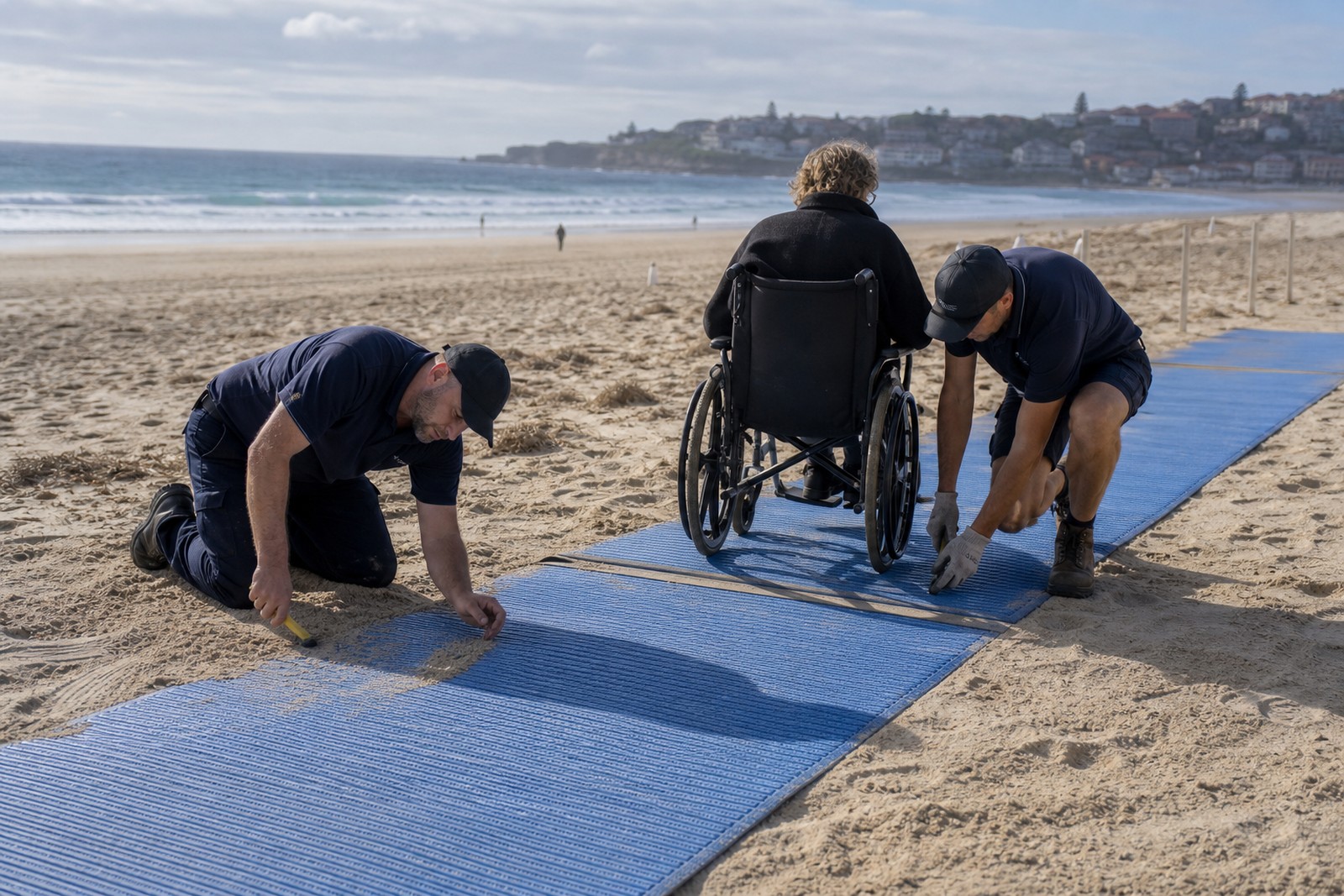
Inspect after the surrounding sand changes
Look beyond the joint itself. A drainage outlet may remove sand from beneath a sound end piece. Sand piled on top can conceal a lifted edge. Record what is visible and whether the connection can be approached safely. If the condition affects travel, control access to that section under the site’s procedure and address anyone already beyond it.
For example, suppose rain has left a hollow under one side of the first mat section. Clearing surface deposits reveals the edge, but the lack of support remains. Ask the grounds team to assess the changed substrate and the mat team to inspect the affected connection. Replacing the connector alone would leave the original ground condition unresolved. Use the supplied installation method and obtain site approval for changes to fixing, support or alignment.
Check movement after physical defects are addressed
Begin with an agreed unoccupied check using equipment representative of the service. Observe the first wheel crossing, the turn and the return approach. If a wheel catches, identify its position, the joint and direction. Stop the affected check and investigate. A participant trial requires suitable conditions, consent, assistance and clear stop arrangements. Planning a beach mat user trial
Keep an acceptance record for the connection that was actually inspected. Identify the drawing revision, location, material condition, supporting surface, action taken and the route extent the operator can open. Recheck adjacent sections if correcting one joint disturbs another. Give the operating team the close-up photograph and a wider view showing the joint in its route. Facility manager’s mat repair and reopening checks