
Before loading the first cooler, take the empty cargo cart to a clear, firm area. Match the cart number to the unit on the dispatch list and read any outstanding faults. A booking for the morning does not cancel a hold left by the previous shift. Start with the empty tub so you can see a crack or missing fixing that bags would cover.
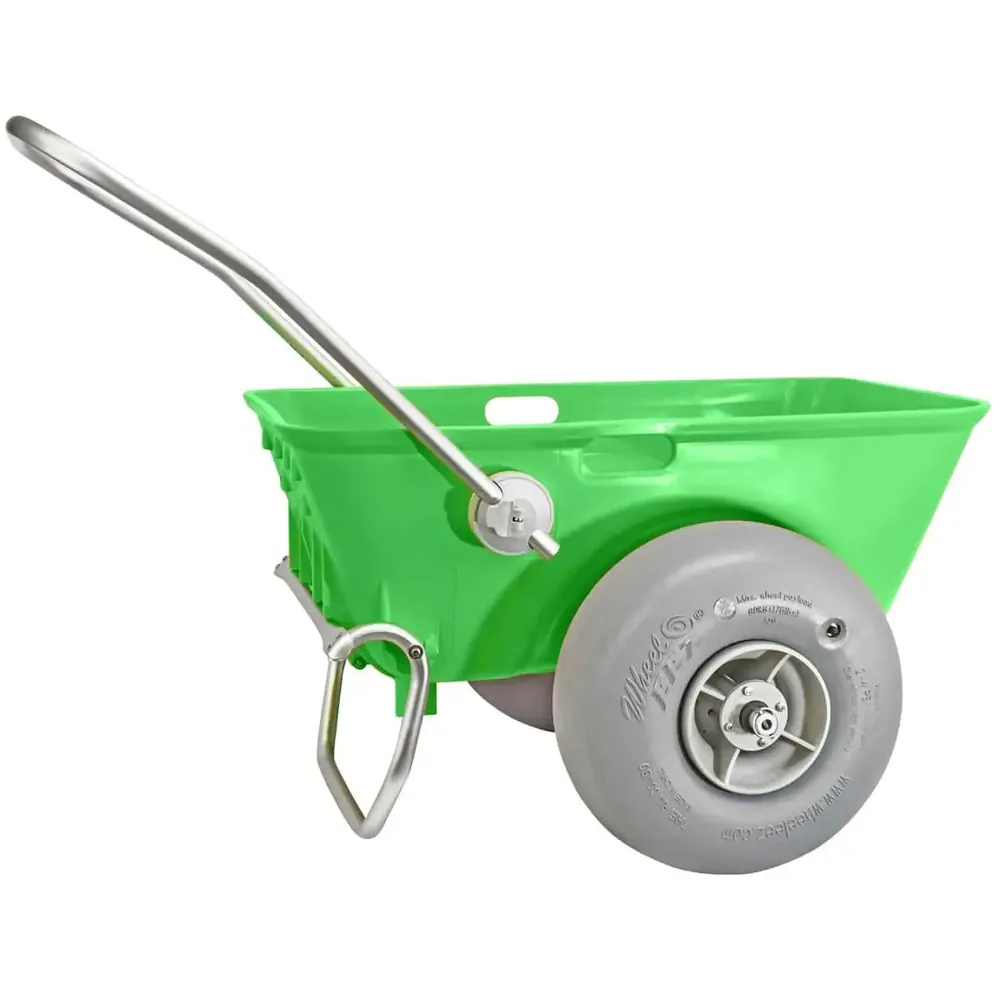
The Ary Beach two-wheel model pictured in its product guide has a molded tub, U-shaped metal pull handle, two balloon wheels and a metal support stand. The following checks address that configuration. A folding cart introduces different points to inspect, including its frame lock, deck and any casters, as shown in the folding model comparison. These carts carry goods only.
Follow the load from the tub to the wheels
| Part of the empty tub cart | Look or listen for | Decision before loading |
|---|---|---|
| Tub and mounting area | Split plastic, a broken attachment, a protruding fixing or damage hidden under loose sand | Clear debris using the instructed care method. Hold a damaged tub or uncertain mounting for review. |
| Handle and attachments | Unusual movement, a loose connection, damage where the handle meets the cart | If the handle cannot be controlled as intended, identify the unit and stop dispatch. |
| Stand | Damage or a change that leaves the empty cart unexpectedly unsteady on level ground | Compare its position with the supplied drawing. Keep a doubtful stand out of use. |
| Two wheels and axle ends | Cuts, rubbing, a missing retainer, uneven appearance or an unfamiliar replacement part | Match the assembly and any inflation instructions to the wheels actually fitted. Hold unresolved faults. |
Move the empty cart a short distance over the clear surface. Listen for repeated contact and observe the wheels from a safe position. The empty check can expose a rubbing wheel or loose handle. It cannot establish a new load rating or prove the cart is suitable for a particular soft-sand run. For that, check the intended cargo, the rated model and the condition of the proposed route.
When a finding stops dispatch
Consider a customer waiting for a cart while the operator notices that one axle end is missing the retainer shown in the order drawing. The wheel may still be on the axle. Take the cart out of the rental line, identify which side is affected and tell the desk whether another inspected unit is available. Neither an empty roll nor a substitute chosen by appearance establishes that the wheel will stay on the axle.
Maintenance records the correct part and checks the completed assembly under the supplier’s instructions. The person responsible for release confirms that the original observation is resolved and records the cart ID and time. Where a defect recurs, reopen the issue record so the next inspector can see both occurrences.
End a passed check with the unit, date, checker and any restriction still attached to the proposed job. For example, a cart may be ready while the intended entrance remains blocked by work. Pass that route information to dispatch before supplies are loaded and the crew discovers the obstruction at the gate.