
A dispatch board that says “three beach carts” cannot tell a camp whether drinking water will reach the shade shelter before lunch. One cart may be carrying equipment back from the morning session, another may be drying, and the only suitable operator may be working elsewhere. Plan dispatch in cargo runs that start and end at named places within the shift.
Match the job to the cart before counting runs
For each delivery, identify the goods, destination, earliest departure, latest useful arrival and the time the empty cart and crew can be used again. Confirm the load fits within the configuration and the published cargo rating for the actual unit. A light stack of crates that cannot sit securely in the tub is still a poor assignment.
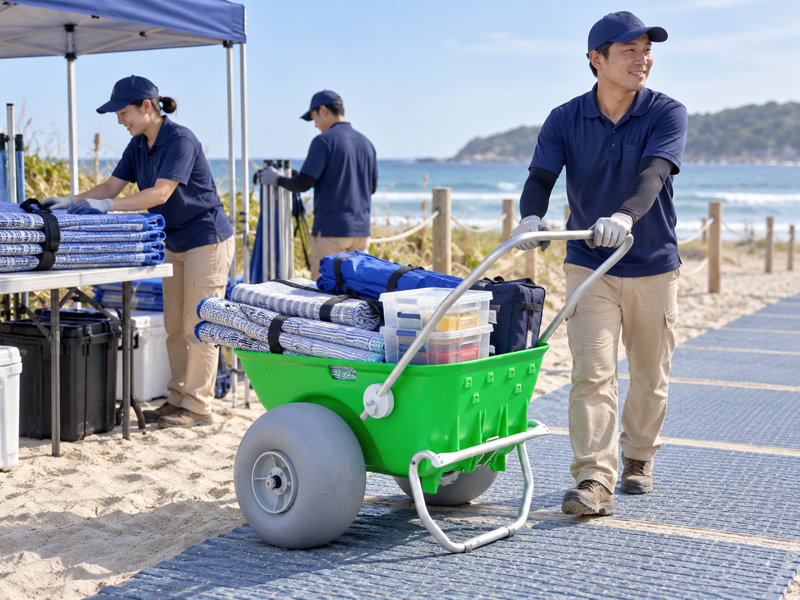
The standard two-wheel molded cargo cart has a deep tub for loose gear. The manufacturer also lists folding carts with different platforms, baskets, wheel arrangements and load ratings. If a team specifies a cart for broad, flat boxes, record the deck or tub space available and how the goods are secured. Do not substitute any available cart merely because it has beach wheels. These runs move goods only.
Work through a two-shift dispatch problem
Suppose a venue has three identified tub carts. A is checked and ready at the depot at 11:30. B is on a morning delivery and returns there at 11:50. C is held for a wheel repair. Two operators are available from 11:30, but the second finishes at noon. Assume a returned cart needs ten minutes at the depot before its next run. The times below are a scheduling example.
| Proposed cargo run | Available cart and operator | Dispatch decision |
|---|---|---|
| Water to the shelter, 11:30–12:00 including return | A and the operator who finishes at noon | Commit them to the full run. Allow until 12:10 for A to be ready again. |
| Equipment to the beach event, requested for an 11:40 departure, 30 minutes round trip | B is still away. C is held. The second available operator cannot leave without a cart. | Offer a noon departure with B after its 11:50 return and ten-minute check. Confirm the revised arrival works for the event. |
| Additional collection requested at 12:10 | A may be ready, but the remaining operator is with B until 12:30. | Arrange competent relief or move the collection to 12:30 or later. Confirm A is still available then. |
The example assumes B can be returned by its morning crew and that the operator assigned to the event is available through 12:30. Tell the event lead what changed before releasing the water run. If noon is too late to set up, the event team can change the sequence or seek another transport arrangement. Listing C as available before its wheel repair closes would conceal the shortfall.
Hand over the next possible departure
At shift change, name each cart’s current location, cargo, expected return and next committed use. Give the incoming dispatcher the actual return time when it changes. If yesterday’s run took longer because an entrance was blocked, use today’s route information before reusing that timing.
Review the missed job by cause. A queue of goods beside idle, serviceable carts points to staffing or a loading bottleneck. A ready crew waiting for suitable carts during the same period points to equipment or fit. Distinguish time on the outward run from unloading, return and preparation for the next customer. Those details tell the manager whether to change the schedule, move a cart or buy another one.