
Beach accessibility equipment fleet planning starts with service roles. A land chair, floating chair, walker, access mat and cargo cart address different tasks. Buying equal quantities of every product can leave a program short of usable chairs while spending money on equipment its staff cannot operate.
Build a role matrix, estimate concurrent bookings and check turnaround capacity before requesting prices. The method below includes an explicitly hypothetical quantity example. Its numbers illustrate planning arithmetic; they do not describe visitor demand, Ary performance or a recommended fleet for every beach.
Images are AI-generated illustrations based on product references. They do not document an actual inspection, factory visit, or project.
1. Which visitor tasks should define the fleet?
Describe visitor tasks: reaching a seating area, travelling along a supported route, walking with suitable support or joining an approved water-access session. Consult intended users and local staff before translating those tasks into products.
Avoid grouping every request under “wheelchair required.” Walking support and seated mobility requests may require different equipment choices. Similarly, land access and water access need separate operating decisions. The application portfolio can help organise product discussions, while local consultation supplies actual service requirements.
Record requests that remain unmet, including timing and reason. This gives future purchasing decisions a better basis than a broad estimate of total beach visitors.
- Name each requested activity.
- Identify assistance and transfer arrangements requiring review.
- Record route and session boundaries.
Define the service before choosing its equipment. Write one short role statement for every activity the program intends to offer.
Service requirement map
| Visitor task | Planning question | Evidence to gather |
|---|---|---|
| Seated land travel | Which route and support arrangement? | User consultation and route review |
| Supported walking | Which approved walking aid fits the task? | Individual suitability and equipment guidance |
| Water access | Can the program support a separate service? | Approved equipment, procedures and staffing |
2. How should chairs, walkers, mats and carts share the work?
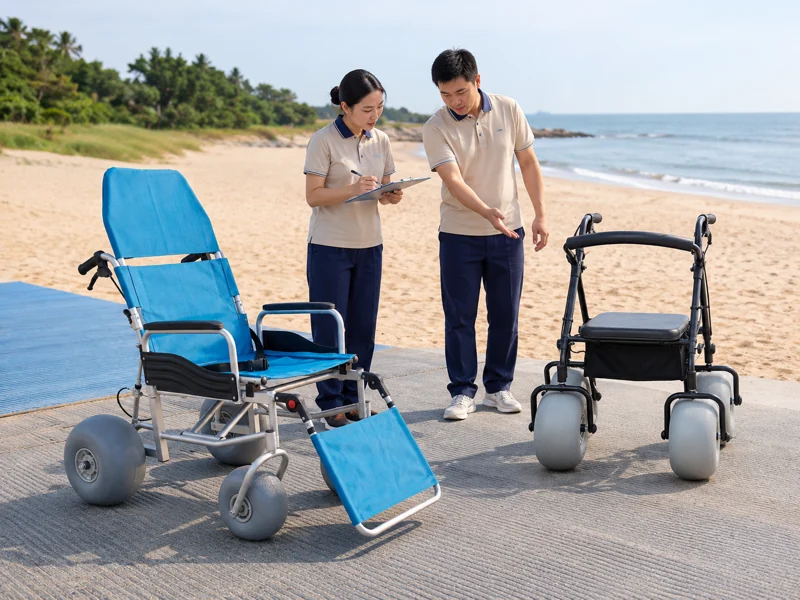
Assign each product a complementary job. A land chair supports its approved seated travel role. A floating chair belongs only in a separately authorised water service. A walker serves its approved walking-support role. Matting creates a route surface, while a cart carries operational supplies within its intended use.
The chair range should be reviewed by configuration, not treated as one interchangeable category. For current high-back enquiries, identify AY-ST-V2.0 explicitly. A fleet planner still needs current model documentation and user suitability review before assigning a chair.
A public example illustrates this mixed approach: Bridport’s scheme describes matting and several specialist chairs with different roles. Its equipment counts and operating arrangements are site-specific.
- Separate passenger equipment from cargo equipment.
- Distinguish route infrastructure from bookable assets.
- Keep land and water permissions visible.
Give every product a defined job and an operating owner. Remove items from the purchase list when no supported role has been identified.
Equipment role matrix
| Equipment class | Proposed role | Planning boundary |
|---|---|---|
| Land chair | Approved seated beach travel | User, route and assistance suitability |
| Floating chair | Authorised water-access service | Separate operating procedures |
| Walker | Approved walking support | Individual suitability |
| Matting | Supported access route | Layout and local condition checks |
| Cargo cart | Move supplies | No passenger substitution |
3. How should route layout influence product selection?
Walk the complete service route with staff, from storage to collection and back. Record door openings, turning areas, thresholds, surface changes and storage access. A product that suits an open beach may still be awkward to retrieve through a narrow equipment room.
For an all-terrain chair, assess the actual planned route using approved procedures. For a beach walker, review its separate role rather than borrowing the chair’s trial result.
Map where visitors transfer, wait and meet staff. Those spaces affect scheduling and congestion. Record temporary restrictions after weather or maintenance events as operating conditions, rather than assuming one inspection covers an entire season.
- Mark collection and return points.
- Identify usable turning and waiting areas.
- Record separate route permissions for each equipment class.
A route can limit usable fleet size before storage does. Complete the route map before deciding how many simultaneous sessions to offer.
Route planning checks
| Location | Record | Fleet implication |
|---|---|---|
| Storage exit | Clear opening and handling space | Limits retrieval options |
| Collection point | Waiting and transfer arrangements | Limits simultaneous handovers |
| Access route | Surface and passing locations | Shapes product allocation |
| Return area | Inspection and cleaning space | Controls turnaround flow |
4. How can a program estimate quantities transparently?
Calculate active units from overlapping bookings. Then review cleaning, inspection, downtime and staff capacity. Daily visitor totals alone do not show how many devices are needed at the same time.
Consider this hypothetical land-chair example. Assume six requested bookings, each requiring one hour of use and half an hour for turnaround. Across six operating hours, one chair could theoretically support four consecutive cycles: six divided by one-and-a-half. Two active chairs provide eight theoretical cycles. This arithmetic assumes compatible booking times, uninterrupted work and sufficient staff.
Suppose this program also budgets one reserve chair of the same approved service role. That creates an illustrative purchase quantity of three chairs. The reserve is a planning choice, not an industry ratio or demand forecast.
- State booking duration and turnaround assumptions.
- Check overlap against an actual proposed timetable.
- Separate active units from maintenance reserve.
Arithmetic capacity still needs a workable schedule. Replace every example input with observed local requests before ordering.
Hypothetical quantity calculation
| Input or result | Illustrative value | Meaning |
|---|---|---|
| Operating window | 6 hours | Assumed service day |
| Use plus turnaround | 1.5 hours | Assumed complete cycle |
| Cycles per active chair | 4 | Theoretical uninterrupted capacity |
| Active chairs | 2 | 8 theoretical cycles combined |
| Reserve chair | 1 | Optional allowance in this scenario |
5. How should planners choose the rest of the equipment mix?
Allocate remaining equipment by function rather than applying the chair calculation everywhere. Mat quantity follows a measured route layout, including approved connection and anchoring requirements. Consult the accessible beach mat information while defining that scope.
For the same hypothetical program, assume consultation identifies one concurrent walker request and staff have capacity to support it. One approved walker could enter the trial plan. Assume supplies need transport between storage and collection; one cargo cart could serve that logistics task. Neither assumption establishes real demand.
Leave a floating chair out of this illustrative initial fleet if a supported water service has not been established. Record it as a separate future service decision. This prevents an attractive product purchase from silently creating an unsupported operating commitment.
- Size matting from a measured layout.
- Size walkers from compatible concurrent requests.
- Size carts from equipment-movement tasks.
Different products need different quantity calculations. Add a short justification beside every line of the proposed equipment mix.
Illustrative complementary allocation
| Item | Hypothetical planning basis | Next evidence required |
|---|---|---|
| Walker | One concurrent suitable request | Consultation and approved trial |
| Matting | One defined access route | Measured layout and specification |
| Cargo cart | One supply movement task | Load and route review |
| Floating chair | Service not yet established | Separate operating plan before purchase |
6. What staff capacity must accompany the fleet?
Map tasks across a busy hour: retrieving equipment, briefing visitors, supporting authorised activities, checking returns and preparing the next issue. Do not count one staff member as available for two simultaneous duties.
The cargo cart can be considered for approved supply transport, but it does not eliminate staffing decisions. Someone still needs to collect equipment, manage its movement and restore its storage position.
Use a simulated timetable with actual role assignments. Include breaks and a backup arrangement for absence. If two bookings return while another visitor arrives, identify who receives each asset and who completes its inspection. Adjust appointment spacing before increasing fleet numbers.
- Assign collection, return and cleaning responsibilities.
- Identify who can release held equipment.
- Include cover for absence and breaks.
More equipment only adds capacity when staff can support it. Rehearse the busiest planned interval and reduce overlapping bookings when tasks cannot be covered.
Staffing load review
| Duty | Timing pressure | Planning response |
|---|---|---|
| Handover | Several arrivals together | Stagger appointments |
| Return inspection | Returns overlap new issues | Assign receiving cover |
| Cleaning | Equipment needs turnaround | Reserve a preparation window |
| Maintenance release | Specialist unavailable | Keep unit held and use approved reserve |
7. How should storage, cleaning and spare parts affect purchasing?
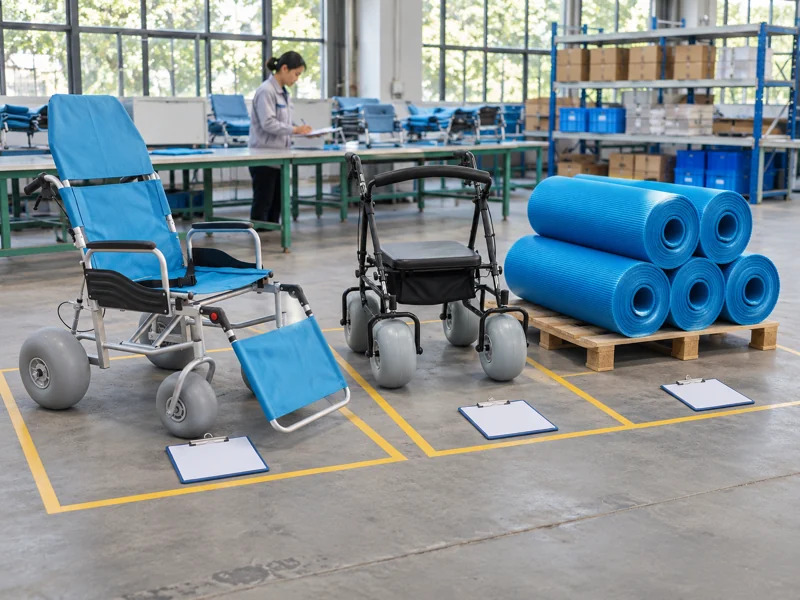
Draw the storage plan using complete equipment envelopes and handling space. Include a separate position for equipment awaiting cleaning and another for maintenance holds. A room that fits tightly packed products may still prevent efficient retrieval.
List cleaning and inspection tasks from each model’s current instructions. Use the manual collection to request relevant files, then build model-specific station cards. Avoid one generic cleaning recipe across tires, fabrics, frames and matting.
Consider spares by consequence of failure and actual availability. A correct approved retainer or wheel assembly may be worth stocking where a missing part would otherwise interrupt service. Obtain supplier terms before choosing quantities; do not invent failure rates or replacement intervals.
- Allocate ready, cleaning and held positions.
- Confirm tools and approved spare identities.
- Include storage handling in staff practice.
A reserve asset also needs space and upkeep. Price your full storage and maintenance arrangement with the equipment purchase.
Support resources
| Resource | Quantity basis | Check before purchase |
|---|---|---|
| Storage positions | Equipment envelopes and access | Retrieval without moving held assets |
| Cleaning station | Tasks and turnaround schedule | Suitable method and drying space |
| Spare assemblies | Failure consequence and supply terms | Exact compatible part identity |
8. Which records reveal whether the fleet mix works?
Track requests by equipment role, then distinguish fulfilled sessions from requests the program could not serve. Add a reason for each unmet request: unavailable equipment, unsuitable configuration, closed route, insufficient staff or timing conflict.
Keep asset downtime in separate records. A chair held for repair should not count as available simply because the program owns it. Record when a hold starts and when an authorised person releases the asset.
Review these records alongside feedback. High use of one product does not automatically prove another unnecessary; a rarely requested configuration may serve a distinct need. Ask whether low use reflects limited awareness, booking restrictions or suitability before removing it.
- Count completed and unserved requests by role.
- Record unavailable hours with reasons.
- Record turnaround time without personal health details.
A fleet decision needs the reason behind each missed session. Review service records before adding identical units or dropping a product role.
Useful operating measures
| Measure | Record | Decision it informs |
|---|---|---|
| Peak overlap | Concurrent requests by role | Active equipment quantity |
| Unserved request | Reason and requested time | Equipment versus staffing change |
| Downtime | Asset, start, release and cause | Reserve and spare strategy |
| Turnaround | Return-to-ready time | Booking intervals |
9. When should a program expand or change its fleet?
Expand a supported role when records show a persistent capacity gap that additional equipment can address. If delays originate in cleaning or staffing, buying more units may move the queue without solving it.
Review product-specific feedback before changing configuration. For example, a request for easier vehicle loading should prompt a review of handling and transport needs. It does not automatically justify substituting every chair with a folding model.
Use the project portfolio to frame questions for supplier discussions, not as evidence of your own demand. Pilot a proposed change on its intended route and update training, storage and spares before wider adoption.
- Identify the cause of unmet service.
- Confirm support capacity for additional units.
- Set a review date for any pilot purchase.
Expand the role with a demonstrated gap. Write the evidence and expected service change beside each proposed addition.
Expansion decisions
| Finding | Likely review | Purchasing response |
|---|---|---|
| Repeated compatible booking overlap | Active chair availability | Consider additional approved units |
| Long cleaning queue | Turnaround process | Improve support capacity |
| Distinct unmet user need | Product suitability | Evaluate a suitable configuration |
| Frequent component holds | Repair and spare provision | Review support stock before expansion |
10. What should the initial fleet brief contain?
Prepare a purchase brief showing service roles, equipment quantities, route conditions, support resources and unanswered product questions. Attach the illustrative calculations only after replacing assumptions with your own planning inputs.
Keep each proposed purchase phase explicit. The initial phase might support land access and walking assistance, while a separate phase evaluates water access. Name what evidence will trigger that later decision. This gives budget holders a reviewable scope without promising services the program has not established.
Send the brief through Ary Beach’s enquiry page for model-specific discussion. Request separate lines for equipment, approved spares, packing and support documentation.
- Include a role and quantity justification per item.
- Attach route and storage constraints.
- Specify training, service and document needs.
Order a fleet the program can operate from opening day. Confirm receiving checks, staff practice and asset records before accepting public bookings.
Q1: Should every beach program buy a floating chair?
Only when a separate water-access service, suitable equipment and supporting procedures have been established. Land access can have its own purchase phase.
Q2: Can matting replace all beach wheelchairs?
Treat matting as a route component. Review individual travel needs and intended routes before deciding which chairs remain necessary.
Q3: How many spare chairs should a new program buy?
There is no universal ratio in this plan. Evaluate downtime consequences, supply support, budget and available storage.
Q4: Should cargo carts count as visitor mobility equipment?
Assign carts their approved cargo role and record them separately from passenger equipment.
Q5: Which evidence should change the next purchase?
Use repeated unmet requests, peak overlap, downtime causes and user feedback. Identify whether equipment quantity, configuration or operating capacity caused the gap.