
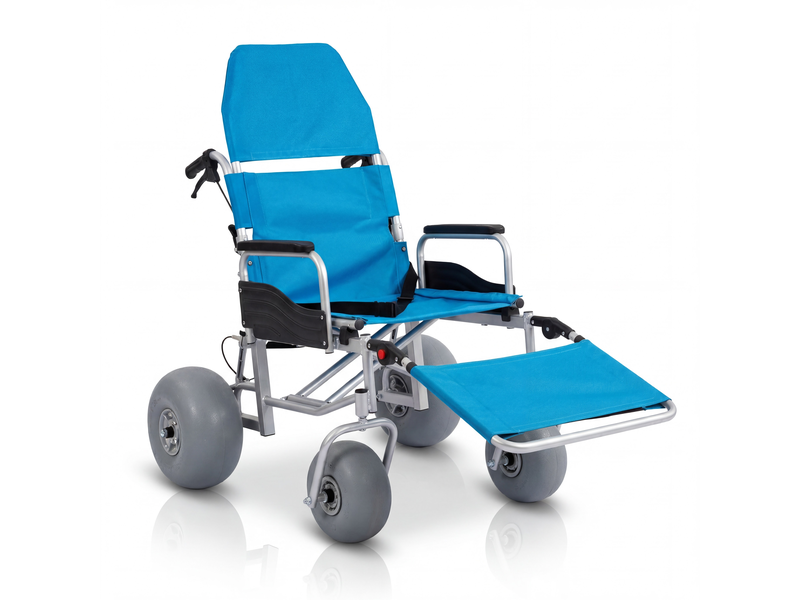
An empty all-terrain beach wheelchair can fit on a vehicle floor and still be too awkward to pass through the door. For an AY-ST-V2.0, prepare the chair as you intend to carry it, measure each piece, and try the full loading and unloading sequence with the actual vehicle. The dimensions on the shipping carton describe how the factory packed the product. Only measurements of your prepared chair answer the vehicle-fit question.
This procedure covers unoccupied equipment carried as cargo. Arrange a suitable passenger seat and transport plan for the person travelling. Neither a successful cargo trial nor a belt fitted to the beach wheelchair establishes that a person may stay seated in it during vehicle travel.
Which dimensions are available before the trial?
The following are manufacturer-listed values for the named configurations. Use them to plan space and handling. The manuals do not give a measured, ready-to-load envelope for every folding and wheel-removal arrangement.
| Manufacturer-listed item | AY-ST-V2.0 all-terrain chair | AY-ST-V3.0 lightweight folding chair |
|---|---|---|
| Overall size, length × width × height | 120 × 110 × 122 cm | 95 × 92 × 77 cm |
| Net product weight | 19.5 kg | 13 kg |
| Shipping carton | 80 × 25 × 90 cm | 55 × 35 × 81 cm |
| Parts affecting the travel arrangement | Folding frame, removable upper backrest, wheel assemblies and adjustable leg support | Folding frame, wheel assemblies, flip-back armrests and flip-up foot supports |
AY-ST-V2.0 manufacturer manual, pages 2–5 and AY-ST-V3.0 manufacturer manual, pages 2–5.
The V3.0 may be worth evaluating for frequent transport if its seating and operating role suit the user. Its smaller carton and lower net weight alone cannot confirm a fit in a particular car. Lightweight beach wheelchair travel and vehicle checks
Measure the shape you will actually lift
Use only a folding or disassembly method the instructions cover. Record whether the upper backrest, leg support and wheels travel attached or detached. Count every loose piece, pair the fittings with the correct unit, and place them in the bags or containers that will be used on the trip. A folded frame standing by itself can give a misleading impression of how much floor space the complete set needs.
Measure the largest piece in the intended loading orientation, including protruding knobs, brackets and wheel mounts. Measure loose wheel assemblies and protected containers separately. On the vehicle, measure the opening at its tightest usable points, the lift-over height, the usable cargo floor and the clearance under the closing hatch. Include passenger seats and luggage in their normal positions.
During the trial, can the handlers keep their intended grip as the frame crosses the sill and turns into its storage position? If a door pillar, seat back or low hatch forces an unplanned grip change, revise the orientation, handling aid or vehicle choice. Confirm suitable handling points and staffing for the actual lift. Neither product weight nor a photograph establishes that one person can lift it.
Secure the empty chair and account for loose parts
Consult the vehicle instructions for permitted cargo anchors and obtain applicable chair guidance for where restraint forces can be applied. Do not attach a cargo strap to the backrest extension, upholstery, adjustment controls or an unidentified tube merely because the strap reaches it. Protect contact surfaces and secure the component containers so loose wheels or hardware cannot travel through the passenger area.
Photograph the stationary, secured arrangement with the normal trip load present. Check access to required exits and equipment before closing the vehicle. If the chair fits but the team cannot establish a suitable securing method, the transport arrangement is still incomplete.
Unload where the service will run
Try unloading at the intended destination. A workshop may have clear space behind a van while the beach station offers only a narrow service bay. Make sure the first component needed for reassembly can be reached without shifting unsecured boxes overhead. Rebuild the empty chair according to the manual, reconcile its loose parts and recheck wheel retention, supports and movement before a visitor uses it.
For storage after the outing, follow the care instructions, allow the chair and fabric to dry, and keep its labelled fittings together. If a retaining part is missing at the destination, keep that unit unavailable and obtain the identified replacement. Repeat the relevant fit checks whenever the vehicle, interior arrangement or chair configuration changes.