
Choosing between PU and PVC beach wheels requires two comparisons: material formulation and complete wheel design. Flexible PVC gets its softness from plasticisation. Polyurethane properties vary with chemistry and formulation. Neither name establishes puncture resistance, payload or compatibility. For a commercial buyer, a useful comparison connects those differences with route effort, maintenance and replacement cost.
Start with candidate part numbers from the beach balloon wheel range. Compare complete wheel assemblies on compatible equipment, using their own approved pressure and load limits. A softer sample squeezed by hand offers little purchasing evidence.
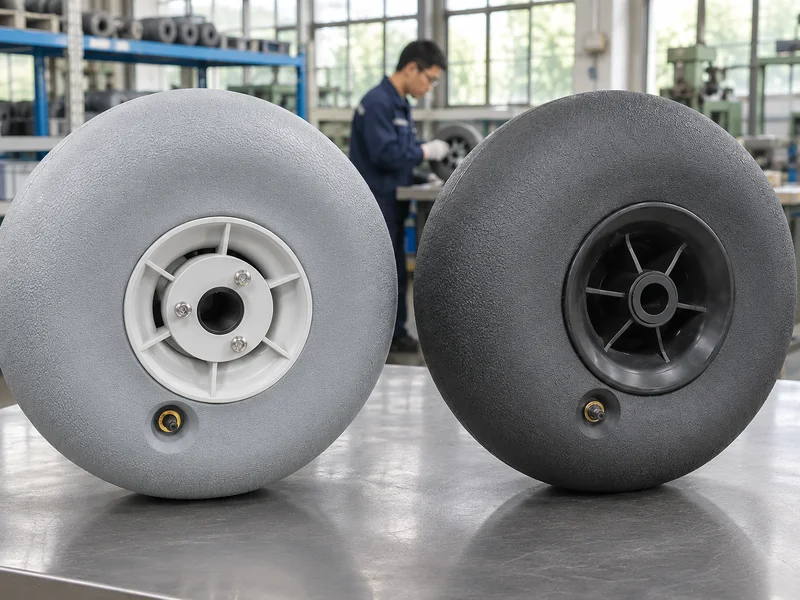
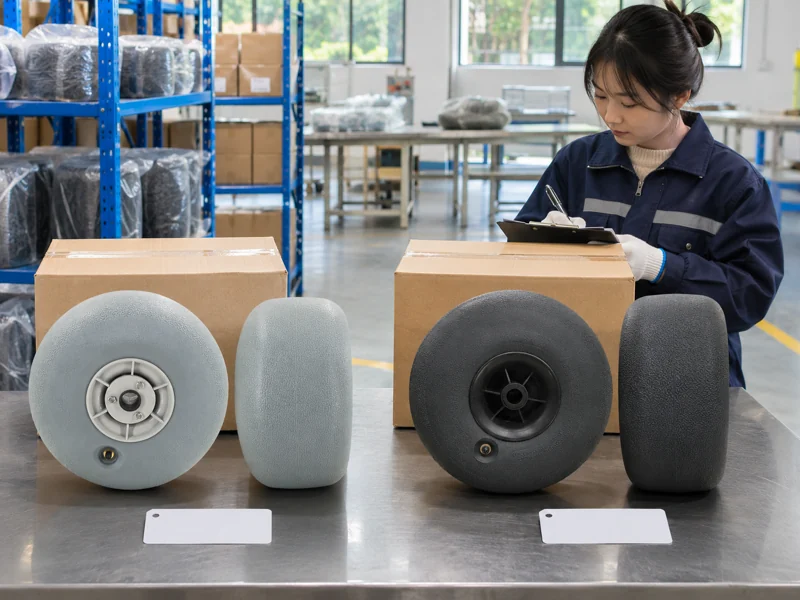
Images are AI-generated illustrations based on product references. They do not document an actual inspection, factory visit, or project.
1. What do PU and PVC tell buyers about wheel material?
PU means polyurethane; PVC means polyvinyl chloride. These identify polymer families, while a finished wheel also contains a hub, running interface and retention arrangement. Ask which component carries each material description. A polyurethane tire can surround a hub made from another polymer.
ECVM explains that plasticisers make naturally rigid PVC flexible. Their selection influences heat, cold and chemical response. BASF describes how its TPU properties vary with raw materials and formulation. TPU guidance cannot identify an unspecified PU tire compound.
- Separate tire material from hub material.
- Identify pneumatic, solid or other supplied construction.
- Match any compound declaration with a part revision.
A material label needs a construction description beside it. Create separate fields for polymer family, construction and hub before comparing quotations.
Material identity comparison
| Question | PU candidate | PVC candidate |
|---|---|---|
| What determines flexibility? | Polyurethane chemistry and formulation | Plasticised PVC formulation |
| What remains unknown from name alone? | Exact grade and wheel performance | Plasticiser package and wheel performance |
| What should a quotation identify? | Tire construction plus hub assembly | Tire construction plus hub assembly |
2. Which material tradeoffs deserve a closer look?
PU offers a broad formulation choice, so a supplier may propose a grade selected for a particular service exposure. Flexible PVC also permits formulation choices through plasticisers and other ingredients. That gives buyers two questions with different emphasis: which polyurethane chemistry was selected, and which flexible PVC compound was selected?
For damp, warm service, BASF reports better hydrolysis resistance for its polyether TPU than its polyester TPU. That comparison concerns specified BASF materials; it does not rank every PU wheel against PVC. It also provides no permission for water use on a beach wheelchair. BASF chemical guidance supplies the formulation context.
- Compare the stated service environment for both candidates.
- Ask whether submitted tests cover finished tires or raw material specimens.
- Separate abrasion, tear and puncture results; they answer different questions.
Compare a documented property with the matching service problem. Shortlist a compound because relevant evidence supports it, rather than because its family sounds stronger.
Tradeoffs worth testing
| Service concern | Useful PU comparison | Useful PVC comparison |
|---|---|---|
| Warm, damp storage | Identified chemistry and exposure evidence | Identified compound and exposure evidence |
| Repeated surface wear | Finished tire wear test and conditions | Equivalent test and conditions |
| Cleaning chemicals | Compatibility for actual formulation | Compatibility for actual formulation |
3. Does softer material always roll better on sand?
No universal ranking follows from softness alone. Compare tire width, inflated shape, pressure and loaded response alongside material. If two samples have different dimensions or construction, a route result compares those complete assemblies. Calling it a pure material test would hide those differences.
For an all-terrain chair, include transitions between firm paths and loose sand. Record straight travel and turning separately. A wheel that feels acceptable in a straight line still needs evaluation at corners and collection areas. Use approved loading and a controlled procedure; a hand-squeeze demonstration cannot reproduce that task.
- Record route surface and recent weather.
- Keep equipment, load and operator consistent where practical.
- Record stops, rubbing and handling comments separately.
The comparison must identify everything that changed. Put dimensions, construction and pressure beside route observations before deciding which sample performs better.
Interpreting a route result
| Observation | Possible confounder | Next comparison |
|---|---|---|
| Different push effort | Width or pressure differs | Repeat with approved comparable setup |
| Different turning response | Hub drag or mounting position differs | Inspect running interface |
| Different visible deflection | Load distribution differs | Confirm setup and load placement |
4. How should pressure and puncture claims affect selection?
Separate pneumatic construction from polymer type. Manufacturer listings include low-pressure PU balloon wheels. PU does not automatically mean solid or puncture-proof. Require a pressure method for each pneumatic candidate, including compatible equipment and inspection conditions. Do not assign a pressure merely because another tire looks similar.
If a supplier claims better puncture resistance, ask what penetrator, loading, specimen and test method support that comparison. A material tensile result does not answer how a complete tire responds to a sharp object. For the lightweight chair configuration, pressure guidance must remain tied to its approved wheels.
- Distinguish air loss from visible surface damage.
- Record valve and tire-body findings separately.
- Confirm whether a field repair method exists before budgeting repair labour.
A puncture claim needs a defined test and a service response. Choose samples with an understandable fault procedure, then trial only within their stated operating limits.
Pressure and damage evidence
| Buying question | Evidence needed | Unsupported shortcut |
|---|---|---|
| How should staff inflate it? | Current wheel-specific instructions | Copy another brand’s value |
| What happens after air loss? | Inspection and repair procedure | Assume every leak is repairable |
| Which tire resists puncture better? | Comparable finished-tire test | Rank by polymer initials |
5. What changes when the wheel serves a different product?
Compare a wheel inside its intended assembly. A beach walker and a cargo carrier have different frames, functions and operating requirements. Sharing a tire diameter cannot establish interchangeable hubs or equivalent handling.
Measure axle diameter, bore, running width and retention position. Inspect spacers and bearings or bushings as part of that assembly. Keep a drawing of original hardware order before removing components. A new tire material may arrive on a different hub, even when its catalog size appears unchanged.
Evaluate access for inflation, cleaning and wheel removal. A service team should know whether an approved replacement fits existing tools and service procedures. That practical difference belongs in a purchasing comparison alongside material evidence.
- Match hub dimensions and running interface.
- Confirm original equipment manufacturer approval for any change.
- Check turning and nearby component clearance.
A material upgrade can introduce a mounting mismatch. Complete fit review before ordering a batch of replacement wheels.
Assembly compatibility checks
| Interface | Record | Purchasing consequence |
|---|---|---|
| Axle and bore | Drawing dimensions and measured values | Wrong fit blocks installation |
| Hub width | Contact-face span including inserts | May alter spacer arrangement |
| Retention | Approved pin, clip or fastener system | Must remain fully engaged |
6. How should repairability change a commercial comparison?
Price repairs as complete jobs. Include diagnosis, approved parts, labour, transport and time awaiting release. A supplier-approved tire repair may require conditions unavailable at a beach kiosk. In that situation, exchanging an approved complete wheel could be operationally simpler, even when component repair remains possible elsewhere.
For beach cargo carts, a workshop may service equipment outside public operating hours. A loan wheelchair program may need a ready spare during opening hours. Those service patterns affect spare stock without proving either polymer more durable.
- Confirm which parts are individually replaceable.
- Ask what repair conditions and curing time apply, if relevant.
- Record who checks repaired wheels before reuse.
Repairability only helps when staff can perform the approved repair. Cost both a workshop repair path and a complete-wheel exchange path using actual supplier terms.
Repair-path comparison
| Item | Component repair | Complete assembly exchange |
|---|---|---|
| Stock required | Approved repair materials and parts | Correct wheel assembly |
| Skill requirement | Procedure-specific repair competence | Approved removal and fitting competence |
| Release check | Repair plus assembly condition | Fit, retention and operation |
7. What should cleaning and storage trials include?
Use approved cleaning instructions for each candidate. Record cleaner identity, dilution if specified, contact time, rinsing and drying steps. A vague note saying “cleaned normally” leaves a later surface change difficult to interpret.
Do not infer chemical compatibility from plastic appearance. BASF’s chemical guidance describes formulation-dependent TPU behaviour and exposure effects. That supports checking an actual compound; it supplies no universal cleaning recipe for Ary wheels. Start with relevant files in the manual collection and resolve missing wheel instructions before a trial.
Also record storage support, temperature conditions and exposure to direct sunlight. Compare samples after equivalent storage periods. Describe tackiness, cracks, deformation or discolouration without diagnosing their cause from appearance alone.
- Photograph condition before cleaning.
- Use the same inspection locations on later checks.
- Keep cleaning observations separate from route damage.
Storage conditions belong in the material comparison. Add a dated storage and cleaning record to both sample files.
Exposure record
| Field | Example entry type | Why record it? |
|---|---|---|
| Cleaner | Named product and approved method | Identifies chemical exposure |
| Storage | Indoor position and support method | Makes comparisons repeatable |
| Condition change | Location, photo and discovery date | Supports investigation without guessing |
8. How can buyers compare total cost without inventing lifespan?
Use verified quotations and your own service records. Separate known costs from assumptions. Purchase price, freight and quoted spare prices can be entered now. Replacement frequency and downtime require observations or clearly labelled scenarios.
A useful calculation adds purchase, freight, service labour and replacement costs over one chosen review period. Keep staffing rates and operating days consistent across candidates. Do not insert a longer PU life or shorter PVC life merely to make a preferred option appear cheaper.
Compare results under more than one replacement scenario when evidence remains limited. If a decision changes after one additional replacement, collect more service data before placing a large order. Send candidate part numbers through Ary Beach’s technical enquiry route for matched quotations.
- Separate quoted amounts from internal estimates.
- Include compatible spare assemblies and tools.
- Record currency, taxes and freight basis consistently.
An uncertain lifespan should remain an explicit assumption. Ask finance to review both the cost sheet and its assumptions.
Cost worksheet
| Cost line | Source | Treatment |
|---|---|---|
| Wheel and freight | Matched supplier quotations | Enter known amount |
| Service labour | Local rate and timed task | Record calculation |
| Replacements | Fleet history or stated scenario | Show uncertainty separately |
9. What would a fair PU-versus-PVC trial record?
Write the trial question before using either sample. For example, ask which approved assembly fits a named cart and meets a particular route’s handling needs. That question gives technicians something observable and prevents a broad claim about all wheels.
Identify each sample, mounting arrangement, load placement, pressure method and route segment. Where dimensions differ, report that openly. Alternate trial order when practical and note changes in surface conditions. Repeat a questionable observation before treating it as a material difference.
Use results from your planned application to select equipment for that application only. A cargo trial supplies no evidence for carrying a seated person.
- Record observations before discussing preferred suppliers.
- Photograph damage and mounting details.
- Stop a trial when approved limits cannot be maintained.
State whether the trial compares materials or complete assemblies. Sign a result that names both its useful findings and its limits.
Trial result sheet
| Result area | Record | Decision use |
|---|---|---|
| Fit | Hub, axle, retention and clearance outcome | Determines usable candidates |
| Handling | Surface-specific observations | Matches route requirements |
| Maintenance | Cleaning, inspection and replacement tasks | Tests service practicality |
10. Which material should a commercial buyer select?
Select the approved wheel assembly that meets your route, service and purchasing requirements with adequate evidence. PU deserves consideration where a documented compound and complete-wheel tests match demanding service. PVC remains a candidate where its specified construction meets those same requirements at an acceptable operating cost. Neither decision follows from initials alone.
Write the purchasing decision around part number and revision. Include mounting approval, pressure guidance where applicable, service instructions and agreed change notification. Preserve the unsuccessful candidate’s observations as well; they can prevent repeating an unsuitable trial later.
- Name the selected assembly and permitted equipment.
- State what evidence supports the choice.
- Record unresolved matters that prevent release.
Buy the configuration that passed your comparison. Attach your selected wheel record to the purchase order and require review before any compound, hub or construction substitution.
Q1: Is every PU beach wheel airless?
PU identifies a polymer family rather than a construction. A wheel can use a PU tire with pneumatic balloon construction; confirm its actual design.
Q2: Does PVC always mean a rigid wheel?
Plasticised PVC can be formulated for flexibility. Finished-wheel behaviour depends on its formulation and construction.
Q3: Can a supplier’s abrasion test prove puncture resistance?
It cannot establish that separate property. Ask for a relevant test with defined conditions and identified specimens.
Q4: Should equal-size PU and PVC wheels use equal pressure?
Use each wheel’s approved instructions. Equal catalog size does not establish equal construction or pressure requirements.
Q5: What if both samples perform acceptably?
Compare fit approval, replacement availability, service effort and documented cost assumptions. Keep both approved configurations distinct in purchasing records.