
A buyer considering polyurethane (PU) beach wheels for a busy cart fleet needs to know what a price premium would buy at that site. Get quotes for complete, compatible wheel assemblies. Record which tire, hub, bearing or bushing, fittings and delivery charges each quote includes. A lower-priced bare wheel and a fully fitted assembly need different amounts of work before either reaches a cart.
Start with a comparable pair
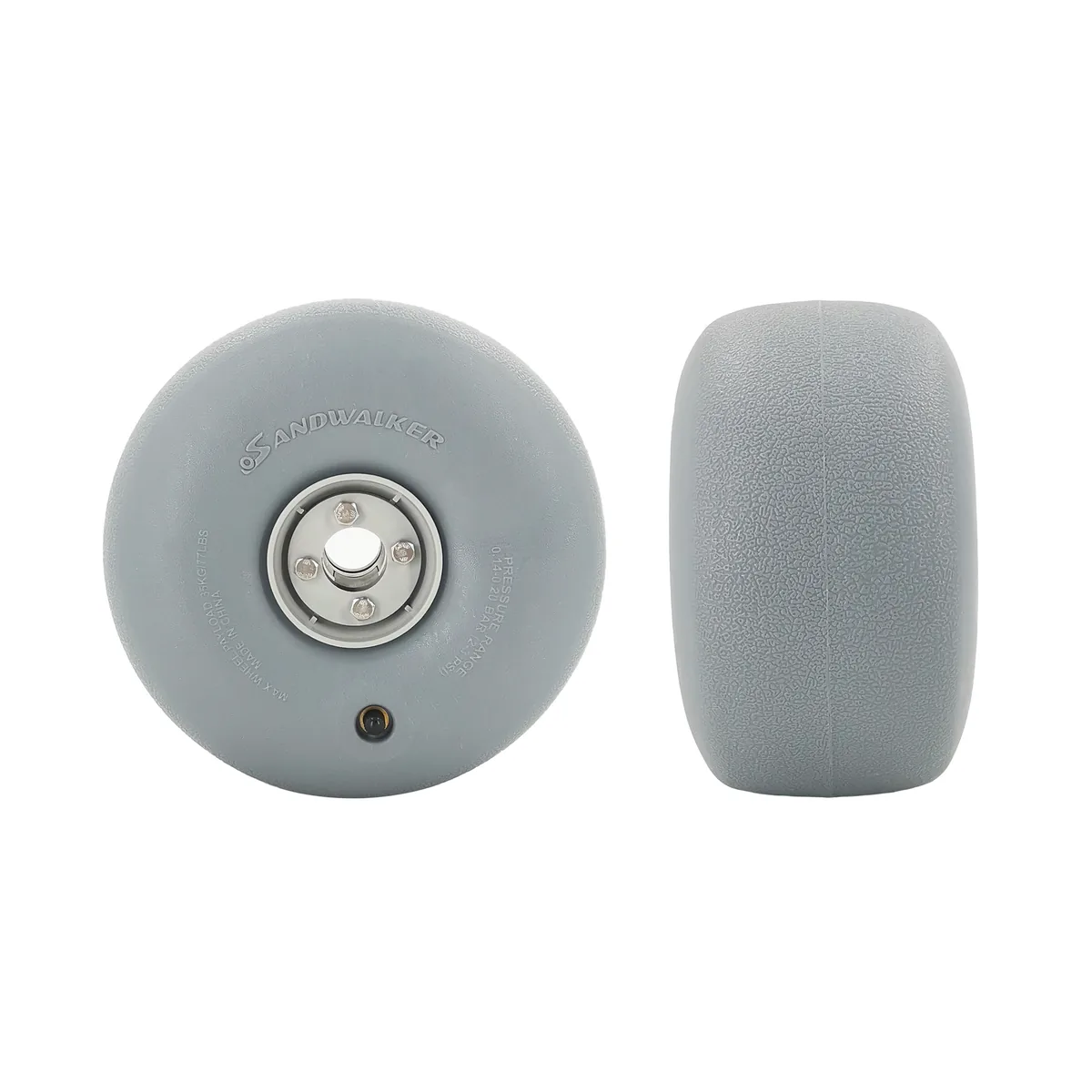
The manufacturer’s 9-inch PU wheel is listed at 225–232 mm inflated diameter, 110–120 mm width and a 60 kg wheel rating. Its 9-inch PVC listing has different dimensions and a 45 kg wheel rating. Those figures describe two particular products. They do not predict service life, give either cart a new payload rating or prove that either assembly fits your axle. Manufacturer’s PU and PVC wheel specifications
Ask for the offered tire specification, inflated dimensions and matched hub drawing. Confirm the host cart’s limits and whether a change to PU is approved for that equipment. If the hub or wheel envelope differs enough to require a frame change, treat that as a different proposal. Keep wheel material, grade and supplier revision identifiable on sample and production orders.
Calculate the service life needed to cover a premium
Suppose two approved assemblies would cost $90 and $60 delivered and installed, with the PU option at $90. If the $60 assembly has documented service of 120 comparable shifts at your site, its installation cost spread across those shifts is $0.50 per shift. The $90 option would need to provide 180 comparable shifts to reach the same $0.50 rate. The difference is 60 shifts. This calculation is an example of a buying threshold, not a forecast of PU wheel life.
Check the assumptions before using it. Include only equivalent costs on each side and track replacement labor, extra transport or missed delivery cover separately if they differ. Use a consistent definition of a shift and record whether the wheel was actually assigned. A wheel that spent half the season in storage has not accumulated the same exposure as one making regular loaded runs.
Choose a pilot that can produce evidence
| At the start | During routine use | At review |
|---|---|---|
| Identify cart, side, wheel revision, hub assembly, starting condition and permitted cargo task. | Record working shifts or trips, route surfaces, loading conditions and authorized care. | Compare cost per observed unit of use, recurring faults and any uncompleted deliveries. |
| Photograph the fitted clearance and tire at repeatable positions. | Record observable damage, rubbing or pressure loss reported under the applicable instructions. | Check whether a failure follows the tire, the mounting hardware or a particular route condition. |
Do not keep a suspect part running to reach an economic target. Hold it under the equipment procedure and record the condition and actual exposure. A prematurely loose fitting may invalidate a comparison of tire wear while still identifying an assembly problem worth correcting.
At the purchase review, tell the buyer what the trial established and what is still uncertain. If the PU assembly has completed only 80 shifts, retain the observation and avoid projecting it to 180 as a proven result. Request a limited repeat order or further monitoring when the decision depends on that missing service history. The wheel selection guide covers other options when material is no longer the deciding constraint.