
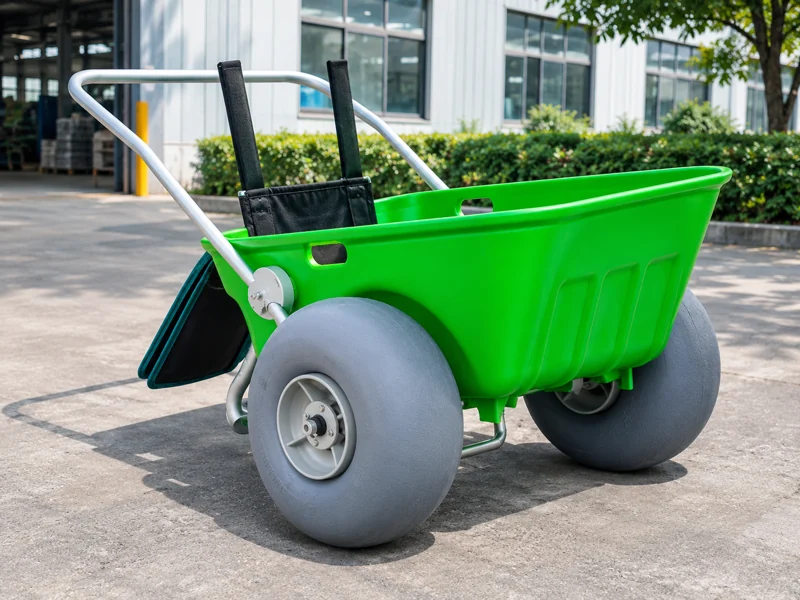
A commercial beach cart resort workflow should define cargo, route, dispatch responsibility and return condition before assigning daily trips. For the hard-bin cart shown in Ary’s supplied photographs, focus on its rigid tub, handle, supporting structure and large wheels. Treat it as a goods-handling tool; people are outside this workflow.
The beach cargo cart category can support a purchasing discussion. Operating limits, loading methods and maintenance instructions must match your delivered model. Trial the actual service route before committing cart availability across several departments.
Images are AI-generated illustrations based on product references. They do not document an actual inspection, factory visit, or project.
1. Which resort jobs suit a hard-bin cart workflow?
Start with repeated goods movements between named points. Possible tasks include taking packaged supplies from a store, moving equipment for a beach service station and returning segregated used items. These are planning examples, not verified customer results.
Group cargo by handling needs. Clean towels, maintenance tools and wet returned items should not share an unplanned load. Decide whether separate containers or dedicated carts are needed under your property’s hygiene procedures.
- List routine outward and return cargo.
- Separate clean, wet and maintenance duties.
- Exclude people and unauthorised goods.
Assign the cart a job before filling its tub. An open bin can collect unrelated items until no department knows what belongs on board. Use a task list and agreed load arrangement.
Compare folding beach carts separately where compact storage or platform handling forms part of the requirement. A rigid tub workflow should retain its own loading and storage assumptions.
Cargo classification
| Cargo group | Preparation | Return arrangement |
|---|---|---|
| Packaged supplies | Identified containers and destination | Unused stock counted |
| Service equipment | Approved placement and retention | Condition checked |
| Wet used items | Segregation under local procedure | Directed cleaning route |
| Maintenance materials | Approved containers and handling | Separate from clean supplies |
2. How should the route be mapped before daily dispatch?
Walk the intended route from storage through loading and unloading points. Mark doorways, ramps, paving changes, sand sections and guest crossings. Check the return route with equal care because its load and traffic may differ.
Record where staff can pause without blocking access. A short route with a narrow doorway can be harder to operate than a longer open path. Trial observations should describe those actual constraints.
- Mark direction changes and restricted clearances.
- Identify busy pedestrian crossings.
- Allocate suitable loading and unloading areas.
Plan return trips during your route walk. Used cargo may need another destination before storage. That extra leg should appear in scheduling and cleaning responsibilities.
Where a service route crosses beach access mats, confirm the installed system and local operating permission before cart use. Avoid assuming an accessible pedestrian route permits every commercial load.
Route station map
| Station | Check | Operating decision |
|---|---|---|
| Store exit | Door clearance and turning space | Approved exit path |
| Guest crossing | Visibility and foot traffic | Timing or controlled crossing |
| Sand section | Actual movement under approved trial | Route and load arrangement |
| Delivery point | Stable space for unloading | Named stopping position |
| Return point | Cleaning and stock handling | Return destination |
3. What should an operator check before taking the cart?
Use a brief inspection aligned with actual components. Examine the hard tub for damage, its connections with supporting structure, handle condition and wheel attachments. Check that cargo from a prior task has been removed or intentionally retained.
Follow supplied instructions for any adjustable or removable handle components. Do not assume a parking brake or folding mechanism exists. Staff need a clear response when a wheel rubs, a handle feels loose or tub damage affects use.
- Check tub condition and visible connections.
- Confirm handle and fitted retention components.
- Review wheel condition and ordinary movement.
An empty cart check belongs before loading. Cargo can hide floor damage and obstruct access to connections. Remove questionable equipment from dispatch until its condition is resolved.
Use balloon wheel information when preparing compatibility enquiries. Inflation, replacement parts and attachment checks need instructions for the actual wheel assembly.
Pre-dispatch checks
| Component | Operator observation | Escalation trigger |
|---|---|---|
| Tub | Damage, debris or sharp contact area | Damage affecting containment or handling |
| Handle | Correct position and ordinary function | Loose or damaged connection |
| Supporting structure | Visible condition and attachment | Distortion or uncertain attachment |
| Wheels | Condition, retention and movement | Damage, rubbing or missing component |
4. How should cargo be prepared and arranged?
Prepare cargo beside your loading area before placing it in the tub. Identify destination, quantity and handling needs. Use the manufacturer’s permitted loading arrangement and capacity for your actual cart; do not infer either from tub volume.
Position goods so operators retain control and visibility. Use only approved retention arrangements and keep loose straps away from moving parts. Avoid adding loads simply because empty space remains around existing containers.
- Check each item against the task list.
- Confirm total load using the approved limit.
- Review stability and access to the handle.
A full tub is not a loading target. Volume and permitted payload answer different questions. Staff need a specific arrangement for each recurring cargo group.
For supplies supporting a beach wheelchair service, allocate separate containers for clean service items and returned items. Mark containers by task rather than relying on staff memory.
Load preparation card
| Field | Staff entry | Dispatch purpose |
|---|---|---|
| Task | Named delivery or collection | Prevents unrelated additions |
| Cargo | Items and quantities | Confirms complete preparation |
| Approved arrangement | Placement and retention reference | Supports repeatable handling |
| Destination | Exact unloading point | Avoids unnecessary movement |
| Return cargo | Planned collection, if any | Preserves capacity and segregation |
5. Who should control shared cart dispatch?
Assign one dispatch point or an agreed booking method when several departments share a cart. Record asset, operator, task and expected return. A missing cart can delay service even when no equipment has failed.
Use plain availability states across departments. “Ready,” “assigned,” “cleaning” and “maintenance hold” tell staff what they can do. Avoid leaving cleaning responsibility implicit when one department finishes and another starts.
- Allocate a named operator for each trip.
- Record destination and return expectation.
- Update availability after handover.
A returned cart becomes available after its return check. A cart left near storage may still contain wet items or a reported defect. Require an actual handover before another team takes it.
Link dispatch with your resort application plan and service timetable. For competing requests, establish priorities in advance rather than asking operators to resolve them at the store door.
Shared cart status
| Status | Meaning | Who changes it |
|---|---|---|
| Ready | Inspection and preparation complete | Dispatch or duty staff |
| Assigned | Named task in progress | Dispatch staff |
| Cleaning | Return preparation unfinished | Cleaning owner |
| Maintenance hold | Equipment unavailable | Authorised service role |
| Ready after hold | Repair and recheck complete | Release authority |
6. How should delivery and unloading be organised?
Choose an unloading point that supports the approved handling method and keeps guest movement clear. Before arrival, the receiving department should know what is coming and where goods belong. Otherwise, operators may wait with a loaded cart in a circulation area.
Follow supplied instructions for stopping, supporting and unloading the cart. Do not assume the handle or tub provides a lifting point. Equipment handling and manual handling arrangements should be assessed for your site.
- Confirm destination readiness before dispatch.
- Keep unloading space clear.
- Count delivered goods and identify return items.
Finish delivery before taking a new request. Mixing tasks during unloading can leave goods unrecorded or create an unplanned return load. Close the delivery line, then approve any additional task.
For several beach service projects, use destination codes that staff recognise. Review delays by location so layout problems become visible in operating records.
Delivery handover
| Step | Operator action | Receiving team action |
|---|---|---|
| Arrival | Use assigned stopping area | Clear agreed unloading space |
| Unloading | Follow approved handling method | Receive designated items |
| Quantity check | Confirm delivered amount | Note shortages or returns |
| Return preparation | Accept only planned cargo | Identify collection destination |
7. How should wet returns and cleaning be handled?
Direct used or wet cargo to its assigned return point before the cart reaches clean storage. Remove contents and inspect the tub. Apply cleaning methods approved for its materials and consistent with local hygiene rules.
Inspect wheel and handle areas after sandy work. Deposits can obscure condition or interfere with movement. Use the supplied procedure for cleaning and drying; a rigid tub does not prove compatibility with every chemical or pressure washer.
- Empty and segregate returned cargo.
- Clean permitted surfaces and connections.
- Recheck condition before marking ready.
Cleaning includes the next load’s requirements. A tub ready for maintenance equipment may still need additional preparation before carrying clean supplies. Record the intended next duty when segregation affects release.
Ask for care instructions through Ary Beach support when your cleaning process differs from those supplied. Resolve that compatibility before routine use.
Return preparation
| Previous task | Return destination | Check before next use |
|---|---|---|
| Clean supplies | Stock-return area | Remaining items and cleanliness |
| Wet collection | Assigned wet-item handling area | Cleaning and drying |
| Maintenance work | Tools/materials return point | Debris and surface contamination |
| Reported equipment issue | Maintenance hold location | Technical assessment and recheck |

8. What storage arrangement suits a rigid cargo cart?
Measure the actual assembled cart and its permitted storage position. Allocate space for its tub, handle and wheel clearances. Do not base storage planning on a folded-wagon footprint. Removable components, if any, require their own approved handling method.
Provide access for inspection and cleaning without moving unrelated equipment. Identify a stable parked position under current instructions. Keep circulation routes clear and avoid loading stored carts with miscellaneous goods.
- Mark each cart’s assigned storage bay.
- Separate ready equipment from held assets.
- Store loose authorised components with clear identification.
Store the cart in a condition staff can inspect. A tub used as a general cupboard hides damage and delays preparation. Keep task containers outside it until dispatch.
Review space after a trial week of actual use. Record obstructions and revise your layout before adding more equipment or allocating another department’s stock to that bay.
Storage bay checklist
| Bay feature | Purpose | Verify |
|---|---|---|
| Assembled footprint | Fit actual rigid cart | Clearance around tub and wheels |
| Handle position | Stable permitted storage | No obstruction of circulation |
| Inspection access | Expose connections and tub interior | Staff can see required areas |
| Status marker | Prevent unauthorised dispatch | Matches dispatch record |
| Drying arrangement | Complete post-cleaning preparation | Fits approved care method |
9. Which operating records should guide maintenance and purchasing?
Track faults by component and operating task. Record repeated delays, cleaning time and unavailable periods without inventing performance targets. These observations can show whether a route, load arrangement or service schedule needs adjustment.
Use part references when ordering replacements. A wheel problem reported on several carts may reflect a shared condition, but staff should investigate before assigning a cause. Keep operating observations separate from confirmed technical findings.
- Record defect location and task context.
- Track completion of repairs and rechecks.
- Review recurring delays with affected departments.
Use actual downtime when planning spares. Stock decisions should follow component compatibility, service authority and supplier availability. A bag of unverified parts cannot guarantee faster repair.
Our supplier support overview provides a starting point for parts discussions. Confirm current availability and terms in writing for your model.
Useful operating measures
| Record | What it can reveal | Possible management action |
|---|---|---|
| Task delay reason | Route or handover bottleneck | Change timing or location |
| Component fault | Repeated inspection finding | Seek technical review |
| Unavailable period | Actual service interruption | Review repair support |
| Cleaning completion | Turnaround between cargo classes | Adjust duty allocation |
| Spare consumption | Parts genuinely used | Revise stock plan |
10. How should a resort introduce the workflow?
Pilot one defined duty with one cart before extending use across departments. Observe preparation, route movement, unloading, return and storage. Record where staff deviate because the written process does not match actual work.
Correct those gaps with operators and receiving teams. A pilot may show that dispatch timing, container choice or a stopping location needs revision. Keep any equipment change within manufacturer instructions and your approved handling arrangements.
- Select a recurring duty with a known destination.
- Record operational problems during complete trips.
- Approve revised instructions before wider rollout.
Expand duties only after the complete return cycle works. Delivering goods is one part of availability. Cleaning, defect reporting and storage must also function before another team can rely on the cart.
Issue a one-page duty card with cargo, route, operator responsibilities and return point. Keep the inspected cart configuration and current instructions beside that card for staff reference.
Q1: Can a hard-bin cart carry guests or children?
This workflow covers goods only. Do not use the cargo cart for passenger transport.
Q2: Should resorts fill the tub before every trip?
No. Use approved payload and loading arrangements. Available volume does not establish a safe or useful load.
Q3: Can clean supplies and wet returns share one trip?
Only within your approved segregation and hygiene procedure. Plan containers, destinations and return handling before dispatch.
Q4: Does a hard cargo cart fold for storage?
Do not assume that feature. Measure the actual cart and use its permitted storage configuration.
Q5: When should a cart return from maintenance hold?
After authorised repair, affected inspections and required functional checks are complete, with physical and dispatch status updated together.