
Commission an access consultant when the project owner has a decision to make. “Review our beach mat” leaves the consultant to guess whether the council needs a route comparison, a design review or an inspection of completed work. Identify the entrance, the destination, the project stage and the decision date in the appointment. Name the person who will act on the findings.
Write a brief that competing consultants can price
State whether the consultant will review existing plans, attend a site walk, involve intended users, examine a trial installation or return after construction. Specify the expected deliverables and which decisions belong to the landowner, designer, supplier or site operator. For a consultant asked to comment on applicable requirements, identify the jurisdiction, project scope and basis for that opinion. Ask the consultant to identify unresolved questions for the responsible authority.
Disclose supplier, designer, operator and commercial relationships. Ask each bidder to describe its involvement in the proposed mat purchase or earlier design, the work it can review independently and any separate specialist needed. Specify who will arrange site access, protect participants’ privacy, obtain consent for photographs and pay participation expenses. A quote for a desktop review and one for a site visit with participants cover different work.
Require evidence that the client can revisit
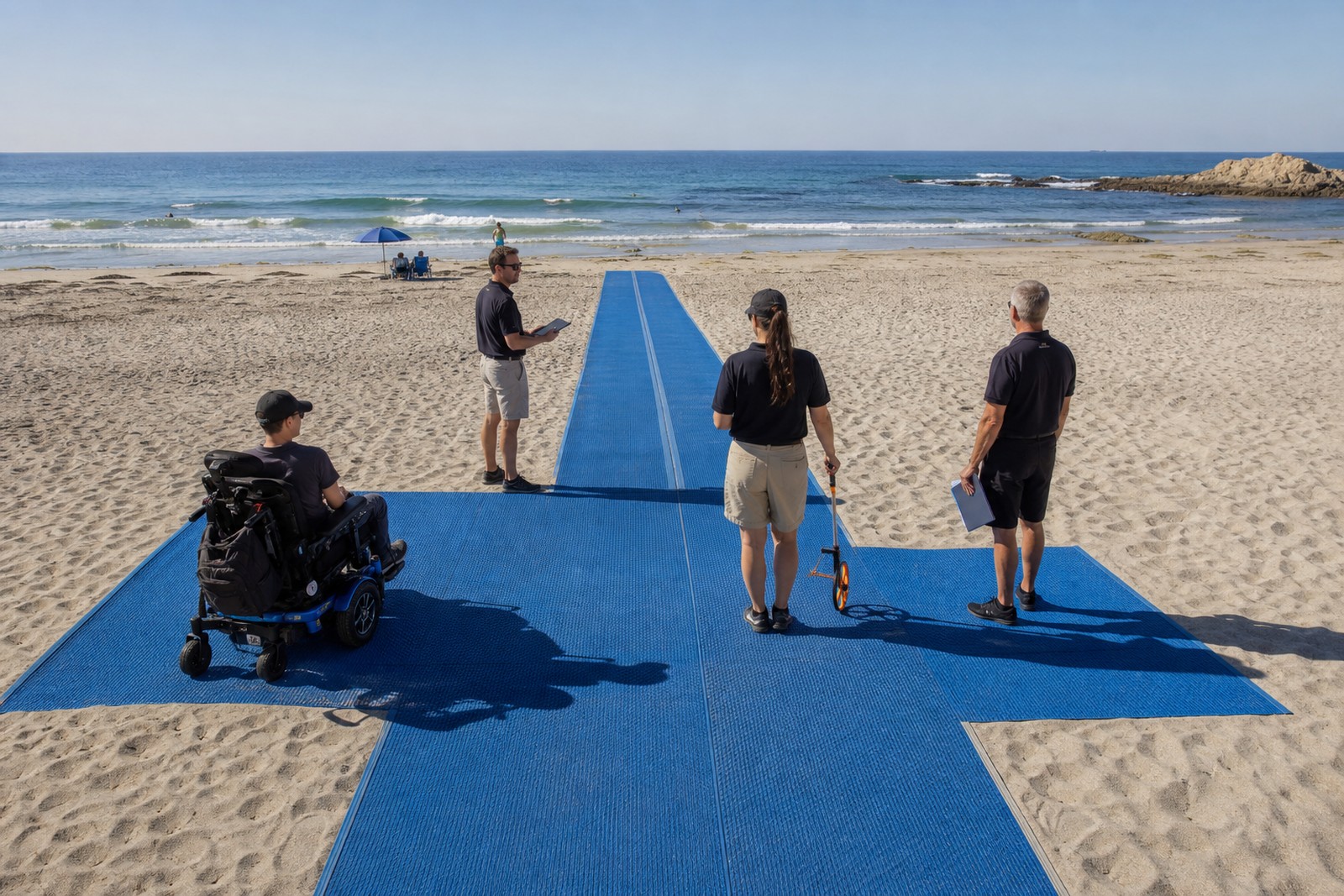
Ask for a numbered plan linking the firm approach, mat entrance, joints, endpoint and return. The field notes should give date, direction of travel, observed sand condition, method of measurement and installation version. A supplier’s nominal mat width belongs in the product column. The observed clear passage at the gate belongs in the field column. If the gate was locked, record the missing measurement and the follow-up owner.
| Evidence in the report | What the consultant can reasonably say |
|---|---|
| Supplier drawing of the proposed connector | Identifies the proposed detail and revision. Installation still needs to be checked against it. |
| Dated measurement at the boardwalk approach | Describes that location, configuration and visit. It does not establish the condition of the rest of the beach. |
| Comment from a participant returning along the mat | Records that person’s experience and any assistance used, with their permission. Retain their words and distinguish the consultant’s interpretation. |
| Area outside the visit or changed after inspection | Identify the gap, why it matters to the client’s decision and what evidence would resolve it. |
A guided beach mat user trial can answer a defined movement or information question. Agree its conditions and stop procedure with the operator. Participants should be free to stop. Never present a single participant’s completed trip as clearance for every visitor or every beach condition.
Turn the findings into decisions and a return visit
Consider an illustrative finding. The observed space at the beach endpoint allows onward travel onto loose sand, but the client commissioned a route where someone can remain on the mat, face companions and return. The consultant should show the measured endpoint and report any observed difficulty. Compare a revised end layout and an alternative destination against the agreed trip, installation needs, operating effort and permission to use the footprint. State which party can authorize each option and what must be checked before it is offered to visitors.
Ask for a finding number, location, evidence, priority, proposed action, responsible party and verification method. At the return visit, compare the revised drawing and actual endpoint against the original finding. Photograph or measure the corrected location and list any remaining limitation. Hand the client the open findings and the route audit record it can use after the consultant’s appointment ends.