For operators, reliable safety comes from suitable equipment, trained supervision, calm conditions, and consistent pre-use checks. A floating beach wheelchair achieves safety through a specialized combination of buoyancy-assisted armrests, three low-pressure balloon wheels, and a lightweight, corrosion-resistant frame designed for controlled shallow waters. Picture a bright afternoon at a gorgeous resort where families play in the surf while a guest in a standard chair sits excluded, facing an impassable barrier of soft sand. This frustrating segregation dampens the vacation spirit and highlights a glaring gap in your facility’s guest experience. Fortunately, deploying a professional floating beach wheelchair solves this by bridging the gap between dry sand and shared, calm waves.
How does a floating beach wheelchair stay balanced?
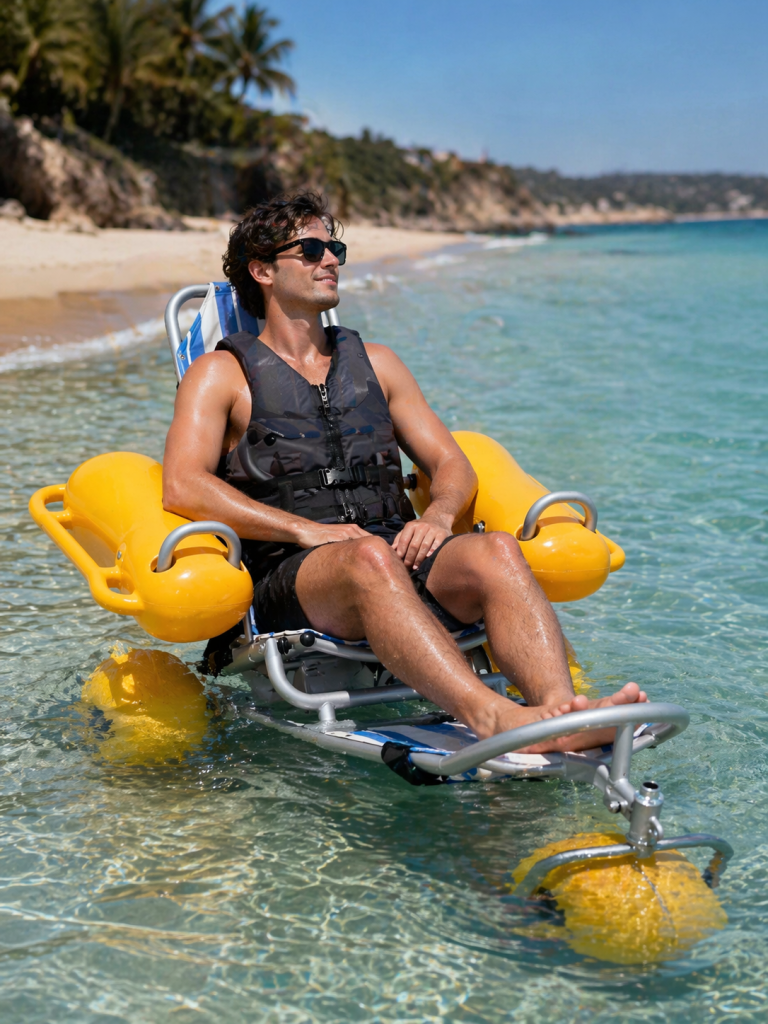
For example, a professional floating beach wheelchair stays balanced by positioning the passenger’s center of gravity below the center of buoyancy, creating an inherent anti-tip design. This clever geometric alignment prevents the chair from rolling or tipping when transitioning from dry sand into the surf.
Why is the three-wheel layout helpful?
However, the tri-point base configuration establishes a highly stable foundation on uneven ground and in water. By using a single front wheel and two rear wheels, the chair avoids the wobbling common in four-wheeled designs.
- For example, Triangular base distribution: Weight is spread across three critical touchpoints.
- Also, Anti-tip geometry: The wide rear track resists tipping during lateral water movements.
- Next, Attendant control: The single front wheel allows for quick, responsive steering.
How does the design resist rolling?
Meanwhile, a lower seating position changes the system’s balance point, but stability still depends on user fit, float condition, water limits, and attendant control.
| Balance Feature | Mechanical Role | Safety Benefit |
|---|---|---|
| Low Center of Gravity | Lowers system balance point | Supports stability within documented conditions |
| Tri-Point Base | Spreads weight over three tires | Supports a wider stance on uneven sand |
| Side Chambers | Provides upward buoyant force | Supports posture within documented limits |
As a result, reviewing these physical safety components reveals how mechanical balance translates directly to passenger peace of mind.
Key Takeaway: Correct weight distribution is the primary line of defense against tipping, making supervised water entry predictable and comfortable.
How is the frame of a floating beach wheelchair joined?
Also, the frame of a professional floating beach wheelchair is joined using commercial-use, marine-grade welds and locking stainless steel pins to prevent structural failure under load. These durable connections are engineered to withstand the constant twisting forces of rolling waves and uneven beach terrain.
Why are welds better than bolts?
Then, welded joints eliminate the risk of hardware loosening due to vibration or water exposure. Unlike bolted frames that can rattle apart over time, a welded aluminum frame acts as a single, solid piece.
- In practice, Rust prevention: No gaps are left open for salty water to accumulate.
- For example, Load distribution: Heavy passenger weights are spread smoothly across the metal.
- Also, No loose parts: Maintenance staff do not need to constantly tighten nuts.
How do quick-release pins operate?
For example, quick-release pins allow for fast disassembly without sacrificing the rigidity of the frame during use. Make no mistake about it: these marine-grade steel pins latch tightly into pre-drilled holes to lock the assemblies in place.
| Frame Joint Type | Mechanical Advantage | Main Maintenance Task |
|---|---|---|
| Precision TIG Welds | Permanent rigid bond | Visual crack checks |
| Stainless Steel Pins | Tool-free assembly | Fresh water rinsing |
| Marine-Grade Sleeves | Snug sliding fits | Debris removal |
However, comparing these structural join methods shows how durable engineering supports simple field assembly.
Key Takeaway: commercial-use welds and locking pins secure the frame against rough coastal conditions, keeping passengers safe and reducing maintenance headaches.
What makes the floats on a floating beach wheelchair buoyant?
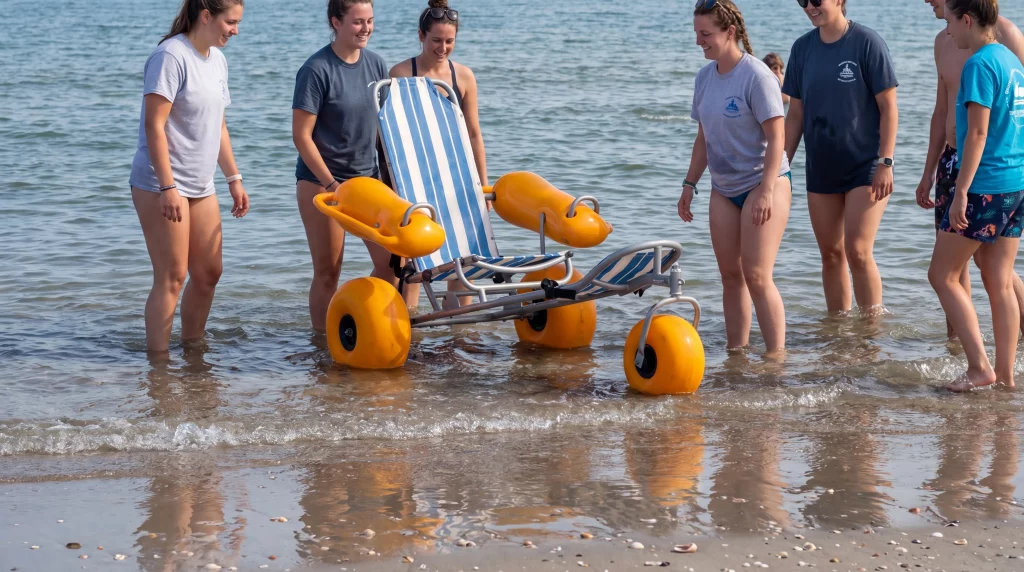
The floats on a floating beach wheelchair are made buoyant by using sealed, air-filled polyethylene chambers integrated directly into the side armrests. These high-visibility orange pontoons provide the primary upward lift when the chair transitions into deep water.
Why are orange armrests used?
The bright orange color of the flotation chambers acts as a powerful visual safety indicator for lifeguards and attendants. In a busy coastal environment, keeping a clear eye on vulnerable swimmers is extremely key.
- Next, High visibility: Staff can spot the chair from hundreds of yards away.
- In practice, Waterline tracking: The color helps monitor the exact depth of the chair.
- For example, Safety zone marking: Other swimmers can with less effort see and avoid the chair.
How is lateral stability maintained?
Wide side floats may support lateral stability within the model’s documented conditions. They do not remove the need for user-fit checks, close supervision, and stop rules.
| Float Feature | Design Purpose | Safety Effect |
|---|---|---|
| Polyethylene Shell | Resists puncture and wear | Prevents sudden water leakage |
| Wide Side Positioning | improves lateral buoyancy | Resists side-to-side rolling |
| Air-Sealed Chambers | Constant flotation capacity | Eliminates the need to inflate |
Examining these flotation parameters explains why dual-chamber armrests are standard in professional maritime mobility.
Key Takeaway: Dual side floats may support lateral stability and visibility within the model’s documented conditions.
How do tires support a floating beach wheelchair on sand?
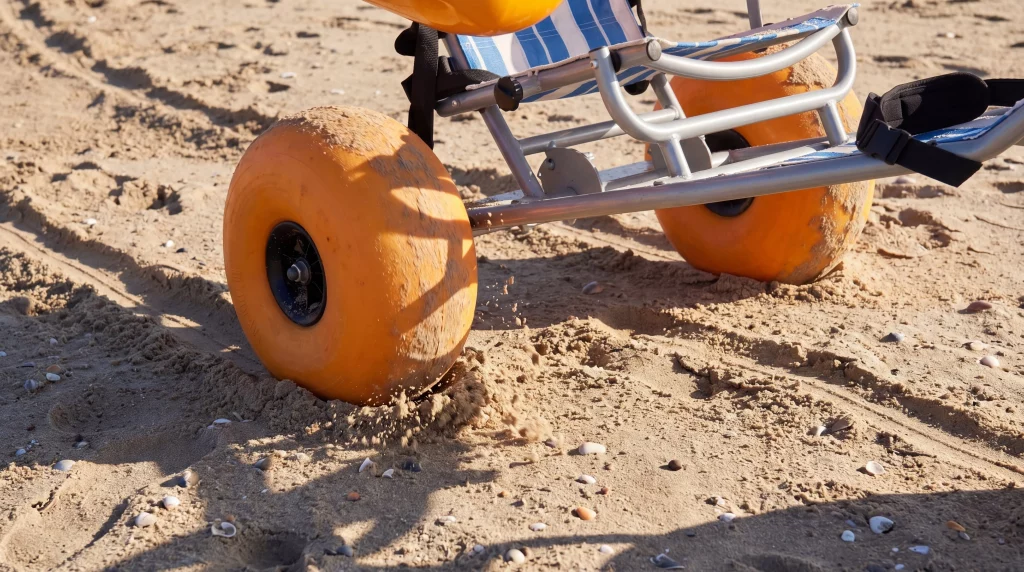
Large low-pressure balloon tires support a floating beach wheelchair on soft sand by distributing the system’s weight over a broad surface area to prevent sinking. This cushioning effect also absorbs the bumps of uneven terrain, giving the passenger a much smoother ride.
What is low ground pressure?
Low ground pressure means the weight of the passenger is spread out so wide that the sand behaves like a firm road. When a tire is inflated to a very low pressure, its footprint expands materially.
- Also, No sinking: The wheels sit on top of the sand rather than sinking.
- Next, Low rolling resistance: Pushing the chair requires far less physical effort.
- In practice, Improved traction: The tires grip loose pebbles and dry sand with less effort.
Why do three balloon wheels float?
These specialized balloon tires are filled with air, which adds to the general buoyancy of the chair once it enters deep water. Believe it or not: the high volume of air inside the tires provides secondary flotation that helps the main armrest chambers.
| Review Area | Practical Guidance | Operational Note |
|---|---|---|
| Tire setup | Use the manufacturer-approved low-pressure setting | Confirm against the model manual |
| Surface check | Review slope, firmness, debris, and access route | Confirm against the model manual |
| Staff effort | Use trained attendants and pause if control declines | Confirm against the model manual |
Evaluating tire performance highlights how low-pressure wheels solve the dual challenges of sand mobility and water entry.
Key Takeaway: Low-pressure balloon wheels prevent the chair from sinking in sand while providing additional buoyant lift once in shallow water.
Why does a floating beach wheelchair need a secure restraint?
A floating beach wheelchair needs a secure restraint to keep the passenger safely positioned in the center of the seat, preventing accidental slips in moving water. When entering the surf, gentle waves can cause sudden shifts in posture that might compromise passenger balance.
How does the restraint buckle work?
A quick-release chest buckle provides a secure latch that remains closed during motion but can be opened instantly in an emergency. This balance between security and quick escape is necessary for any water-based mobility device.
- For example, Salt-resistant polymer: The plastic buckle will not rust or jam from sand.
- Also, Two-point release: The buckle prevents accidental release from bumps.
- Next, Easy operation: Attendants can open the clasp with one quick hand movement.
What material is the webbing?
The restraint is made of high-strength, water-resistant woven polyester that dries quickly and resists rot. Keep this in mind: marine environments expose fabrics to UV rays, salt, and constant moisture, which can degrade standard materials.
| restraint Component | Material Used | Safety Benefit |
|---|---|---|
| Main Chest Strap | Woven commercial-use polyester | Keeps torso secure in wave movement |
| Quick-Release Buckle | Corrosion-free polymer | Allows instant egress if necessary |
| Adjustable Sliders | Marine-grade steel or plastic | Customizes fit for different body sizes |
Reviewing restraint engineering shows how passenger restraint systems protect vulnerable users in dynamic marine conditions.
Key Takeaway: A reliable restraint keeps the passenger centered and secure, mitigating risks from water movement and low muscle control.
Can a floating beach wheelchair handle dry, soft sand?
A compatible model may cross dry, soft sand when its tires, load, route, slope, and attendant method fit the site. Test the exact chair on the intended route before service.
Why is the aluminum frame so light?
A lightweight aluminum frame is used to make pushing easy while keeping the chair durable enough for coastal environments. Aluminum offers an excellent strength-to-weight ratio, helping maintain the frame does not bend under passenger weight.
- In practice, Less physical effort: Attendants do not struggle to push on soft sand dunes.
- For example, Easy lifting: Staff can load and unload the chair with less effort from transport vehicles.
- Also, Corrosion resistance: The aluminum alloy resists saltwater rust by design.
How do low-pressure tires absorb shocks?
The soft rubber of low-pressure wheels acts as a natural suspension system, cushioning the passenger over bumpy shorelines. For rough surfaces: these tires absorb the impact of shells, rocks, and sand ridges instead of passing the shocks to the seat.
| Terrain Type | Wheel Response | Attendant Effort Level |
|---|---|---|
| Dry, Powdery Sand | Tires flatten and glide | Low to Moderate |
| Wet Shoreline Sand | Tires roll firmly on surface | Very Low |
| Shallow Tidal Surf | Tires float and roll | Low |
Understanding how the chassis and tires respond to diverse beach surfaces helps resort operators plan safe pathways.
Key Takeaway: Lightweight frames and balloon tires make dry, soft sand easy to navigate, preventing fatigue for the assisting attendant.
Who must supervise a floating beach wheelchair in the water?
A capable attendant whose training matches the site and activity should supervise a floating beach wheelchair throughout approved water entry and flotation. This specialized equipment is not designed for independent operation, and an assistant must remain in physical control of the chair.
What are the main attendant duties?
The attendant serves as the physical link between the passenger and a safe aquatic experience. They must stay alert to environmental shifts and passenger comfort throughout the entire water session.
- Next, Depth monitoring: Keeping the chair within designated shallow water limits.
- In practice, Directional control: Steering the chair gently against oncoming waves.
- For example, Egress support: Assisting the passenger during entry and exit from the seat.
Why is training necessary for staff?
Proper training makes sure beach staff understand flotation mechanics and water safety protocols. For staff training: an untrained attendant might push the chair into deep water or lose grip of the handle during a wave.
| Staff Role | Key Operational Task | Critical Safety Focus |
|---|---|---|
| Trained Attendant | Controls push handle | Maintains firm contact with bottom |
| Beach Lifeguard | Monitors general area | Watches for sudden tidal currents |
| Resort Manager | Inspects equipment daily | Validates staff training logs |
A documented attendant role remains a required control for this operating approach.
Key Takeaway: A documented supervision plan defines control contact, stop rules, communication, and the exit route; it does not remove water risk.
Where can you operate a floating beach wheelchair safely?
Protected environments like beachfront lagoons, quiet lakes, hotel swimming pools, and designated wading zones are the best spots. Avoid areas with strong rip currents, high waves, or steep drop-offs that could undermine stability. The Padre Island beach wheelchair guidance is one example of a site publishing its own device and route limits.
What water conditions are safe?
Safe water conditions are characterized by calm surfaces, clear visibility, and gentle slopes. When the water is quiet, the floating chair behaves predictably and remains easy to control.
- Also, Minimal wave height: Waves should be under one foot for safety.
- Next, Gentle beach slope: The underwater transition must be gradual.
- In practice, Absence of currents: Avoid tidal rivers or rip-prone coastlines.
Why is deep water dangerous?
Deep water poses a risk because the assistant can lose their footing, making it difficult to control the chair. For the stop rule: if the attendant can no longer stand firmly on the seabed, they cannot steer or retrieve the chair with less effort.
| Review Area | Practical Guidance | Operational Note | Operational Note |
|---|---|---|---|
| Water conditions | Use only calm, controlled, designated zones | Confirm against the model manual | Confirm against the model manual |
| User fit | Confirm the model instructions and restraint adjustment | Confirm against the model manual | Confirm against the model manual |
| Attendant control | Maintain hands-on supervision throughout use | Confirm against the model manual | Confirm against the model manual |
Examining these depth zones clarifies how water depth directly impacts the physical control of the equipment.
Key Takeaway: Limiting operations to calm, shallow waters helps maintain that attendants maintain solid footing, keeping passengers safe.
How do you inspect a floating beach wheelchair before use?
You inspect a floating beach wheelchair before use by conducting a quick visual and physical check of the tire pressure, restraint connections, weld joints, and flotation armrests. Spending a few minutes checking these core components before every session prevents mechanical issues in the surf. Keep the user manual resource beside the checklist for the exact model.
What is the tire pressure check?
Checking tire pressure makes sure the balloon wheels have the correct flexibility to roll over sand and float in water.
- For example, Tread flexibility: Tires should feel soft and yield slightly to hand pressure.
- Also, Valve seal: Verify that the air valves are tightly capped.
- Next, Balanced inflation: Make sure all three wheels have equal air pressure.
How do you check flotation chambers?
Checking the side armrests confirms that the sealed chambers have no cracks or leaks that could compromise buoyancy. For float inspection: even a tiny hairline fracture can allow water to slowly seep into the pontoon over time.
| Review Area | Practical Guidance | Operational Note |
|---|---|---|
| Water conditions | Use only calm, controlled, designated zones | Confirm against the model manual |
| User fit | Confirm the model instructions and restraint adjustment | Confirm against the model manual |
| Attendant control | Maintain hands-on supervision throughout use | Confirm against the model manual |
Following this checklist helps maintain that every component is functionally prepared for saltwater exposure.
Key Takeaway: A brief, structured pre-use inspection catches wear early, protecting passenger safety and extending equipment lifespan.
Does a floating beach wheelchair have a reliable footrest?
Yes, a high-quality floating beach wheelchair features a built-in, marine-grade aluminum footrest that keeps the passenger’s legs securely supported during transport and water entry. This rigid, non-slip plate prevents the user’s feet from dangling or dragging in the sand. Use the supplier overview to prepare model-specific questions about fit, inspection, and replacement parts.
Why is foot support critical?
Proper foot support prevents lower limb injuries and helps the passenger maintain a stable, relaxed posture. What matters next? keeping the feet elevated reduces drag when rolling through shallow water.
- In practice, No dragging: The plate holds feet safely above sand and waves.
- For example, Comfortable angles: The footrest promotes natural joint positioning.
- Also, Easy transfers: The solid plate provides a clear step for entry.
Key Takeaway: Built-in aluminum footrests complete the protective layout of the chair, keeping passenger limbs safe during entry, transit, and floating.
| Launch Priority | Practical Action |
|---|---|
| Product fit | Confirm user needs, route, and water conditions |
| Staff readiness | Train attendants and document stop rules |
| Long-term care | Plan rinsing, inspection, and secure storage |
This final check connects procurement decisions with reliable daily operations.
Frequently Asked Questions
Can I use a floating beach wheelchair without a trained assistant? No, not under this operating approach; follow the model and facility procedure. The attendant should maintain the control required by the model and site procedure while monitoring depth and conditions.
What is the best way to clean the chair after saltwater use? A thorough freshwater rinse is highly recommended. Rinsing off salt crystals and sand prevents corrosion and protects the frame joints and bearing assemblies over time.
How do I store the wheelchair during the winter or off-season? Store the chair in a clean, dry, covered storage area. Disassemble the modular frame parts if space is limited, and verify that all fabric slings are directly dry to prevent mold.
Can the balloon tires puncture on sharp shells or gravel paths? Inspect tires before use and keep the route within the model limits. Remove the chair from service when cuts, deformation, pressure loss, or embedded debris appear.