
When a volunteer finds a lifted edge on a beach mat, the operator needs to know which edge, what has changed and whether people are approaching it or already using the route beyond it. “The mat needs attention” leaves another team searching the whole beach. A short, well-located report lets the duty lead protect the affected stretch and send the right person to inspect it.
Before taking a volunteer shift
Walk the assigned section with the site operator. Agree on names a person can recognise from either end, such as “west ramp,” “first connection on sand” or “viewing bay.” Ask who is on duty, how to reach them, which actions volunteers are authorised to take and who will respond if that person is unavailable. Carry the actual local emergency contact and location instructions.
Look at the type of mat installed. On a modular path, a junction between sections is a useful reference. On a roll system, use an identifiable end, joint or adjacent landmark. Have the operator show where the approved mat should meet the hard approach and what its normal edges look like. Any securing hardware and permitted adjustments depend on the actual system and the site. The supplier’s description of an interlocking product illustrates why model-specific component details matter. Beach access mat construction and care
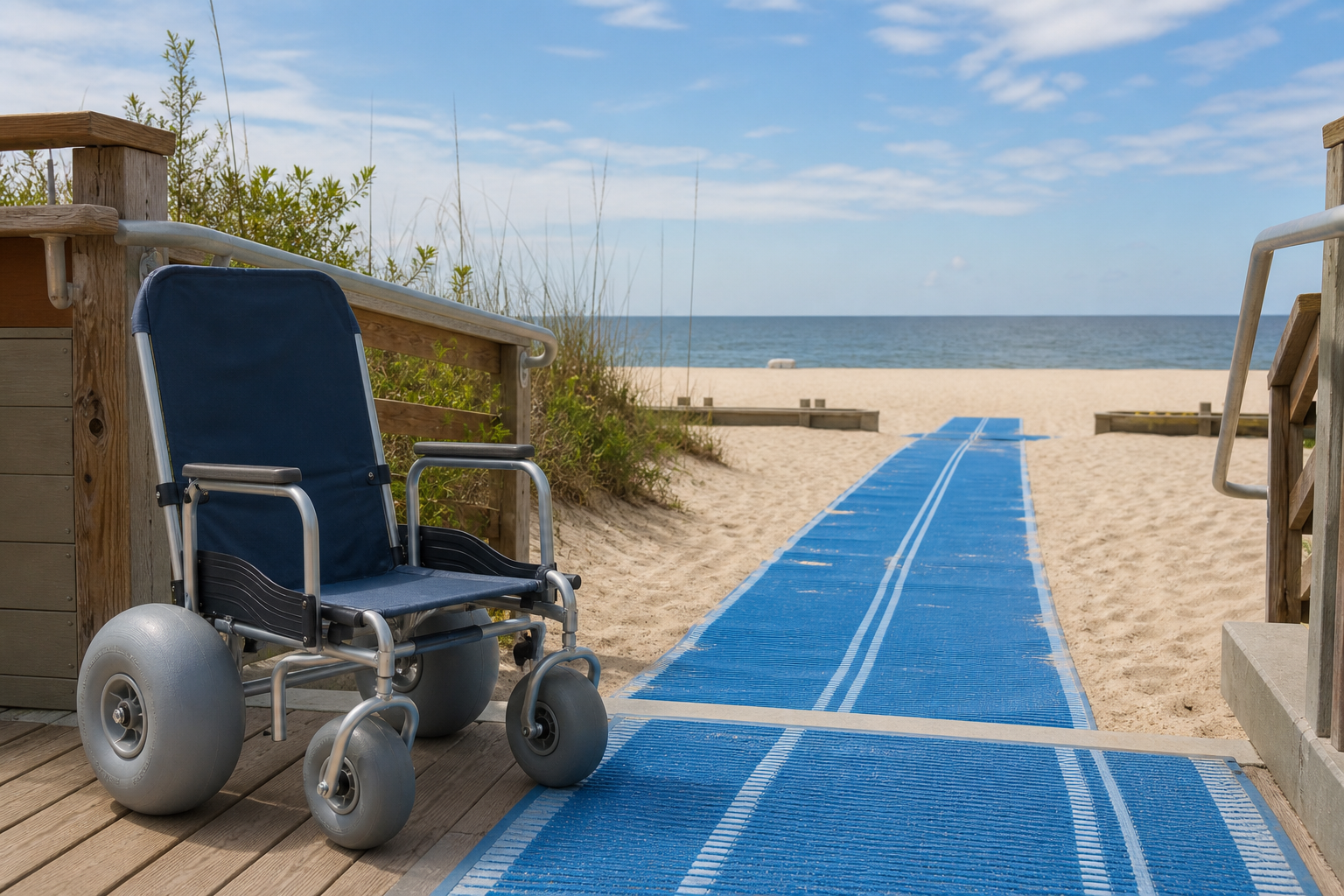
Report what you can see from a suitable position
Record the entrance, direction of travel, location, time and visible condition. If appropriate under site policy, take one wider photograph to establish location and a close view of the affected part. Keep visitors and personal details out of the photograph wherever possible. Do not ask a wheelchair user to recreate a wheel catch or cross a suspect connection to prove the defect.
| Useful observation | Detail that helps the operator find it |
|---|---|
| Two mat sections no longer meet evenly | Identify the section, which side is raised and whether the change is visible from the return direction. |
| Sand has moved away below an edge | Describe where the exposed gap starts and whether the adjacent surface appears unsupported. Leave the diagnosis to the maintainer. |
| Loose sand or litter hides part of the surface | Identify the location, extent and visibility of the next connection. Say if the approved path past it is unclear. |
| Equipment, a gate or a temporary barrier blocks the route | Name the obstruction and the last confirmed place where people can turn back. |
Here is an illustrative radio report: “West ramp, first joint on sand, left edge when returning toward the car park. At 10:10 this morning the edge was raised and sand was missing underneath. Two visitors are beyond it. Please advise on their return. I can meet the route lead at the ramp.”
Hand the decision to the operating team
If someone may be in immediate danger, follow the agreed emergency or closure procedure and contact the operator promptly. Use only the protective measures assigned in the shift briefing. Tell the duty lead when people are already beyond the reported defect so their return can be addressed.
A volunteer who is authorised to observe and report has not thereby been trained to re-anchor a mat, replace a connector or release a repaired route. Avoid lifting panels to investigate an unseen fault. The maintenance team can inspect the mat and supporting ground under the approved procedure. The operator decides which stretch can reopen and updates visitor information. Facility manager’s inspection and repair guide
Find out what happened to the report
Before finishing the shift, confirm who received the message and what information may be given to the next visitor. An acknowledgement such as “maintenance is on its way” means the report was received. Wait for the operator’s confirmed route status before describing the section as open.
A coastal group can help identify patterns across shifts. If several volunteers report sand loss at the same ramp after wind changes, pass the dated locations and observations to the facility lead together. If visitors repeatedly mention a difficult return turn, record their comments separately from what volunteers observed. Those are useful inputs to a site review. They do not establish a repair method or a reason to expand the route. Groups still choosing and funding their first site can use the separate nonprofit beach mat project guide.