
A guide can be ready to meet a traveler, describe the route and call the equipment lead without being qualified to release a wheelchair after repair or supervise an activity in water. Start training with the duties the guide will actually perform. Identify who takes over when the guest’s request or a fault falls outside those duties.
Teach the booking and the equipment together
Give the trainee a sample booking for an assisted land outing and the corresponding empty chair. Ask them to find the model and unit number, locate the current instructions and show where the handoff takes place. They should be able to explain the destination, last usable surface, return meeting point and assistance actually arranged. Ask them to deliver the explanation to a colleague playing the guest and invite that person to ask about a different destination.
On the AY-ST-V3.0, guides may encounter a folding frame, flip-back armrests, flip-up pedals and different front and rear inflatable wheels. The manufacturer lists a net weight of 13 kg. Staff assigned to empty-equipment handling need instruction on the correct configuration and locally approved handling arrangements. Practise with the designated cargo vehicle, its opening, luggage and load restraint. A published net weight cannot determine a one-person lift or vehicle fit. The guest has separate passenger transport arrangements. AY-ST-V3.0 manufacturer manual
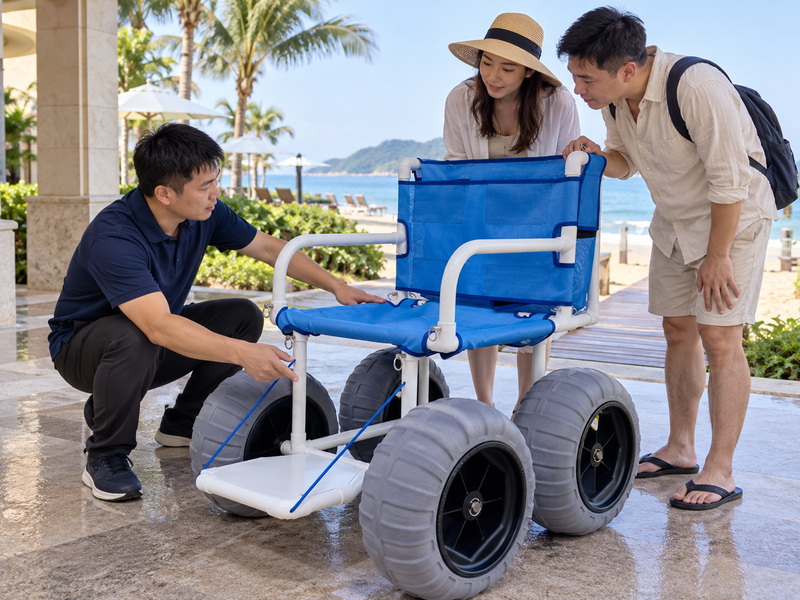
Observe each role at a realistic handoff
| Role to train | What a supervisor observes |
|---|---|
| Guest-facing guide | Identifies the booked unit, asks about preferences, gives precise directions and checks the traveler knows whom to contact for an early return. |
| Authorized equipment checker | Completes the prescribed checks on the identified empty chair, records any defect and keeps a held unit out of the booking. A guide performs this role only when separately trained and assigned. |
| Transport or logistics worker | Demonstrates the agreed empty-chair loading, custody and receiving arrangement with the actual vehicle. |
| Shore activity lead | Makes the local decision about any supervised water activity using the appropriate model, personnel, conditions and return arrangements. |
Ask the group to practise a change after pickup. For example, a guest holding a land-chair booking asks the guide to go past the approved dry stopping point into the water. The guide identifies the land model, pauses at the agreed point and offers to contact the shore provider about the separate request. No guide should infer permission from a guest’s enthusiasm or from seeing another model used at that beach. The V1 floating chair manual describes a different product for calm water.
Record the task someone demonstrated
For each observed task, note the trainee, unit and revision, setting, supervising person and duty the person may now perform. If a trainee can complete the guest briefing but cannot identify the correct wheel fixing on the empty equipment, assign the briefing and retain equipment release with a qualified checker. Give the trainee a specific practice task and another observed opportunity.
When a vehicle, equipment revision or local partner changes, revisit the affected demonstration. A new vehicle may change loading and unloading while leaving the guide’s guest briefing largely intact. Give the next shift a list of actual cover and contacts. During a tour, someone should be able to find the right person without asking the guest to diagnose the problem.