
Before buying a second beach wheelchair for a busy itinerary, find out which guests did not get the service they requested and why. A chair can spend the day at the hotel while the booked shuttle has no space for it. Counting that as a shortage of chairs sends the next investment to the wrong place.
Follow one request through to handback
Give each traveler request a reference, the equipment or support requested, the destination and local time. Record whether the operator confirmed it, whether the agreed configuration reached the traveler at the agreed place and whether the outing and return took place. If the guest accepted a shorter route or an alternative chair, record the agreed change and the actual outcome. A request for two units at the same time needs an explicit quantity even if one person made the booking.
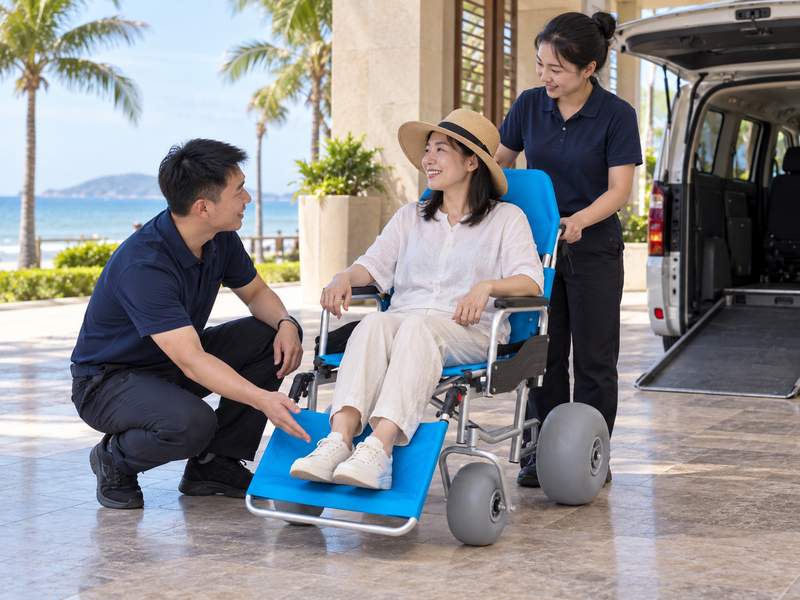
Keep physically serviceable equipment separate from equipment ready to dispatch to this itinerary. For example, the AY-ST-V3.0 is a folding land chair with a listed net weight of 13 kg. The driver still needs a verified loading path and space for the actual folded empty chair alongside the trip’s luggage. If the rostered vehicle cannot carry it, record a transport constraint. The chair might be available for another local route. Manufacturer’s V3.0 specifications
Read a worked week without losing the missed requests
Suppose twelve distinct requests for one land chair each fall within the same reporting week. Ten receive confirmed slots. Eight guests receive the agreed chair at the meeting point on time, one gets it late and one confirmed request cannot be served. The two requests without confirmed slots remain visible as unmet demand.
| What management wants to know | Result in this example |
|---|---|
| What share of requests could the operator confirm? | 10 of 12, about 83%. The two unconfirmed requests need reasons. |
| How reliably did confirmed bookings get the agreed on-time handoff? | 8 of 10, or 80%. The late handoff counts as late even if the traveler completed the outing. |
| How many chairs actually reached a confirmed guest? | 9 of 10. An on-time count alone would hide the late but completed delivery. |
| How much scheduled equipment time was mechanically serviceable? | If two units were each scheduled for 20 hours and one spent five hours on repair hold, 35 of 40 chair-hours were serviceable, or 87.5%. |
A handoff to the traveler establishes delivery, not completion of the return trip. Record that separately against the time and place agreed with the guest. Ask whether the destination and support matched what had been described. Allow free-text feedback as well as a count of returned chairs.
Decide which failure a change would prevent
Separate vehicle capacity, staffing, equipment faults and site closures when explaining missed service. Link a fault to the backup equipment plan. For a delayed vehicle, check the delivery and collection record before attributing the failure to the equipment provider. If a guest declined because the marketed endpoint differed from the actual route, give that case to the person maintaining the tour listing.
At the end of the period, compare matching time blocks and keep the original counts alongside any percentages. A new chair could help when suitable units were already in use. A missed handoff caused by a locked loading entrance calls for a different change. Assign the action and look for that same cause in the next comparable period.