The best beach wheelchair for your 2026 vacation is the model that fits your terrain, water plans, transfers, and transport. The eight types below cover the most common travel and facility needs, from a folding manual chair to a managed rental fleet.
You arrive at the coast, follow the boardwalk to the sand, and then the wheels stop dead. A chair that looked capable online can still be too bulky for your car, unstable at a surface change, or wrong for the water; matching the design to your actual route prevents arrival day from becoming a string of workarounds.
Which Beach Wheelchair Fits Your 2026 Trip?
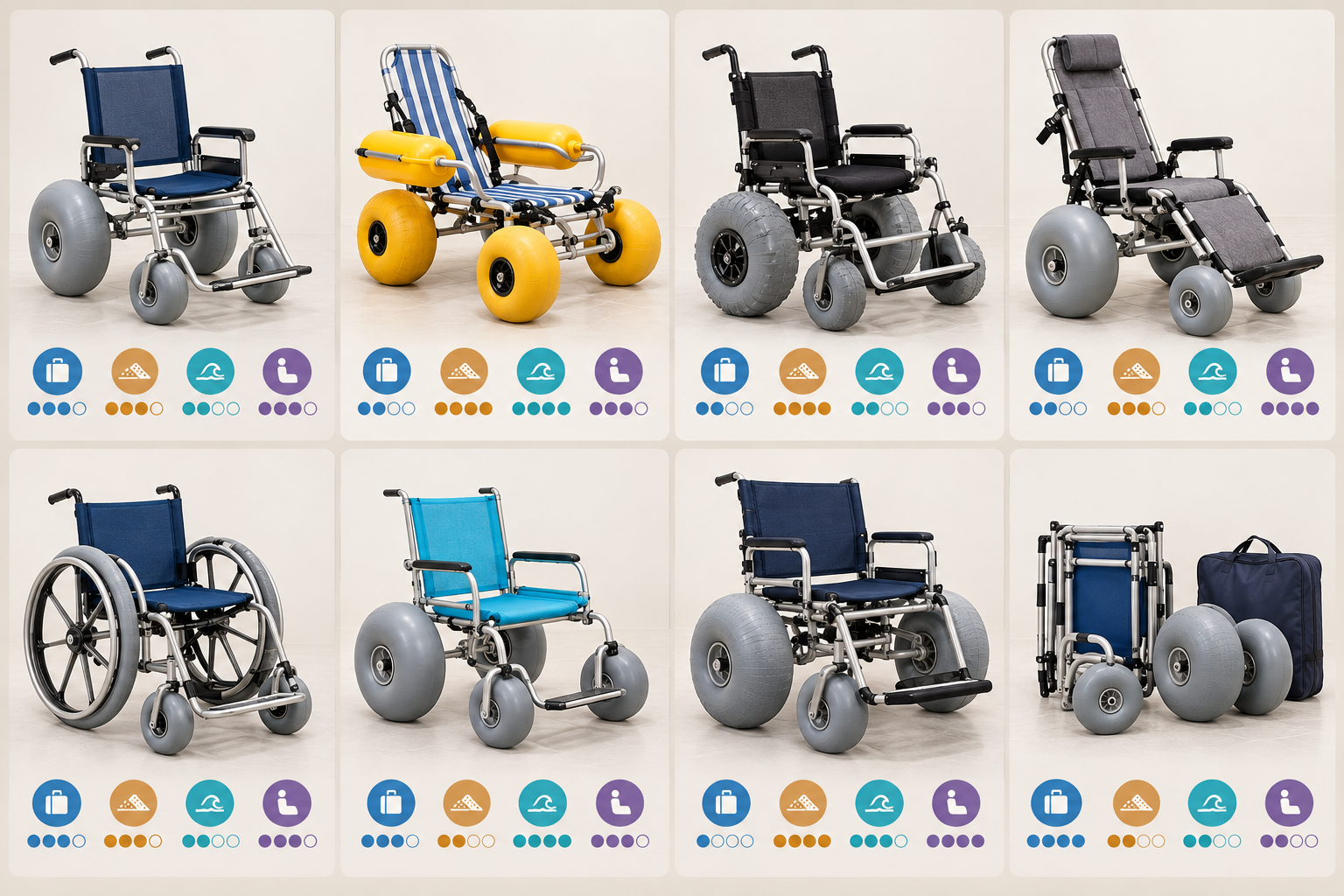
The right beach wheelchair matches your route, transfer method, body support, transport space, and available help. Start with the hardest part of the day—deep sand, a boardwalk drop, a pool ramp, or vehicle loading—because that limit will narrow the field faster than a long feature list. Then confirm the selected chair’s published capacity and operating instructions for the person who will use it.
What should you check before choosing?
Start with the route: Walk or call ahead about parking, curb cuts, surface changes, slope, tide line, and storage. Ask who will push, assemble, clean, or supervise the chair, since a good fit for an attended resort may be a poor fit for an independent traveler.
- Map every surface from the vehicle to the water.
- Confirm transfer height, belt position, and foot support.
- Check cargo dimensions and the weight of each removable part.
| Trip factor | Best starting point |
|---|---|
| Mostly soft sand | Wide balloon tires |
| Planned water entry | Purpose-built floating model |
| Frequent car loading | Folding or knock-down frame |
| Longer seated periods | Added posture and leg support |
Terrain covers one part of the buying decision. Key Takeaway: You get a shorter, safer shortlist when you define the route, transfer, support, and transport limits before comparing models.
Which Lightweight Beach Wheelchair Travels Easiest?
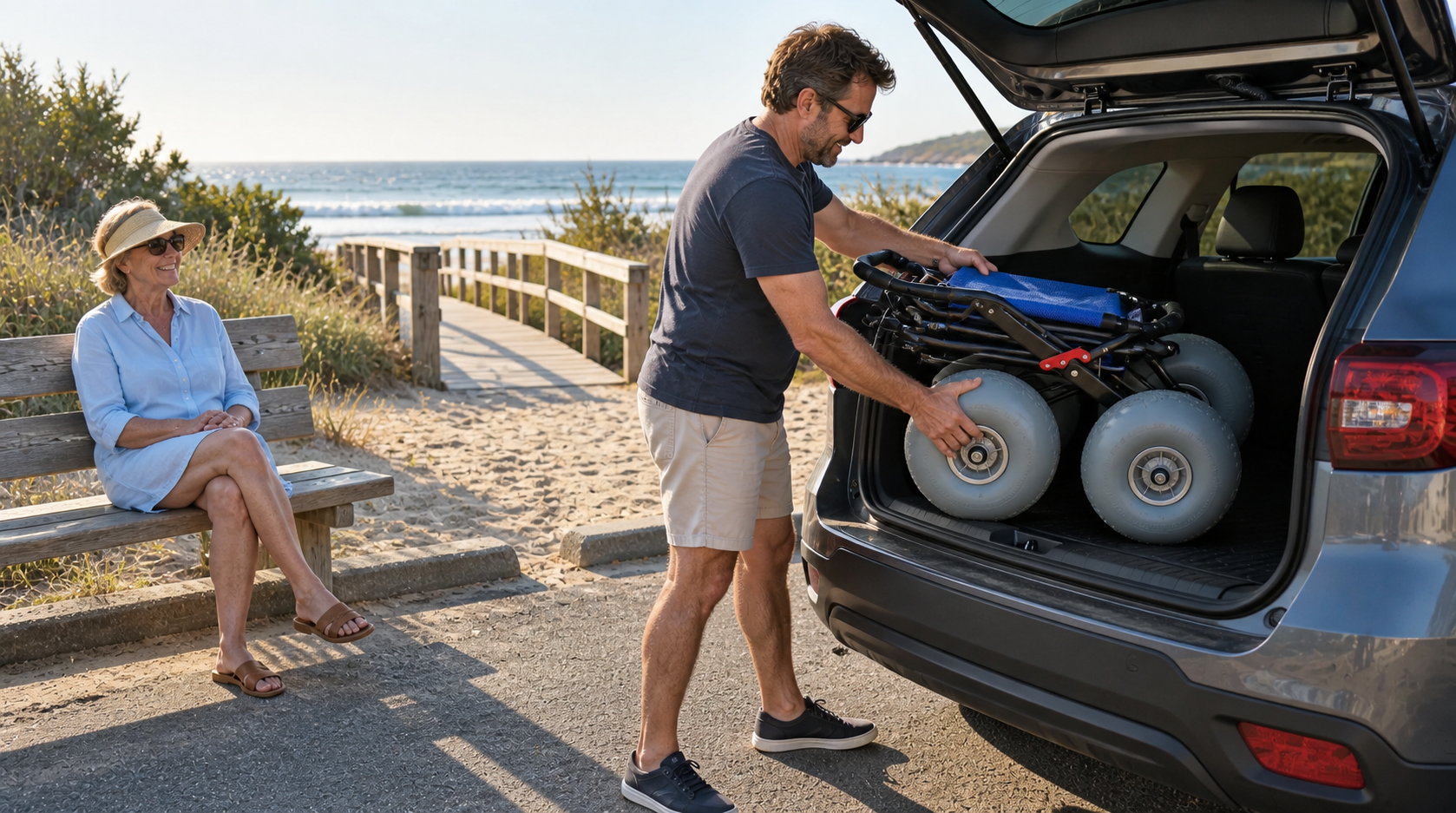
A folding manual beach wheelchair is usually the easiest option for road trips and short hotel stays. A compact frame can fit behind a rear seat or inside a small cargo area; use the heaviest removable component as the practical measure of “lightweight.” Check how many parts detach and whether you can rebuild the chair without placing hardware in the sand.
Can you load it without turning the trip into a chore?
Test the handoff: Practice folding, lifting, and reassembly at home before you leave. A visit to the lightweight beach wheelchair page can help you compare a compact travel frame with larger resort-style designs.
- Measure the cargo opening, not only the floor area.
- Put loose pins and straps in one marked pouch.
- Recheck wheel locks and quick-release axles after assembly.
| Travel question | Better sign |
|---|---|
| One-person loading | Manageable heaviest component |
| Tight cargo space | Flat fold or removable wheels |
| Repeated setup | Tool-free, obvious connections |
| Hotel storage | Clean, stable folded footprint |
The best travel design is the one you can handle at both ends of the drive. Key Takeaway: You avoid strained lifts and missing parts when you judge the loading sequence as carefully as the ride on sand.
Which Floating Beach Wheelchair Works Best Near Water?
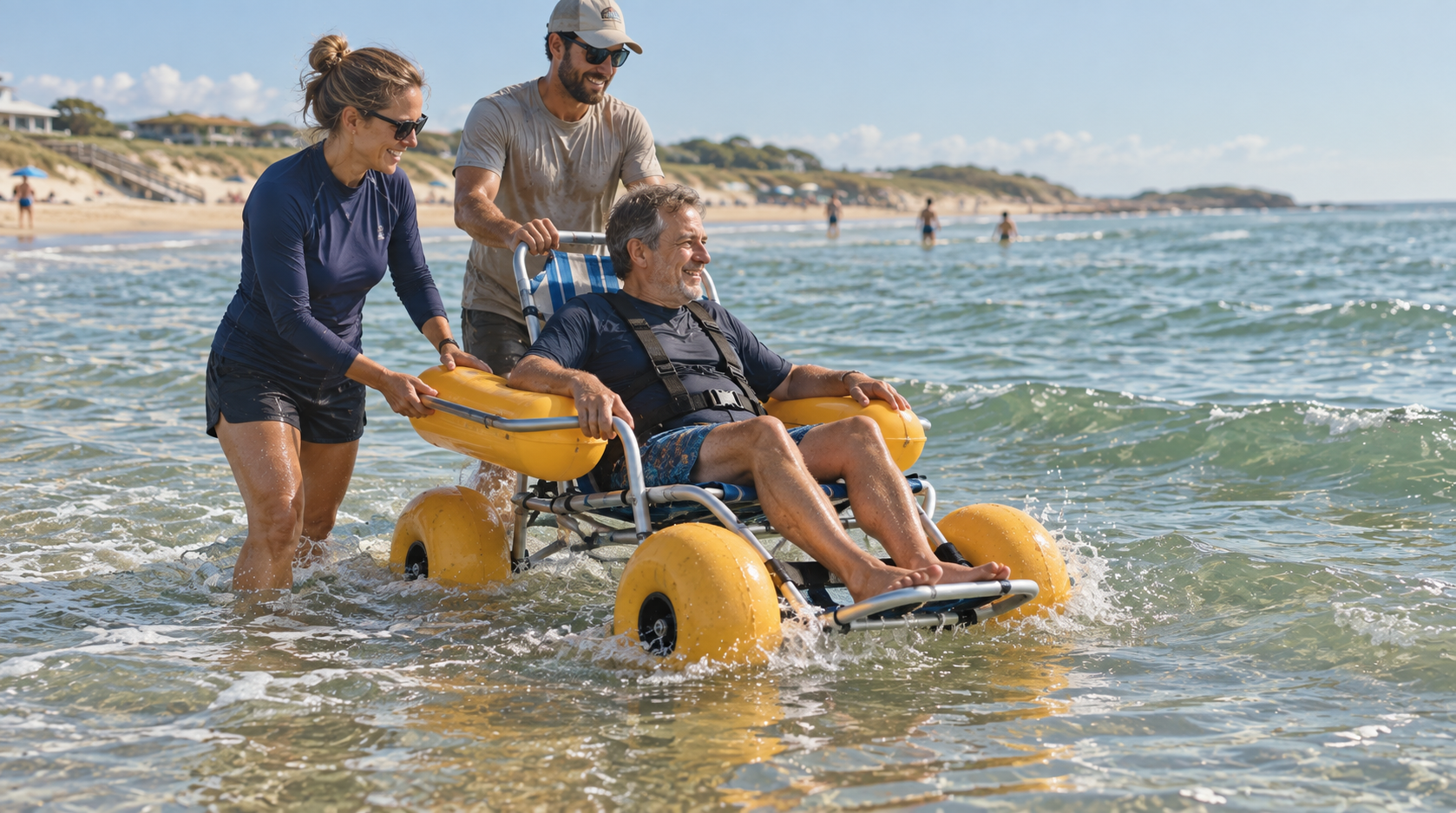
A purpose-built floating beach wheelchair works best for supervised entry into calm, shallow water when local rules and the maker’s instructions allow it. Large buoyant wheels and side floats can support water access, but they do not turn rough surf into a controlled setting. The user still needs a fitted belt, clear transfer plan, attentive adult helpers, and a prompt exit when wind, waves, or tide change.
How do you plan a safer water entry?
Draw the boundary: Decide in advance where the chair may go, who holds each point on the frame, and which conditions end the session. For a U.S. beach, check NOAA tide predictions before you set an exit time. Conditions at the site still decide whether to enter. Resort operators can also review a floating wheelchair resort setup when planning staff roles and equipment storage.
- Use only the water depth and conditions allowed by the maker.
- Keep trained adult attendants within reach of the chair.
- Rinse salt and sand away after every water session.
| Water-use factor | Practical response |
|---|---|
| Calm shallows | Controlled entry with attendants |
| Breaking surf | Stay out of the water |
| Changing tide | Set an early exit point |
| Salt exposure | Fresh-water rinse and dry storage |
Conditions and supervision set the limits for water access. Key Takeaway: You protect the user and the equipment when you set a firm operating boundary before the chair reaches the shoreline.
Which All-Terrain Beach Wheelchair Handles Mixed Ground?
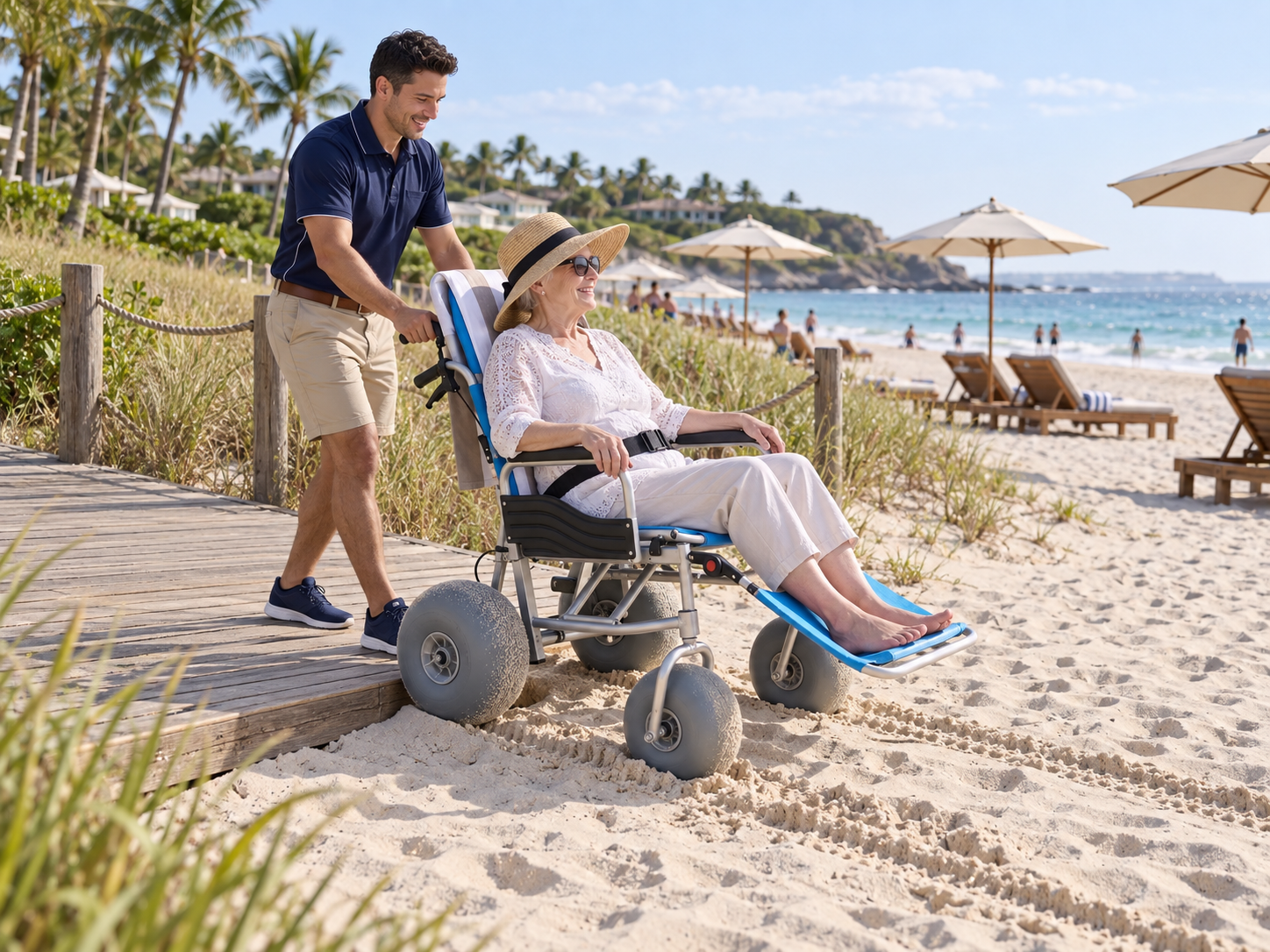
An all-terrain beach wheelchair with wide balloon tires and a stable frame is the better fit for routes that mix boardwalks, packed paths, grass, and soft sand. The trouble spot is often the surface junction rather than the open beach: a lip, gap, or sharp turn can demand more control than a straight sand track. Look at turning space, push-handle height, front-wheel behavior, and the user’s position when the chair changes surface.
Where will mixed-ground performance be tested most?
Watch the surface change: Inspect the steepest ramp and roughest edge before the user arrives. If the front wheels tend to dig in, the operator needs the correct technique from the chair manual and enough space to approach squarely.
- Note boardwalk gaps, drop-offs, loose gravel, and cross slopes.
- Keep bags off the push handles so steering stays predictable.
- Use another adult spotter where the route narrows or drops.
| Route section | What to inspect |
|---|---|
| Boardwalk edge | Lip height and approach room |
| Soft sand | Tire width and push effort |
| Packed path | Tracking and turning radius |
| Grass or gravel | Stability on uneven patches |
Mixed routes expose difficult surface junctions faster than straight sand travel. Key Takeaway: You reduce stalls and sudden tilts when you test the full route, especially the points where one surface meets another.
Which Reclining Beach Wheelchair Supports Longer Outings?
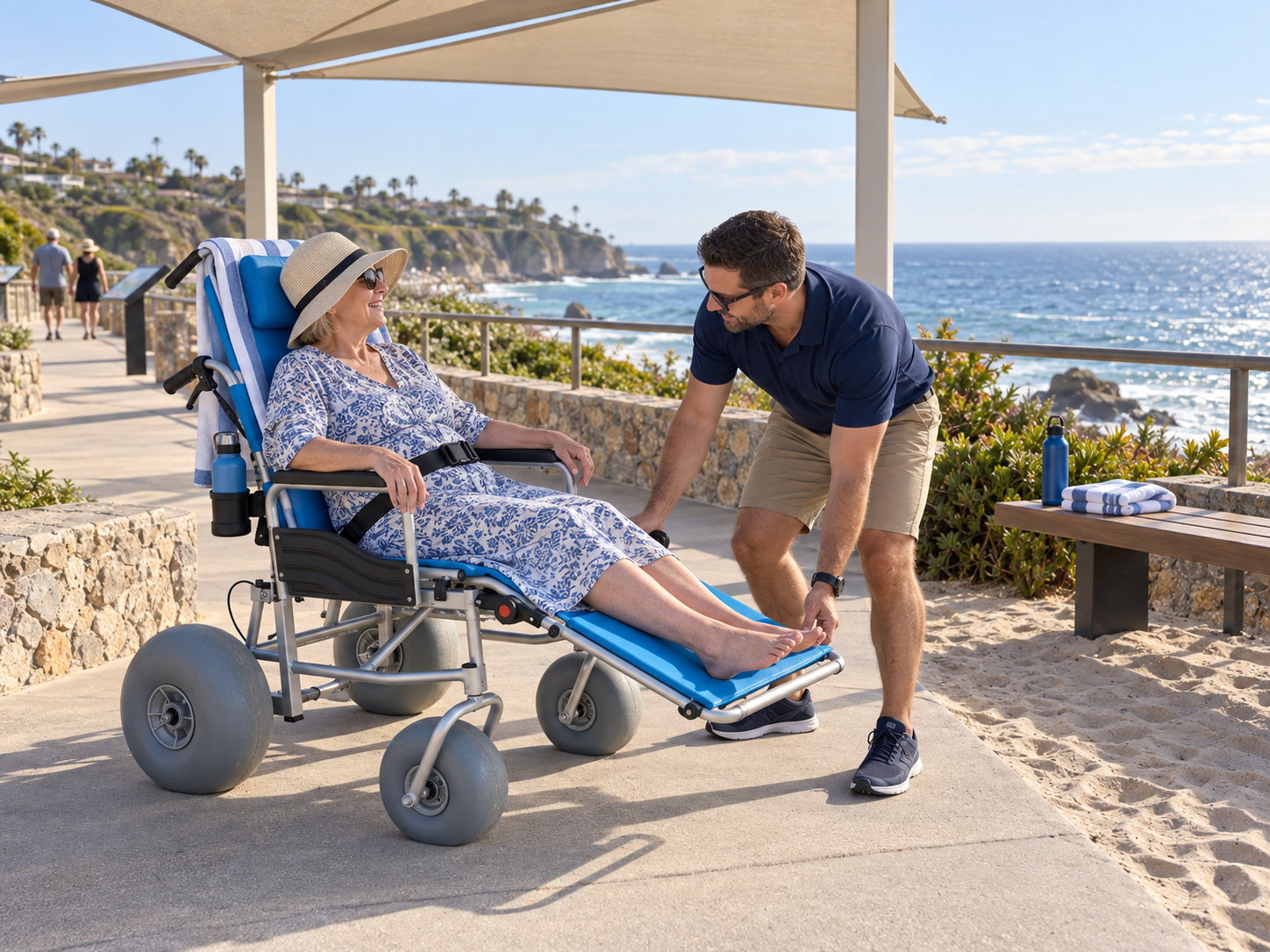
A reclining beach wheelchair is the stronger choice when the user needs added head, trunk, or leg support during a longer outing. Recline can change pressure, sightline, transfer method, and the chair’s balance, so the selected position must follow the maker’s instructions and the user’s care plan. Shade, hydration, skin checks, and planned breaks still matter even when the seat looks comfortable.
Which support details matter beyond the backrest?
Look at the whole posture: Head support, belt placement, arm support, foot position, and seat depth work as one system. The person’s clinician or seating specialist should guide any needs tied to posture, pressure, or medical conditions.
- Check that feet stay supported as the back angle changes.
- Keep belts flat and placed only as directed.
- Plan a shaded stop before fatigue or heat builds.
| Support area | Question to ask |
|---|---|
| Head and trunk | Is support stable at the chosen angle? |
| Legs and feet | Does the rest move with the recline? |
| Transfer | Can the planned method work at the beach? |
| Time outdoors | Are shade and breaks already scheduled? |
Recline helps only when the rest of the seating setup follows the user. Key Takeaway: You make a longer outing more manageable by pairing the chair’s support features with a personal seating and break plan.
Which Self-Propelled Beach Wheelchair Gives More Control?
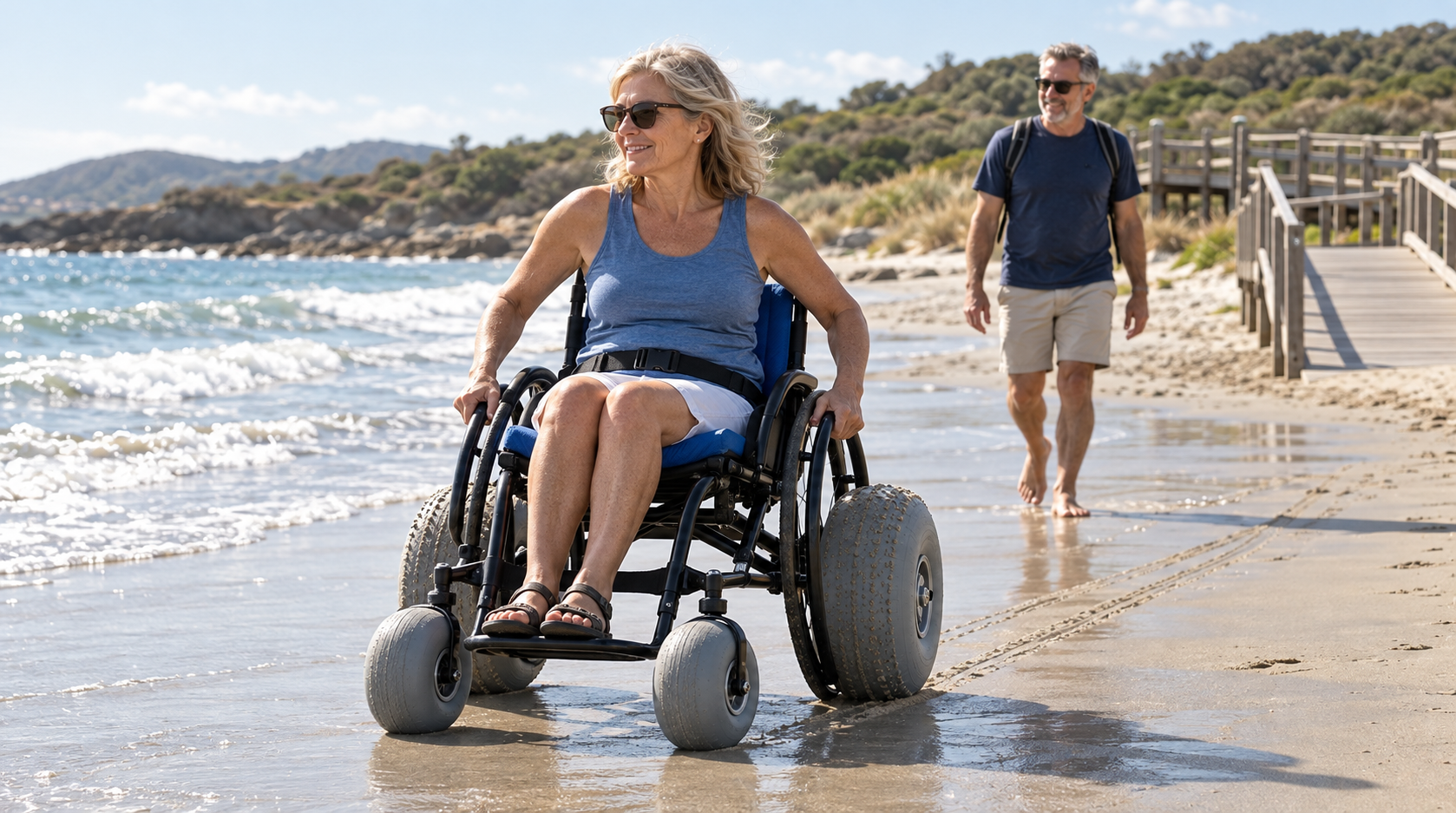
A self-propelled beach wheelchair gives more control to a user who can reach the hand rims, manage the rolling resistance, and travel on a suitable surface. Firm damp sand may allow steady movement, while deep dry sand can raise effort quickly and make steering harder. A push handle and nearby adult backup remain useful even when independent movement is the goal.
How do you judge real-world propulsion effort?
Try the return leg: A route that feels easy at the start may feel very different after sun, distance, or a surface change. Test reach, grip, braking, turning, and fatigue on a short controlled route before committing to a longer shoreline trip.
- Keep hands clear of tires and frame pinch points.
- Choose a turnaround point before effort rises sharply.
- Have a helper ready for slopes, loose sand, or fatigue.
| Propulsion factor | Lower-risk condition |
|---|---|
| Surface | Firm and level |
| Rim reach | Comfortable through the full stroke |
| Distance | Short route with a set turnaround |
| Backup | Adult helper within easy reach |
Independent control is useful only when the surface and distance stay within the user’s working range. Key Takeaway: You preserve choice without gambling on fatigue when you test the route and keep backup help close.
Which Poolside Beach Wheelchair Suits Wet Decks?
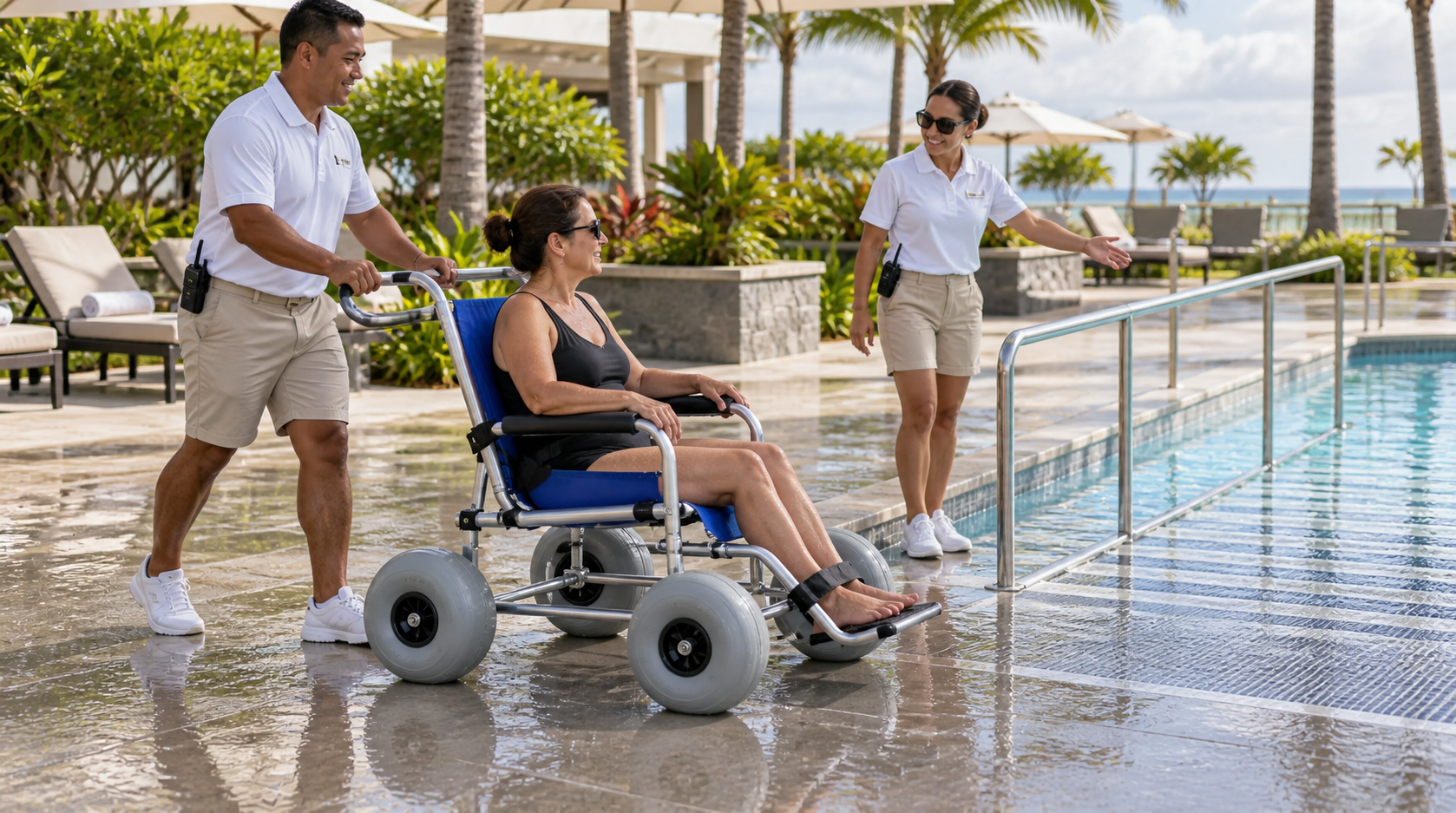
A corrosion-resistant beach wheelchair with quick-drain seating and a stable push configuration suits wet pool decks better than a sand-only chair. Wet surfaces add slip risk for both the user and staff, and pool chemicals can shorten the life of unprotected hardware. Confirm that the chair is approved for the planned deck or ramp use; a poolside label does not automatically permit immersion.
What should staff check around a pool ramp?
Clear the lane: Move loungers, towels, hoses, and service carts before the transfer begins. Staff need dry footwear with grip, a known turning point, and a rinse-and-dry routine that covers joints, belts, and wheel hubs.
- Follow the facility’s pool-ramp and transfer rules.
- Inspect brakes, belts, foot support, and tire condition.
- Rinse and dry the chair after chemical or salt exposure.
| Deck concern | Operating response |
|---|---|
| Wet tile | Slow route with clear footing |
| Tight ramp | Confirm width and turning room |
| Pool chemicals | Rinse hardware after use |
| Shared equipment | Clean and inspect between users |
Poolside access covers the route, staff technique, cleaning routine, and chair materials. Key Takeaway: You lower slip and maintenance problems when those four pieces are ready before each use.
Which Heavy-Duty Beach Wheelchair Fits Rental Fleets?
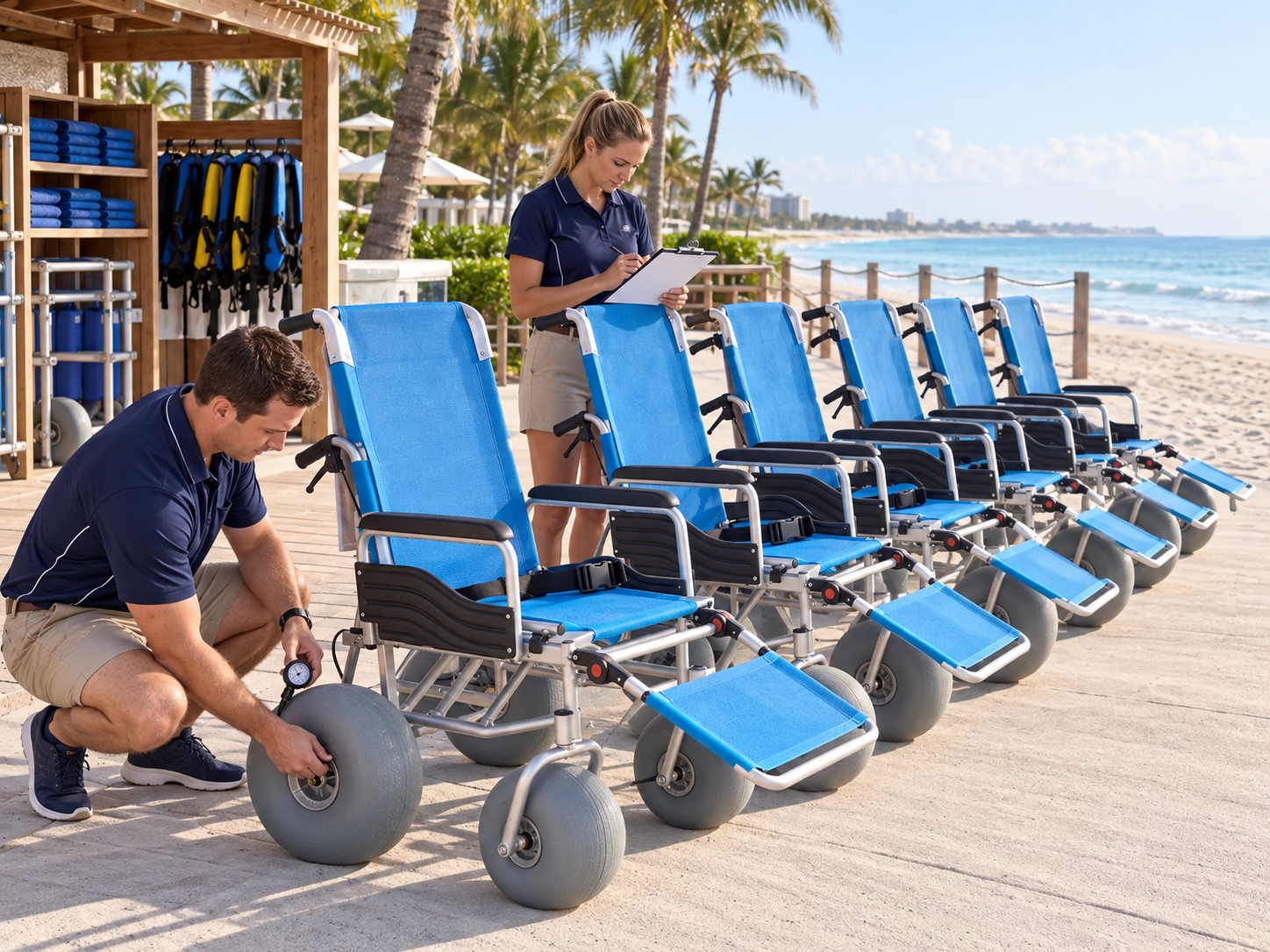
A heavy-duty beach wheelchair fits a rental fleet when its capacity range, replaceable wear parts, cleaning process, and staff training match daily demand. Fleet buyers should favor consistent controls and service parts across every unit because mixed designs complicate handoffs and inspections. The strongest-looking frame is not enough if belts, tires, hubs, or upholstery are hard to replace.
What makes a fleet practical after opening day?
Count the service steps: Build a repeatable check for every return, then record damage or missing parts before the next booking. Standard chairs, spares, and staff language make the guest handoff clearer and keep small faults from becoming closures.
- Use one inspection card for tires, belts, frame, and footrest.
- Stock the wear parts named by the maker.
- Train more than one staff member for fitting and route guidance.
| Fleet need | Useful buying test |
|---|---|
| High turnover | Fast cleaning and inspection |
| Staff changes | Consistent controls across units |
| Wear and damage | Available replaceable parts |
| Booking peaks | Spare chair or repair buffer |
Fleet value comes from uptime and clear handoffs across the chair’s working life. Key Takeaway: You get more usable days from each unit when service parts, records, and staff training are part of the buying decision.
Which Compact Beach Wheelchair Works With Small Vehicles?
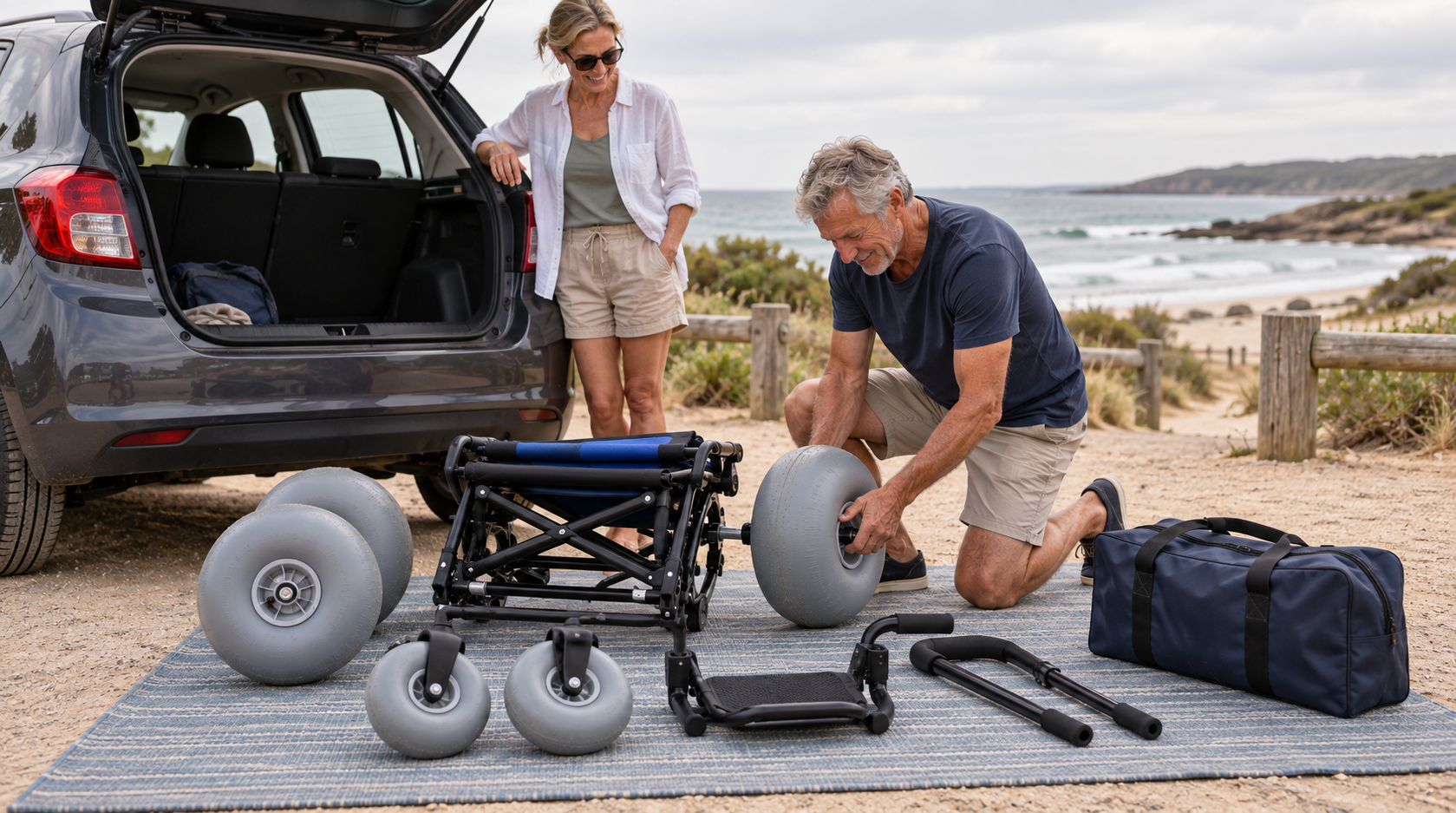
A knock-down beach wheelchair works best with a small vehicle when its largest part fits through the cargo opening and each component can be lifted safely. Published folded dimensions may omit loose wheels, footrests, bags, or the space needed to angle the frame inside. Make a cardboard floor template, measure the hatch opening, and leave room for luggage before you choose.
Can the packing plan work twice in one day?
Run the full sequence: Pack the chair, drive around the block, unload it, assemble it, and pack it again. The portable beach wheelchair travel guide gives you another way to compare storage and route needs before departure.
- Record the weight of the heaviest single component.
- Protect upholstery and axles from loose luggage.
- Keep pins, tools, and instructions in the same bag.
| Vehicle check | Pass condition |
|---|---|
| Hatch opening | Largest part clears without force |
| Cargo depth | Frame fits with the hatch shut |
| Lifting | Each part has a safe handhold |
| Reassembly | Parts lock without sand in joints |
A compact claim means little until the chair passes your own hatch and lifting test. Key Takeaway: You avoid last-minute cargo problems when you rehearse the exact pack, unload, and rebuild cycle with your travel gear included.
Should You Rent or Buy a Beach Wheelchair?
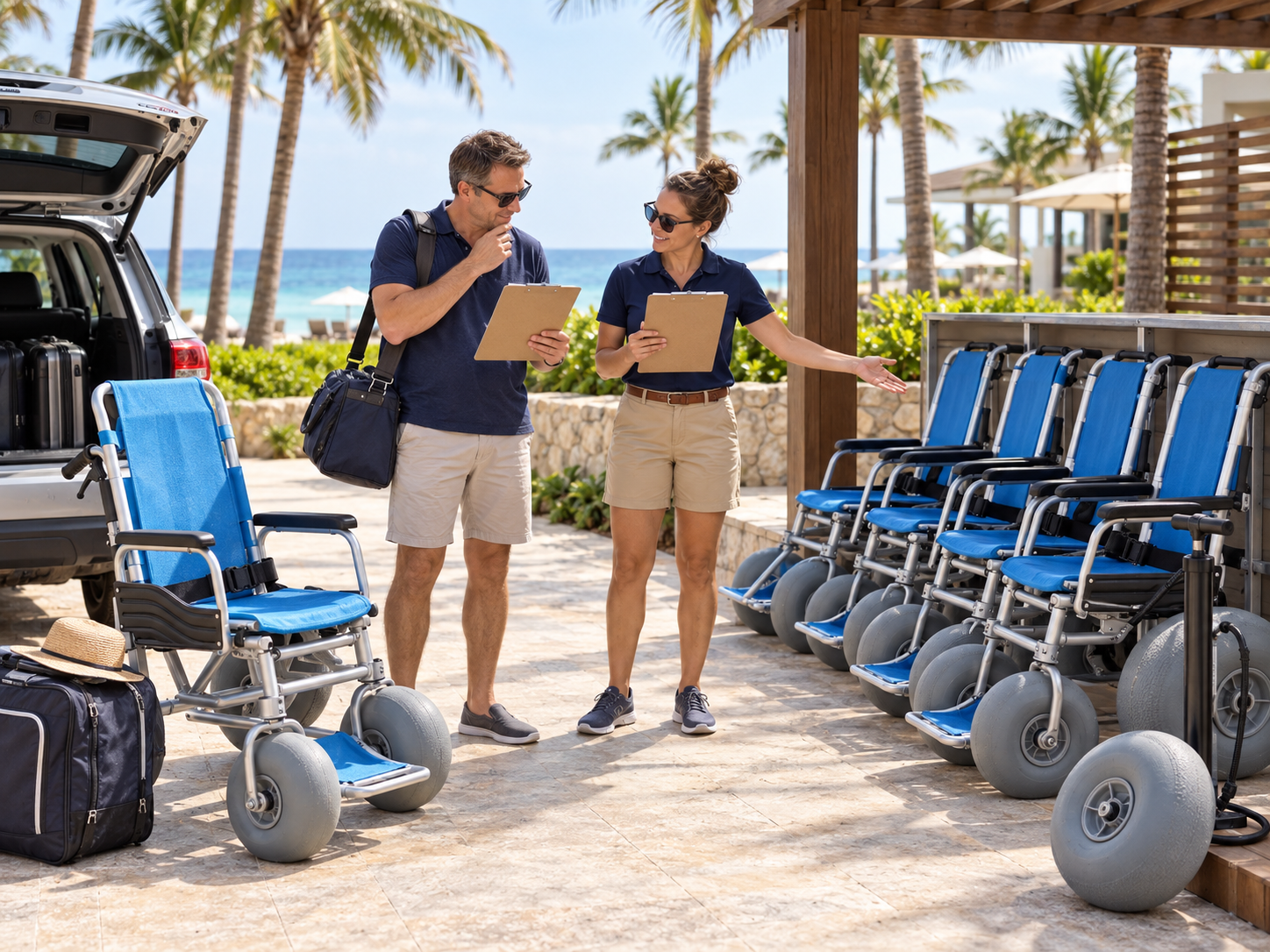
Rent a beach wheelchair for an occasional trip when a suitable model is available at your destination; buy one when fit, repeat use, dependable access, or fleet demand outweigh ownership work. Rental cuts transport and storage duties, but the available model may not match the user or planned route. Ownership gives you time to practice and customize permitted accessories, while adding cleaning, maintenance, storage, and transport responsibilities.
Which cost belongs in your decision?
Price the whole use cycle: Compare rental delivery, deposits, booking risk, and pickup hours with purchase, storage, parts, cleaning, and transport. For an organization, also count staff time, inspection records, spare capacity, and the cost of turning a guest away when no suitable chair is available.
- Try a rental when you need a short real-world trial.
- Buy when the same person or program will use it often.
- Ask for written capacity, care, and operating guidance either way.
| Situation | Likely better fit |
|---|---|
| One short vacation | Rental |
| Frequent family trips | Ownership |
| Resort or public program | Fleet purchase |
| Uncertain model fit | Supervised trial or rental |
The lower upfront price may not be the lower-cost option across several trips. Key Takeaway: Compare access, fit, staff time, storage, and maintenance alongside the opening payment. This guide has narrowed eight chair types by terrain, water use, support, propulsion, deck conditions, fleet work, vehicle space, and ownership model; if you want help matching those factors to a traveler, resort, rental program, or public beach, contact us today with the route details and expected users. We believe beach access should be planned as dependable public and hospitality infrastructure, not treated as a last-minute favor.
Frequently Asked Questions
Can I take a beach wheelchair into shallow water?
Yes, but only when the chair is specifically approved for water use and conditions stay within its instructions. Use trained adult help, a fitted restraint, calm water, and a clear exit point; a sand chair without flotation parts should remain on land.
What’s the best beach wheelchair for air travel?
A compact knock-down model is often the most practical candidate, but the airline makes the final handling decision. Ask about dimensions, removable parts, advance notice, battery rules if any, and how the chair will be protected in the cargo process.
How do I know if a chair will work on soft sand?
Wide low-pressure balloon tires are a strong sign, but a route test gives the better answer. User weight, tire pressure, slope, sand depth, turning, and the operator’s strength all change push effort.
Can I rent before deciding whether to buy?
Yes, and a supervised rental can reveal transport, transfer, and route issues that a product page cannot. Try the closest available configuration and record what worked before ordering.
What’s the best option for a resort or public beach?
A serviceable heavy-duty model is usually the better base for a shared program. Choose capacity coverage, clear controls, washable materials, available parts, staff training, and a backup plan around the people and routes you serve.