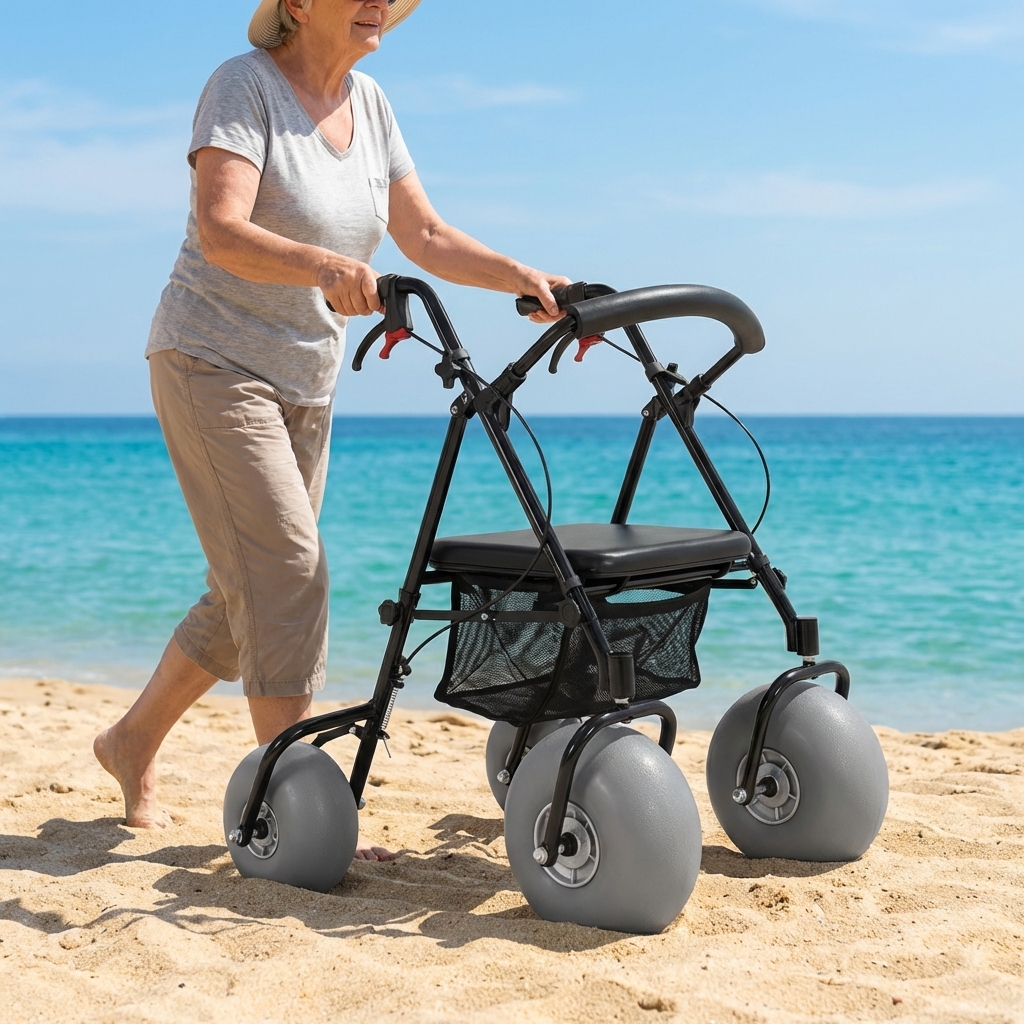
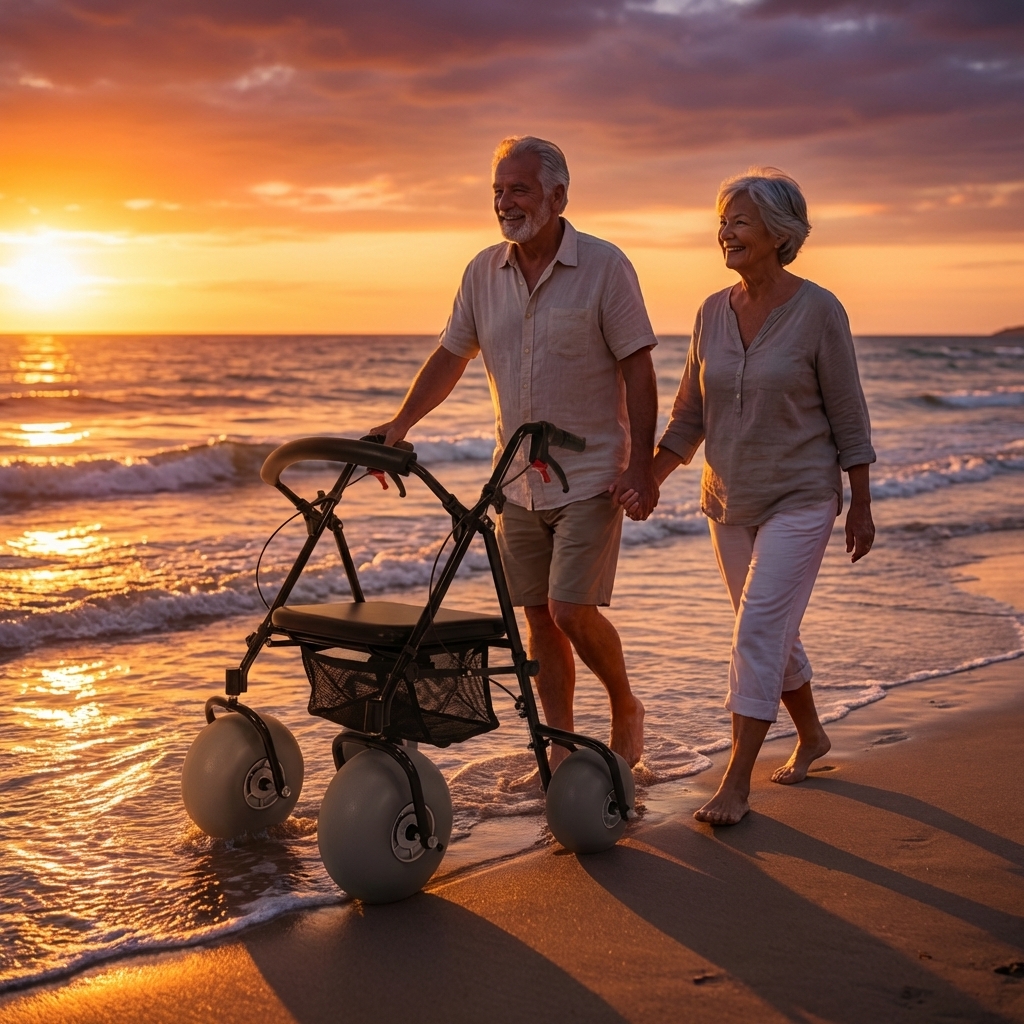
Beach walkers for seniors are specialized mobility aids equipped with oversized, low-pressure balloon tires designed to glide over soft sand rather than sinking into it. Walking along the shoreline is one of life’s simplest pleasures, yet for many seniors, the beach has become a “look but don’t touch” destination because traditional mobility aids fail on uneven coastal terrain. The soft, shifting sand that feels wonderful underfoot can be a treacherous obstacle, leading to social isolation where seniors are forced to stay on the boardwalk while family enjoy the water. Fortunately, beach walkers for seniors utilize high-flotation technology and corrosion-resistant materials to reclaim that lost freedom and ensure every grain of sand is accessible.
Why are beach walkers essential for senior coastal mobility?
Beach walkers are essential because they provide the necessary lateral stability and weight distribution required to navigate soft, shifting sand safely. For many individuals, maintaining an active lifestyle is the primary key to physical and mental longevity, and standard pavement walkers are simply not built for the unique resistance of a coastal environment. Using specialized beach walkers for seniors allows users to move at their own pace without the constant fear of becoming stuck or losing their balance on the dunes.
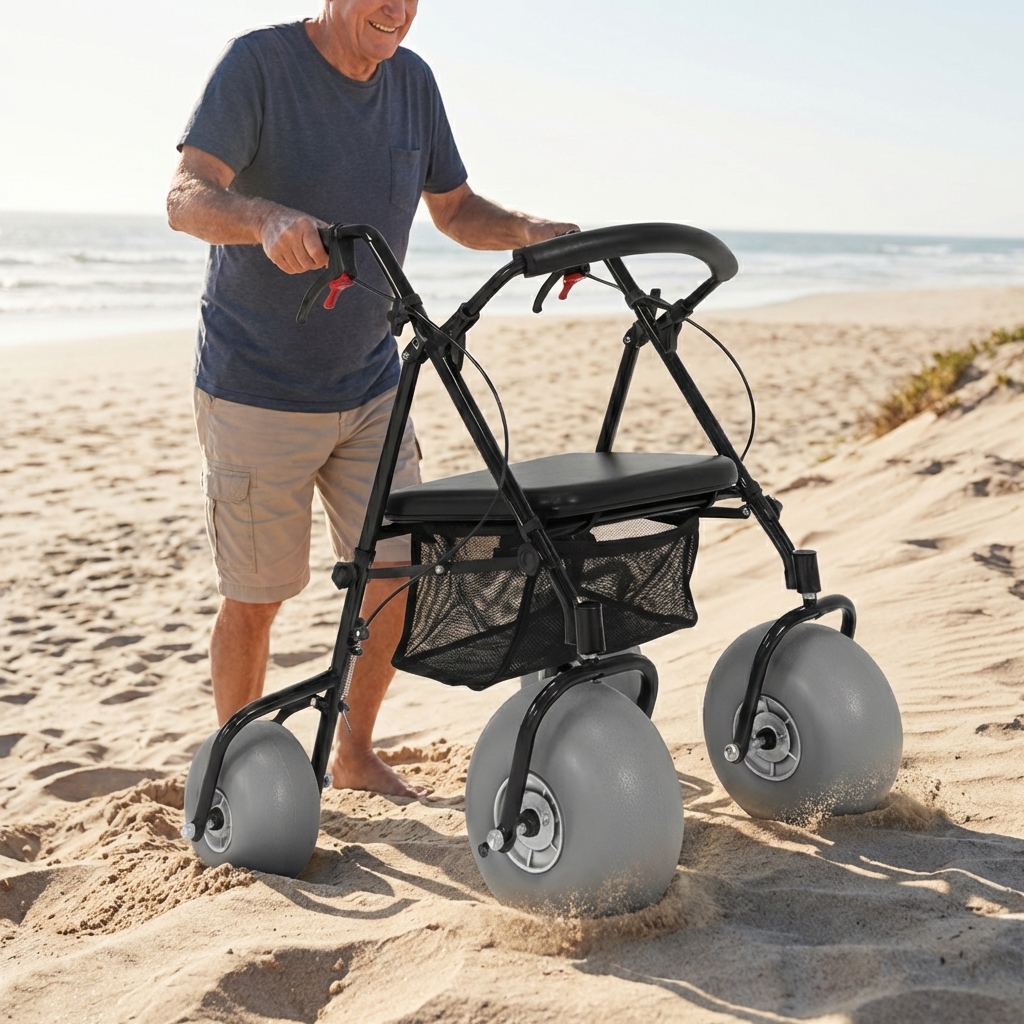
Maintaining independence on the shoreline
A dedicated mobility frame provides the support needed to handle the uneven nature of sandy paths without physical assistance. It allows for a sense of autonomy that standard walkers cannot provide in nature.
Think about it:
- Users can choose their own path along the high-tide line.
- The wide base prevents the frame from tipping on hidden slopes.
- It encourages social participation during family beach outings.
Reducing the risk of falls on uneven dunes
Sand is rarely a flat surface, and the wide-base design of these walkers compensates for hidden holes or slopes effectively. This ensures the user’s center of gravity remains centered even when the ground beneath them shifts.
Here is the deal:
- Large tires absorb the shock of shells and debris.
- The sturdy frame offers a reliable handhold during moments of fatigue.
- Safety brakes allow for controlled descents down dune transitions.
Key TakeawaySpecialized walkers translate senior mobility from the sidewalk to the sand by providing stability that standard equipment cannot offer.
| Benefit | Senior Mobility Impact |
|---|---|
| Stability | Prevents tipping on soft or uneven sand surfaces |
| Confidence | Reduces fear of falling, encouraging longer walks |
| Ergonomics | Height-adjustable handles protect posture on slopes |
How do beach walkers for seniors differ from standard ones?
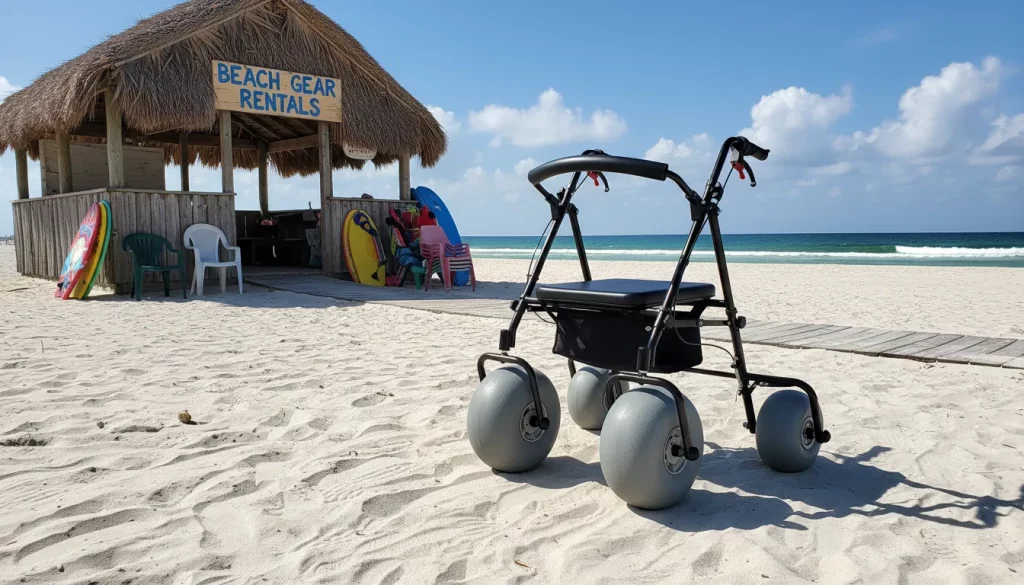
The primary difference lies in the wheel diameter and material, as beach models use large pneumatic balloon tires instead of thin plastic or rubber wheels. Standard walkers are designed for hard, flat surfaces, whereas beach walkers for seniors are engineered for hostile, corrosive environments where salt and sand would normally destroy mechanical parts. The difference in performance is immediate, as the wider footprint allows the device to “float” on top of the sand rather than digging into it.
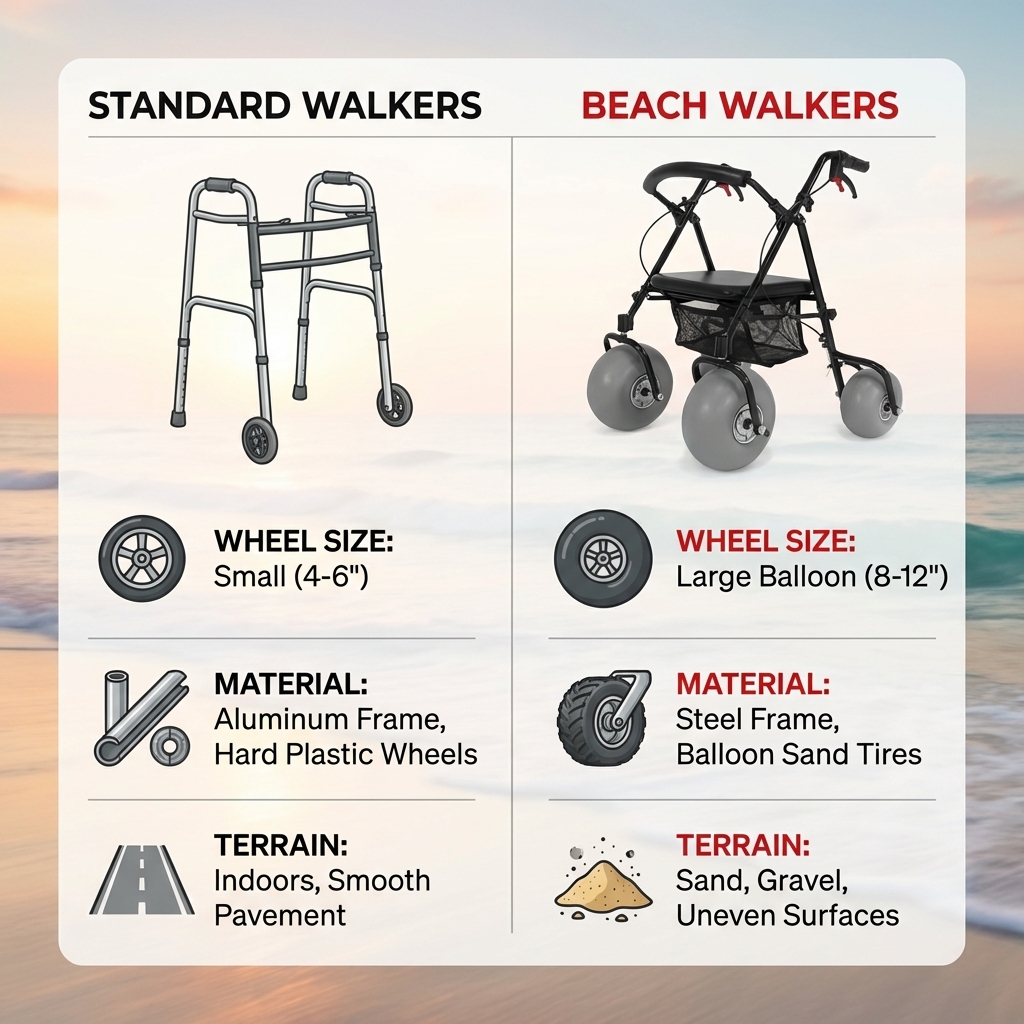
Specialized wide-base sand feet
Instead of small rubber tips that sink instantly, these walkers often use wide, flared feet or oversized balloon wheels. This distributes the weight of the user across a much larger surface area to prevent plunging.
You might be wondering:
- How much easier is it to push?
- Does the extra width make it harder to steer?
- Can it still handle paved boardwalks effectively?
Corrosion-resistant frame materials
Coastal air is thick with salt and moisture, which causes standard aluminum or steel to rust almost immediately. Professional-grade walkers utilize anodized aluminum or 316 stainless steel to ensure the frame doesn’t seize after a single season.
But wait, there’s more:
- Sealed bearings prevent sand from entering the wheel axles.
- UV-resistant fabrics ensure seats and bags don’t fade or tear.
- Powder-coated finishes provide an extra layer of protection against salt spray.
Key TakeawayThe “secret sauce” of a beach walker is weight distribution combined with marine-grade durability.
| Feature | Standard Walker | Beach Walker |
|---|---|---|
| Wheel Size | Narrow (digs in) | Wide/Balloon (glides) |
| Material | Standard Aluminum | Marine-Grade/Anodized |
| Terrain | Flat Pavement | Sand, Grass, Gravel |
Can a floating beach wheelchair replace a walker on sand?
A floating beach wheelchair serves a different purpose, as it is designed for users who require full seating and wish to enter the water, whereas a walker is for ambulatory users. While beach walkers for seniors promote active exercise and upright movement, a wheelchair solution is often better for those with limited stamina. However, the two can work in tandem to provide a complete accessibility solution for a full day at the coast.
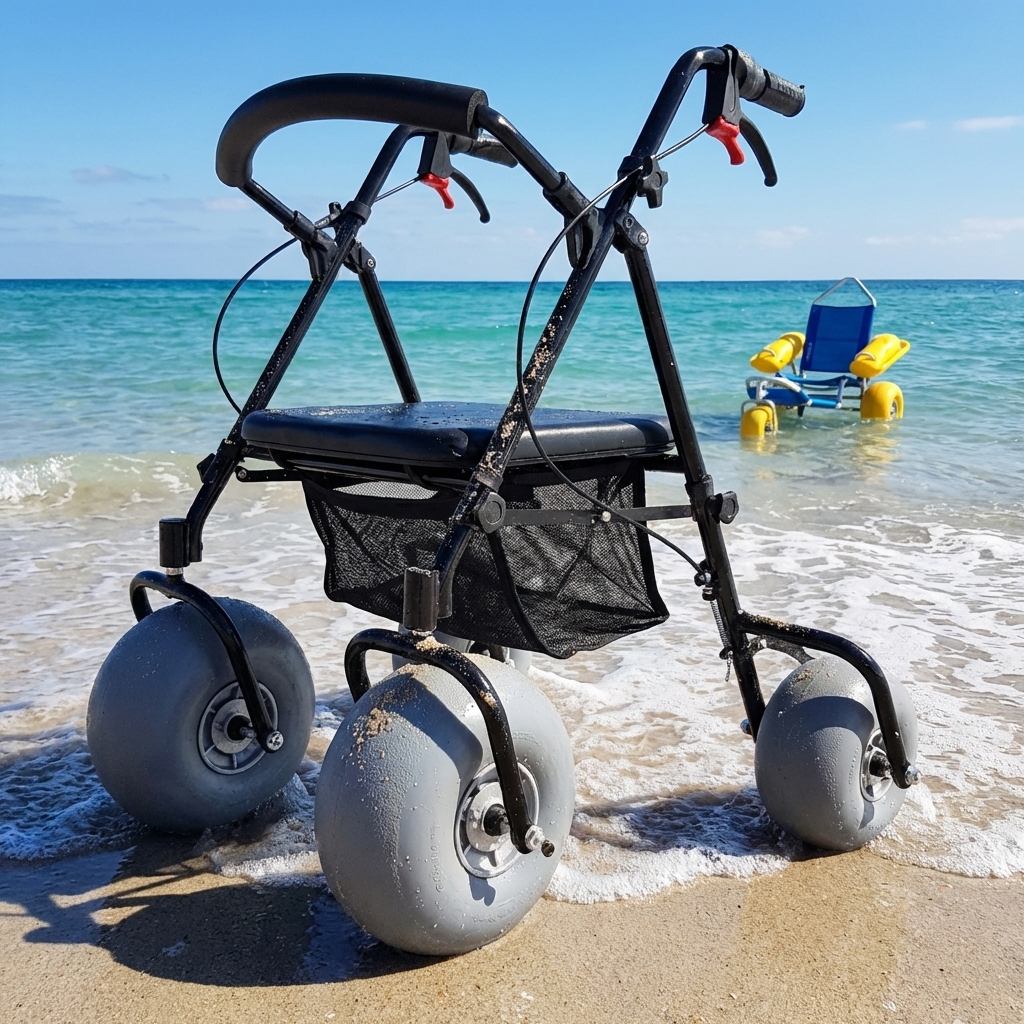
Transitioning from walking to water immersion
A walker typically stops at the waterline because it does not have the buoyancy required for the surf. However, a floating beach wheelchair is designed to bridge this gap, utilizing specialized armrests to stay level while the user enjoys a swim.
It gets even better:
- Users can move from the dunes directly into the waves.
- Pontoons provide lateral stability in moving water.
- Caregivers can easily push the chair through the transition zone.
Support for limited upper-body strength
If a senior tires easily, pushing a walker through thick sand might become a burden regardless of tire size. A wheelchair solution provides a comfortable place to rest and allows a family member to take over the effort of movement.
Here is the deal:
- Deep-seated cushions provide better spinal support.
- Five-point harnesses ensure safety for those with poor balance.
- Integrated sunshades protect users during long periods of rest.
Key TakeawayWalkers promote exercise, while floating wheelchairs provide total access to both the sand and the sea.
| Use Case | Recommended Equipment |
|---|---|
| Active Exercise | Beach Walker / Rollator |
| Water Immersion | Floating Beach Wheelchair |
| Distance Travel | All-Terrain Wheelchair |
What features ensure stability on loose, shifting terrain?
Stability is ensured through a low center of gravity and a wide wheelbase that prevents the device from tipping when encountering dunes or holes. To navigate the coast safely, the beach walkers for seniors must handle high rolling resistance without straining the user’s arms or back. High-end models integrate several engineering choices to ensure that the user feels secure even when the ground is moving beneath them.
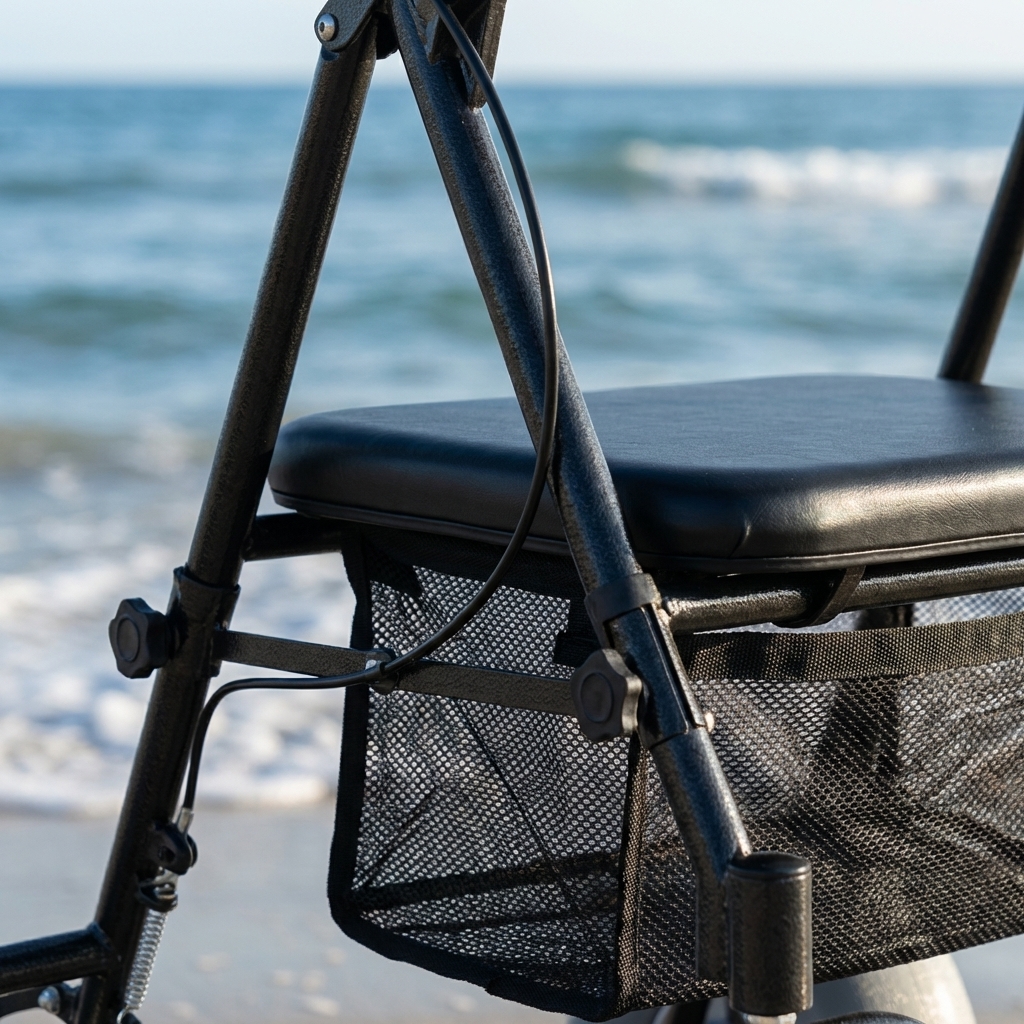
Marine-grade stainless steel frames
The frame must be rigid enough to support the user’s weight but flexible enough not to snap when a wheel hits a pocket of soft sand. Stainless steel offers the perfect balance of strength and salt resistance for long-term coastal use.
You might be wondering:
- Is stainless steel too heavy for a senior to lift?
- How does it stand up to constant saltwater exposure?
- Does the frame require special cleaning products?
Ergonomic height-adjustable handles
Seniors have varying height requirements to prevent back strain, especially when pushing through resistance. Having adjustable handles ensures the user can maintain a “power position” when navigating thick dunes.
Think about it:
- Correct posture reduces the risk of muscle fatigue.
- Grips are often made of soft foam to prevent slipping in humid air.
- Height locks ensure the handles don’t slip during a heavy push.
Key TakeawayTrue stability comes from a low center of gravity and a frame that can withstand the torque of moving through sand.
| Stability Component | Function |
|---|---|
| Frame Geometry | Prevents forward or lateral tipping |
| Handle Grip | Soft foam to prevent slipping in humid air |
| Braking System | Ensures the unit stays put on coastal inclines |
How does a floating beach wheelchair handle the water entry?
The water entry is managed through displacement physics and buoyancy-assisted frames that keep the user upright as they move from sand to surf. While beach walkers for seniors focus on the trek across the sand, specialized aquatic chairs use pontoons to make the transition into the ocean seamless. This allows the user to experience the therapeutic benefits of the water without the risk of falling in the waves.
Integrated armrest pontoons for buoyancy
A floating wheelchair usually features oversized armrests made of closed-cell foam that act like outriggers on a boat. These keep the user upright as the chair enters the water and begins to float.
It gets even better:
- The pontoons prevent the chair from flipping in light surf.
- Users can float comfortably with their head well above the waterline.
- The foam is resistant to saltwater and UV damage.
Safe navigation through the gentle surf
The wide wheelbase prevents the chair from being easily flipped by a small wave, which is critical for senior safety. This allows the individual to sit comfortably while the water reaches chest height.
Here is the deal:
- Low-pressure tires act as additional flotation devices.
- Non-corrosive hardware ensures the chair remains functional after immersion.
- Attendants can easily pull the chair back to shore using integrated tow bars.
Key TakeawayBuoyancy is the defining feature that allows a mobility device to move from a “sand chair” to a “water chair.”
| Water Entry Step | Safety Feature |
|---|---|
| Sand-to-Water | Balloon tires prevent digging in at the tide line |
| Immersion | Pontoons provide lateral stability |
| Floating | Balanced weight distribution keeps the user’s head up |
Are lightweight folding models better for senior travel?
Lightweight folding models are often superior for seniors because they can be easily transported in standard vehicle trunks or taken on air travel. Since many people visit the coast as part of a vacation, the “packability” of beach walkers for seniors is a top priority for families. Models that offer tool-free disassembly allow for a quick transition from the car to the sand without the need for heavy lifting or complex setups.
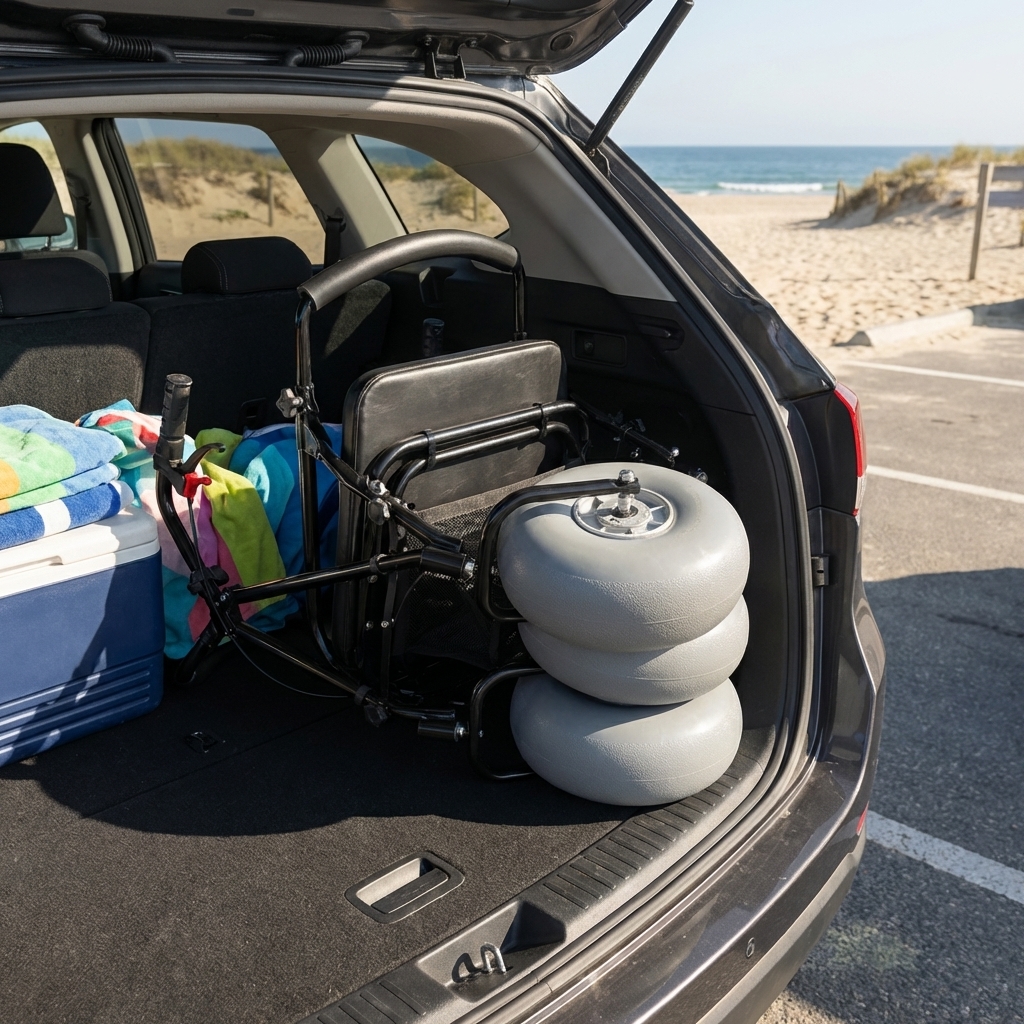
Tool-free assembly for quick transport
The best beach mobility aids use quick-release pins that allow a senior or caregiver to pop the wheels off in seconds. This means the frame can be folded flat and stored without needing a toolbox.
Think about it:
- No loose screws to lose in the sand during assembly.
- Components are light enough for one-person management.
- Color-coded parts make the setup process intuitive.
Compact storage for vehicle trunks
Aluminum frames are often chosen for these models because they offer high strength-to-weight ratios. This makes it possible to lift the unit into an SUV or trunk without straining.
But wait, there’s more:
- Folding backrests reduce the vertical height of the device.
- Included travel bags protect the interior of your car from sand.
- The compact footprint allows for storage in small hotel closets.
Key TakeawayIf you plan to visit multiple beaches, prioritize a model that can be disassembled and transported without heavy lifting.
| Travel Feature | Benefit for Seniors |
|---|---|
| Quick-Release Axles | Wheels come off in seconds |
| Aluminum Frame | Lightweight enough for one-person lifting |
| Folding Backrest | Reduces vertical height for storage |
Why are low-pressure balloon tires vital for sand access?
Low-pressure tires are vital because they operate at 2-4 PSI, allowing them to spread weight over a large area like a snowshoe. Unlike standard tires that act like a knife cutting into the surface, the wheels on beach walkers for seniors “float” on top of the sand. This significantly reduces the amount of physical energy required to push the walker, which is essential for seniors with limited cardiovascular endurance.
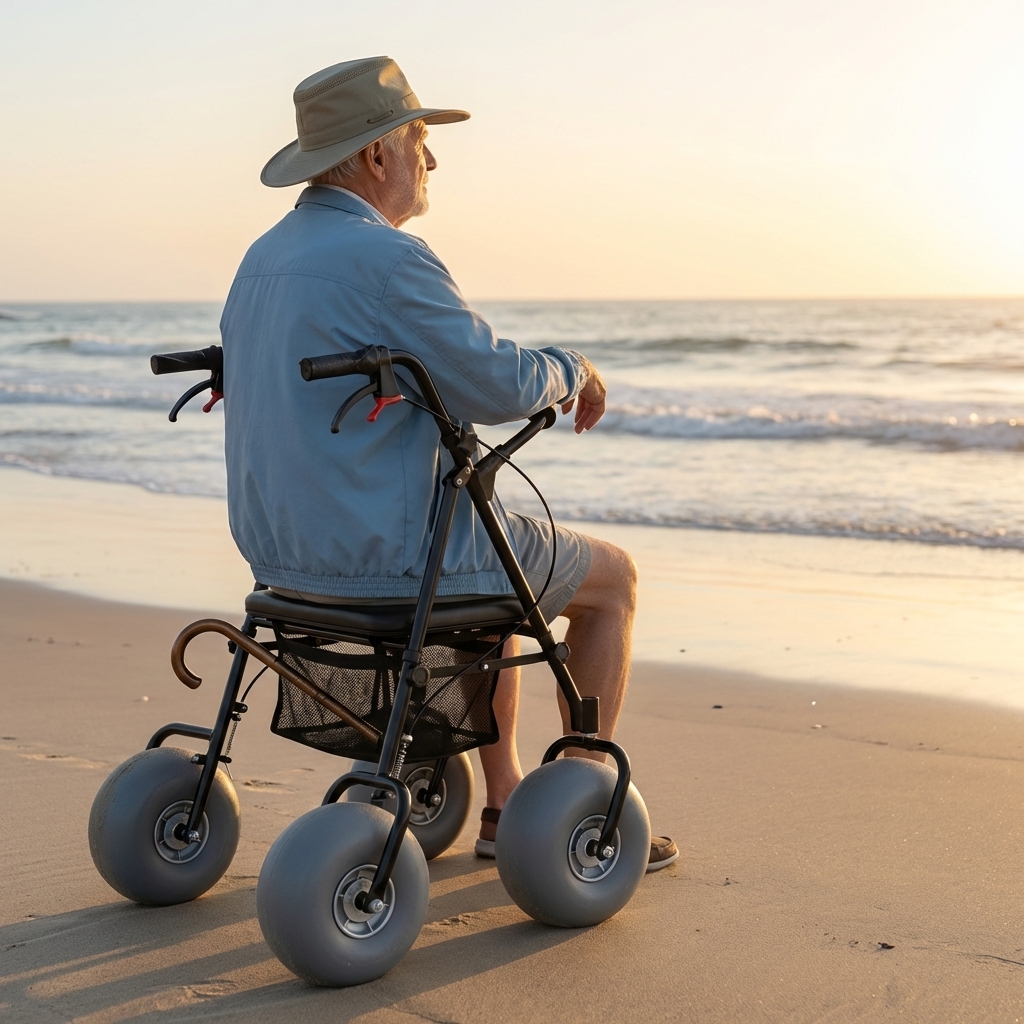
Weight distribution to prevent sinking
Standard tires have a high PSI and a small contact patch, making movement on sand nearly impossible. Balloon tires solve this by conforming to the surface and distributing the load evenly.
You might be wondering:
- Do these tires ever go flat?
- Can they be used on regular pavement too?
- How do you inflate them to the correct pressure?
Maneuvering over shells and debris
Because the tires are soft and pliable, they “swallow” small rocks and shells rather than bouncing over them. This provides a much smoother ride for the senior, protecting their joints from jarring impacts.
Here is the deal:
- The soft rubber reduces vibration through the handles.
- It is much easier to steer through “mushy” wet sand.
- The tires are wide enough to cross gaps in boardwalk planks.
Key TakeawayBalloon tires are the single most important component for any all-terrain beach walker or wheelchair.
| Tire Type | Sand Performance | Best Use Case |
|---|---|---|
| Balloon Tire | Excellent (Floats) | Soft sand and dunes |
| Solid Rubber | Poor (Sinks) | Paved boardwalks only |
| Tuff-Tire | Moderate (Multi-use) | Grass, gravel, and packed sand |
Should you use a floating beach wheelchair or a walker?
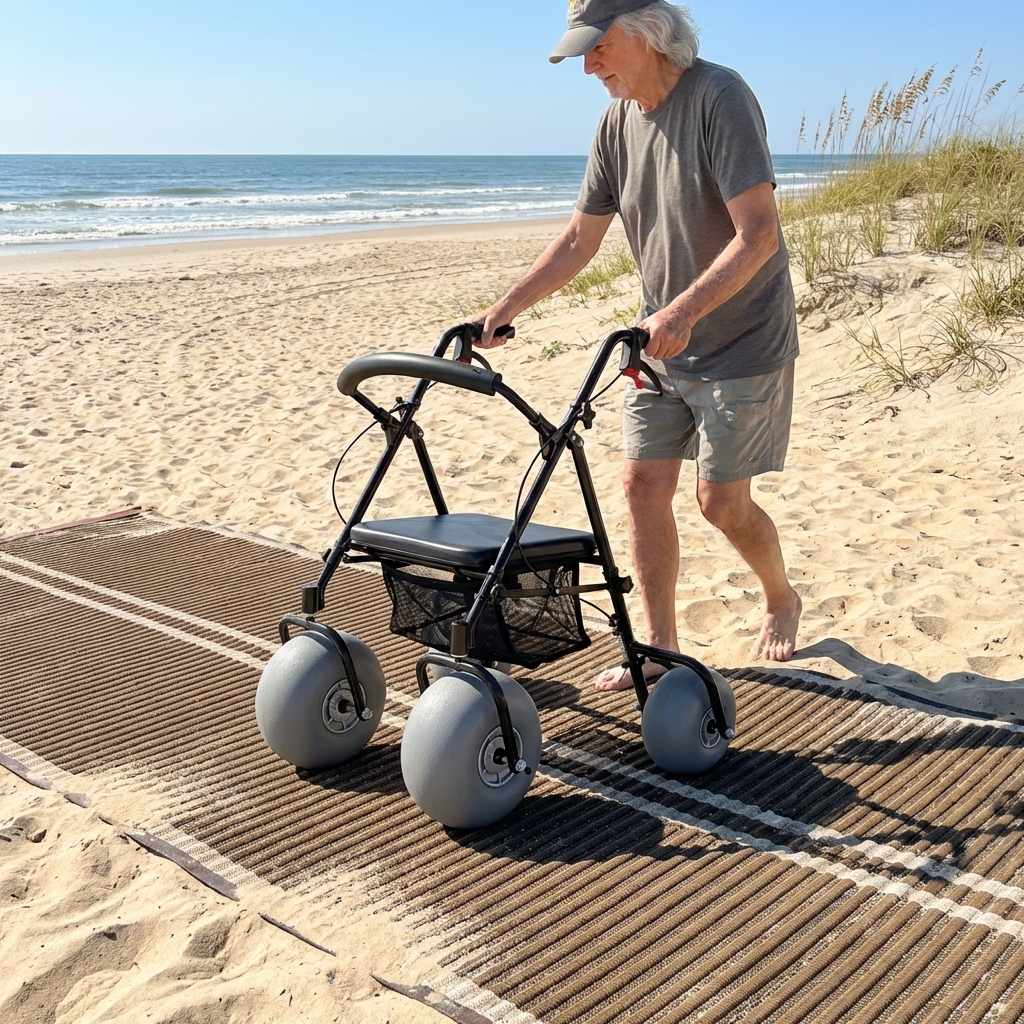
The choice depends on the user’s mobility level, as those who can walk short distances will benefit more from a walker’s exercise potential. For those who require total support, beach walkers for seniors might not be enough, and a seated wheelchair solution would be safer. Often, the best strategy is to use both, using a beach mat for the initial entry and a walker for strolls along the shoreline.
Assessing personal mobility levels
If the senior can walk 50 feet on a sidewalk, a walker is likely the best choice for beach exercise. However, if balance is a major concern, the seated security of a floating chair is the wiser investment.
It gets even better:
- Walkers allow for active calorie burning and leg strength.
- Wheelchairs provide a “base camp” for resting during the day.
- Many families rent both types to see which fits their needs.
Using accessible beach mats for pathways
Sometimes, the best solution is to improve the terrain itself by rolling out a portable pathway. These mats create a firm “highway” over the sand, making it much easier for any mobility device to function.
Think about it:
- Mats create a stable transition from the parking lot.
- They are visible and provide a clear path for those with low vision.
- They can be used to create a dedicated seating area on the sand.
Key TakeawayDon’t be afraid to mix and match. A mat for the arrival zone and a walker for the shoreline often provide the best balance.
| User Ability | Recommended Setup |
|---|---|
| High Independence | Beach Walker |
| Moderate Support | All-Terrain Wheelchair + Mat |
| Low Mobility | Floating Beach Wheelchair |
How do you maintain beach mobility gear for longevity?
Maintenance is performed by rinsing the equipment with fresh water after every use to remove salt crystals and abrasive sand. Even high-quality beach walkers for seniors can suffer from “tea staining” or seized bearings if left with salt residue for weeks in a humid garage. A five-minute cleaning routine can add years to the life of the investment and ensure that the folding mechanisms remain smooth.
Freshwater rinse protocols after use
It is non-negotiable: you must rinse the unit with fresh water after every beach visit. Pay close attention to the axles, the undersides of the fabric, and the brake cables where salt hides.
Here is the deal:
- Salt acts as an abrasive that wears down moving parts.
- Dry sand can clog folding hinges and locking pins.
- A simple garden hose is all that is required for effective cleaning.
Inspecting hardware for salt corrosion
Periodically check all pins, fasteners, and tires for signs of wear or air loss. Even 316 stainless steel requires a quick wipe-down with a silicone-based spray to keep it looking brand new.
But wait, there’s more:
- Check tire pressure before every trip to ensure maximum “float.”
- Tighten any bolts that may have loosened from vibration on uneven ground.
- Store the unit in a dry area away from direct coastal air when not in use.
Key TakeawayFive minutes of cleaning after a beach trip can add five years to the life of the mobility aid.
| Maintenance Task | Frequency | Purpose |
|---|---|---|
| Freshwater Rinse | After Every Use | Removes salt and sand |
| Tire Pressure Check | Weekly | Ensures optimal sand performance |
| Hardware Inspection | Monthly | Prevents rust and loose parts |
Where can you find the best beach walkers for seniors?
The best walkers are found through specialized medical suppliers and beach accessibility experts who understand the nuances of coastal engineering. While standard retail stores may carry basic mobility aids, beach walkers for seniors require specific features that only dedicated manufacturers provide. Investing in professional-grade equipment ensures that you receive the durability, safety, and support needed for a successful shoreline adventure.
Buying from accessibility specialists
Specialists offer technical support and spare parts that general retailers often lack. They can guide you on tire selection based on the specific type of sand at your local beach.
Think about it:
- You get a warranty that covers coastal use conditions.
- Experts can help you choose the right frame size for your height.
- Replacement tires are readily available if one gets damaged.
Evaluating online reviews and certifications
Look for products that have been tested in real-world environments and carry certifications for load-bearing safety. User reviews from other seniors can provide valuable insight into how easy the walker is to fold and transport.
You might be wondering:
- Is there a return policy if it doesn’t fit my car?
- Does it come fully assembled or in parts?
- What do other seniors say about the handle comfort?
Key TakeawayProfessional-grade equipment from a specialized manufacturer is the only way to guarantee safety and longevity in a salt-rich environment.
| Buying Tip | Why It Matters |
|---|---|
| Check for 316 Stainless | Guarantees the frame won’t rust in salt air |
| Verify Tire Size | Large 12-inch tires are best for soft sand |
| Look for Tool-Free Setup | Makes travel significantly less stressful |
Frequently Asked Questions
Can I use a beach walker on the street?Yes, beach walkers can be used on paved surfaces, though the soft balloon tires may wear down faster on asphalt. For mixed terrain, many users prefer “tuff-tires” which handle both sand and pavement well.
What’s the best way to clean sand out of the wheels?The most effective method is using a pressurized freshwater hose while spinning the wheels. This flushes out the sand from the axle gaps and prevents the bearings from grinding.
How do I know if I need a walker or a floating wheelchair?If you want to walk for exercise and have moderate balance, a walker is ideal. If you have significant mobility limitations or want to enter the deep water, a floating wheelchair is the safer choice.
Can a senior assemble a beach walker alone?Many modern models are designed with quick-release pins and lightweight frames specifically to allow for independent assembly. However, for the first setup, having a partner is recommended to adjust the handle height.
What is the weight limit for most beach walkers?Standard professional beach walkers are typically rated for 250 to 300 lbs. Always check the specific manufacturer’s load rating before purchasing to ensure it meets your safety requirements.
Summary of Beach Mobility Solutions
Reclaiming your coastal independence is entirely possible with the right technology. At Ary Beach Accessibility Solutions, we are dedicated to making every beach accessible for everyone through innovative design and quality craftsmanship. Whether you need the exercise support of a walker or the water-entry capabilities of a floating chair, our solutions are engineered to withstand the toughest coastal conditions. Please contact us today to find the perfect mobility aid for your next seaside adventure. Our vision is to ensure that no senior is ever left on the boardwalk again.