Yes, specialized beach wheelchairs are designed to float, providing users with full aquatic access. Many people with mobility challenges face the “sand barrier,” where standard mobility aids sink and stall. This creates a frustrating experience where the shoreline feels like a boundary rather than a gateway. By choosing a floating beach wheelchair rental , you can overcome these obstacles and transition directly from the dunes into the waves.
Do all beach wheelchairs have the ability to float?
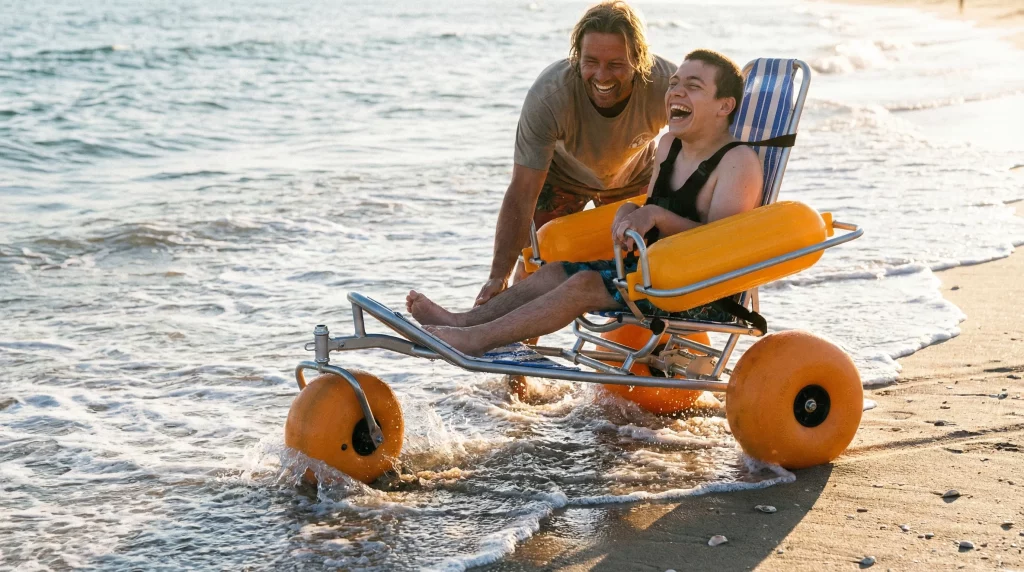
No, not every chair built for the sand is designed for buoyancy. Some models are strictly all-terrain vehicles intended to navigate soft sand or gravel without sinking. While these are excellent for land travel, they may lack the flotation components required for safe water immersion.
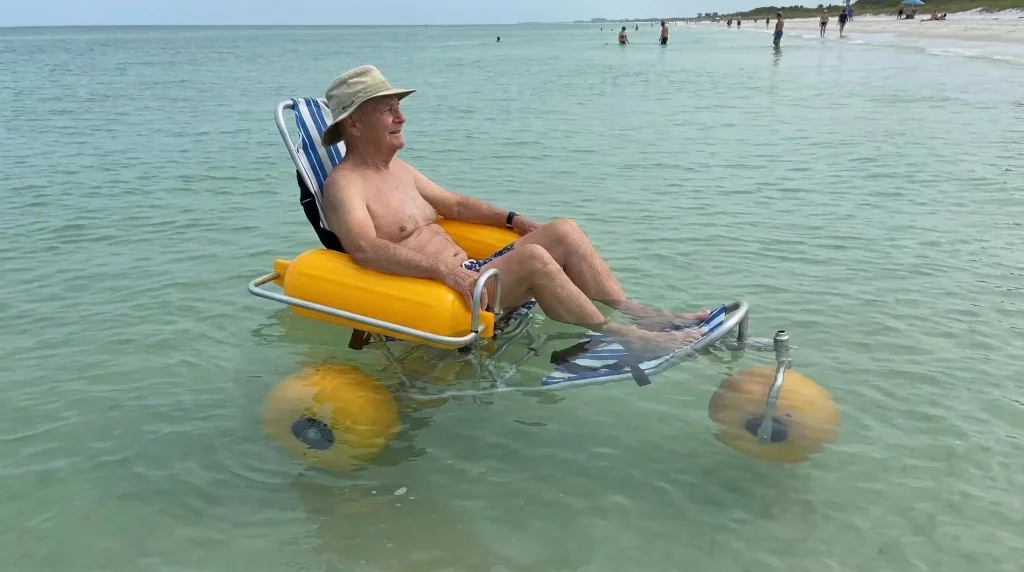
When searching for a floating beach wheelchair rental , it is essential to verify the specific water-entry capabilities of the model. Buoyant chairs typically feature integrated armrests made of closed-cell foam and oversized tires that act as flotation devices.
Distinct Design Categories
- Static Beach Chairs: Designed for sand mobility but not for deep water entry.
- Amphibious Chairs: Engineered with specific flotation markers to support weight in water.
- Submersible Models: Heavy-duty frames that can withstand complete saltwater immersion.
Critical Identification Features
But that’s not all. You should look for specific visual cues that indicate a chair is water-ready.
- Integrated orange or yellow flotation armrests.
- Three or four wide-diameter balloon tires.
- Non-corrosive aluminum or stainless steel frames.
Key Takeaway: Always confirm a chair’s buoyancy rating before attempting water entry to ensure user safety.
| Feature Type | Land-Only Chairs | Floating Chairs |
|---|---|---|
| Buoyancy | Low / None | High (Amphibious) |
| Water Depth | Edge only | Up to 1.2 meters |
| Armrests | Standard / Padded | Floating Foam-Filled |
This comparison highlights why selecting the correct equipment is vital for a safe aquatic experience.
How does the engineering make these wheelchairs buoyant?
Buoyancy is achieved through a meticulous balance of lightweight materials and air displacement. Most high-quality models utilize marine-grade aluminum frames that are naturally light and resistant to rust. When looking for a floating beach wheelchair rental, you will notice that the displacement of water by the tires and armrests provides the necessary upward force.
The primary source of lift comes from the large, low-pressure balloon tires. These wheels are filled with a significant volume of air, which naturally wants to rise to the surface when submerged.
Frame and Component Materials
- Aluminum 6061-T6: Provides a high strength-to-weight ratio for easier floating.
- Stainless Steel 316: Used for hardware to prevent saltwater corrosion.
- UV-Resistant Plastics: Ensures the flotation armrests don’t degrade in the sun.
The Physics of Water Access
Here is the deal: the chair is designed to displace more weight in water than it weighs itself.
- Balloon tires act as individual “buoys” at each corner.
- Padded armrests provide secondary lateral stability.
- Mesh seating allows water to pass through, reducing drag.
Key Takeaway: Engineering focus on air-filled tires and lightweight frames is what transforms a wheelchair into a flotation device.
| Component | Material Choice | Primary Function |
|---|---|---|
| Frame | Anodized Aluminum | Structural Support / Weight Reduction |
| Tires | Polyurethane Balloon | Floatation and Sand Traction |
| Armrests | Closed-cell Foam | Stability and Buoyancy |
Understanding these materials helps buyers evaluate the long-term durability and safety of their fleet.
What safety features ensure the user stays upright?
Stability in moving water is the most critical safety factor for any amphibious device. A floating beach wheelchair rental must have a wide wheelbase to prevent tipping when waves or currents are present. The low center of gravity ensures that the user remains seated securely even as the chair begins to float.
Furthermore, these chairs are often equipped with high-visibility safety harnesses. These straps are designed to keep the user positioned correctly without restricting their ability to exit the chair in an emergency.
Essential Stability Controls
- Wide Track Tires: Spreads the footprint to prevent side-to-side rolling.
- Three-Wheel Design: Often provides better maneuverability in shallow surf.
- Safety Tether: Allows a caregiver to maintain a physical link to the chair.
User Protection Systems
But that’s not all; the seat fabric plays a role in safety too.
- Breathable mesh prevents the “sail effect” in wind.
- Quick-dry materials reduce the risk of skin irritation.
- High-contrast colors help lifeguards spot the chair easily.
Key Takeaway: Wide wheelbases and specialized harnesses are non-negotiable safety requirements for water-entry chairs.
| Safety Element | Design Purpose | Operational Benefit |
|---|---|---|
| Wide Wheelbase | Anti-tip Geometry | Stability in uneven surf |
| Safety Harness | User Retention | Secure seating during entry |
| Bright Colors | High Visibility | Easier monitoring by staff |
These features combine to create a secure environment for users exploring the water’s edge.
Can you use a floating wheelchair in a swimming pool?
Yes, these chairs are highly effective in pool environments, particularly those with zero-entry ramps. A floating beach wheelchair rental allows for a dignified transition into the water without the need for mechanical lifts. The non-marking tires are safe for delicate pool liners and tiled surfaces.
Because pool water is usually calmer than the ocean, the buoyancy of the chair provides a very stable platform for aquatic therapy. Many resorts and water park accessibility programs utilize these chairs to enhance guest inclusion.
Pool Entry Methods
- Zero-Entry Ramps: The chair rolls directly from the deck into the water.
- Submersible Lifts: While not always necessary, the chair can be placed on a lift.
- Deck-to-Water Transfer: Caregivers can guide the chair into the shallow end.
Maintenance in Chlorinated Water
Here is the deal: chlorine is a chemical that requires post-use attention.
- Rinse the frame with fresh water after every pool session.
- Check the tire pressure frequently, as pool temperatures can vary.
- Inspect the fabric for any chemical bleaching or wear.
Key Takeaway: Floating chairs are versatile tools that work equally well in resorts, water parks, and private pools.
| Environment | Primary Entry Method | Stability Level |
|---|---|---|
| Ocean | Sand Rolling | Variable (Currents) |
| Resort Pool | Zero-Entry Ramp | High (Still Water) |
| Aquatic Center | Ramp or Transfer | High (Still Water) |
This versatility makes the floating chair a cost-effective choice for multi-use facilities.
Which wheels are best for both sand and water?
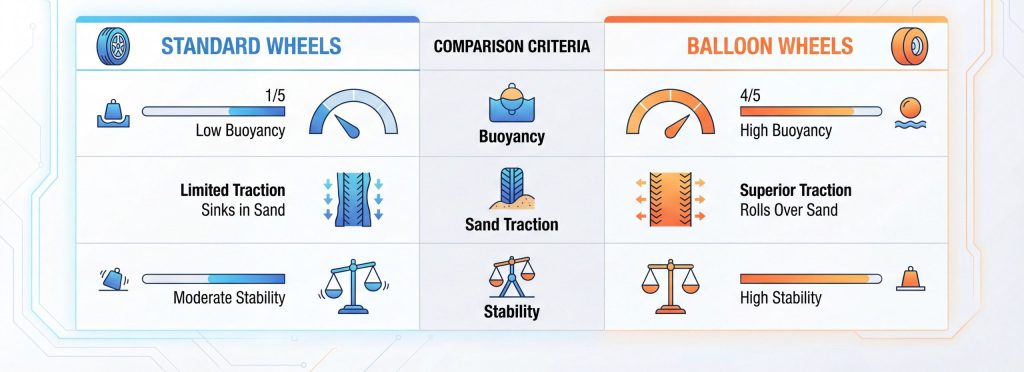
Low-pressure polyurethane balloon tires are the gold standard for amphibious mobility. When using a floating beach wheelchair rental , you will find that these wheels provide both the surface area needed for sand and the air volume needed for water. Standard narrow wheels will sink immediately in soft sand, making the chair impossible to push.
These wheels are designed to operate at 2-4 PSI. This low pressure allows the tire to “mold” over obstacles and spread the user’s weight across a larger footprint, effectively floating on top of the sand.
Tire Performance Metrics
- Buoyancy Rating: Larger diameters provide more lift in water.
- Traction Level: Soft tires provide better grip on wet sand.
- Durability: Polyurethane is resistant to punctures from shells or gravel.
Why Balloon Tires Excel
But that’s not all; the engineering behind the wheels goes further.
- They act as natural shock absorbers for a smoother ride.
- The wide design prevents the chair from becoming “bogged down.”
- Air-filled chambers provide 80% of the chair’s total buoyancy.
Key Takeaway: Balloon tires are the essential component that enables a chair to navigate both soft dunes and ocean waves.
| Tire Type | Sand Performance | Water Performance |
|---|---|---|
| Standard Pneumatic | Sinks / Poor | No Buoyancy |
| Large Balloon | Floats / Excellent | High Buoyancy |
| Solid Plastic | Sinks / Poor | Negative Buoyancy |
Choosing the right tire ensures the user doesn’t get stuck midway to the water.
Are these wheelchairs easy for one person to push?
Modern engineering has significantly reduced the physical effort required to operate these devices. A high-quality floating beach wheelchair rental features a lightweight frame and ergonomic push handles designed for a single caregiver. On sand, the balloon tires reduce friction, allowing the chair to glide rather than drag.
Once in the water, the task becomes even easier because the water supports the weight of the user. The caregiver only needs to provide direction and stability, making the experience manageable for almost any assistant.
Maneuverability Features
- Front Caster Wheels: Allow for easy 360-degree turns on hard surfaces.
- Push Bar Height: Adjusted to reduce back strain for the operator.
- Low Friction Axles: Ensure the wheels spin freely even when wet.
Reducing Caregiver Fatigue
Here is the deal: the right chair should do most of the work for you.
- Aluminum frames weigh up to 40% less than steel alternatives.
- Weight distribution is optimized for easy tilting over curbs.
- Balloon tires absorb the “drag” of soft sand.
Key Takeaway: Lightweight materials and specialized tire physics make single-caregiver operation safe and efficient.
The following data compares push-force requirements across different terrains:
| Terrain Type | Standard Wheelchair Force | Floating Chair Force |
|---|---|---|
| Hard Boardwalk | Low | Low |
| Soft Dry Sand | Extremely High (Stuck) | Moderate |
| Shallow Water | Impossible | Very Low (Floating) |
Caregivers should always test the chair on the specific sand type of their local beach to gauge effort.
What is the weight capacity for floating models?
Most standard floating chairs are designed to support adults weighing between 250 and 300 pounds. When procuring a floating beach wheelchair rental , it is vital to check the manufacturer’s specifications to ensure a safe buoyancy-to-weight ratio. Heavier users may require models with additional flotation components.
It is a common misconception that more weight means less buoyancy. In reality, as long as the weight stays within the rated capacity, the chair will simply sit slightly lower in the water while remaining stable.
Capacity Classifications
- Pediatric Models: 50–120 lbs (designed for children).
- Standard Models: 250–300 lbs (most common for rental fleets).
- Bariatric Models: 400+ lbs (reinforced frames and extra wheels).
Impact of Weight on Buoyancy
But that’s not all; weight distribution matters as much as the total number.
- Proper seating ensures the chair doesn’t tip forward or backward.
- High-capacity models use four balloon tires for better balance.
- Reinforced all-terrain wheelchair frames prevent flexing under heavy loads.
Key Takeaway: Always select a chair with a capacity that exceeds the user’s weight to maintain optimal buoyancy.
Proper sizing ensures the user feels secure and the chair performs as engineered.
How do you maintain a wheelchair used in saltwater?
Saltwater is highly corrosive, meaning maintenance is the key to longevity for any floating beach wheelchair rental. Even marine-grade materials require a freshwater rinse after every use to remove salt crystals and fine sand. If left unattended, salt can seize bearings and degrade the finish of the frame.
Focus your cleaning efforts on moving parts like the axles and folding hinges. Most modern chairs use plastic bushings that are designed to be “maintenance-free,” but they still benefit from the removal of abrasive sand.
Daily Maintenance Steps
- Freshwater Rinse: Spray the entire chair, especially the underside.
- Sand Removal: Use a soft brush to clear sand from the seat mesh and hinges.
- Tire Check: Ensure the balloon tires are at the recommended 2-4 PSI.
Long-Term Care Tips
Here is the deal: a few minutes of care can save thousands in replacement costs.
- Store the chair in a shaded, dry area when not in use.
- Check for any “nicks” in the powder coating that could lead to rust.
- Use beach mats and ramps to reduce direct contact with abrasive surfaces when possible.
Key Takeaway: Consistent freshwater rinsing is the single most important task to prevent saltwater corrosion.
| Maintenance Task | Frequency | Priority |
|---|---|---|
| Freshwater Rinse | Daily (Post-Use) | Critical |
| Tire Pressure Check | Weekly | High |
| Bearing Lubrication | Monthly (If applicable) | Moderate |
Following a strict protocol ensures the equipment remains safe and functional for years.
Can a floating wheelchair be used as a lounge chair?
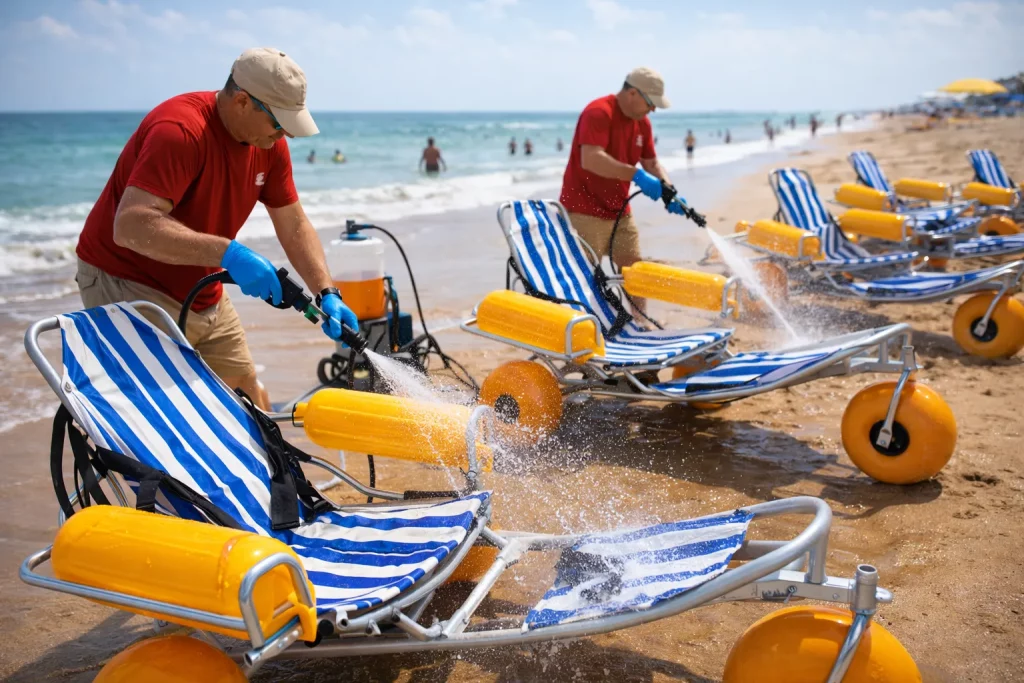
Yes, the versatility of these designs allows them to function as comfortable beach loungers. When utilizing a floating beach wheelchair rental , users can enjoy a day on the sand without needing to transfer between multiple pieces of equipment. The ergonomic mesh seating provides excellent support for long-term use.
The high-quality fabrics used in these chairs are breathable and designed to shed water quickly. This means a user can come out of the ocean and be dry and comfortable on the sand within minutes.
Comfort Features
- Reclining Backrests: Many models offer multiple seating angles.
- UV-Protected Fabric: Prevents the seat from becoming uncomfortably hot in the sun.
- Breathable Mesh: Allows for airflow, reducing perspiration on hot days.
Why It Beats a Standard Lounger
But that’s not all; the chair offers mobility that a standard lounger cannot.
- The user can move with the tide without a difficult transfer.
- Integrated armrests provide a secure place for personal items.
- Elevated seating makes it easier for users with limited leg strength to stand up.
Key Takeaway: Dual-purpose functionality makes these chairs the ultimate tool for a full day of coastal relaxation.
| Feature | Standard Beach Lounger | Floating Wheelchair |
|---|---|---|
| Mobility | None | High (All-Terrain) |
| Water Access | No | Yes (Buoyant) |
| Transfer Ease | Difficult | High (Armrest Support) |
Investing in a high-quality chair provides a comprehensive solution for both relaxation and adventure.
Where can you find a floating beach wheelchair rental?
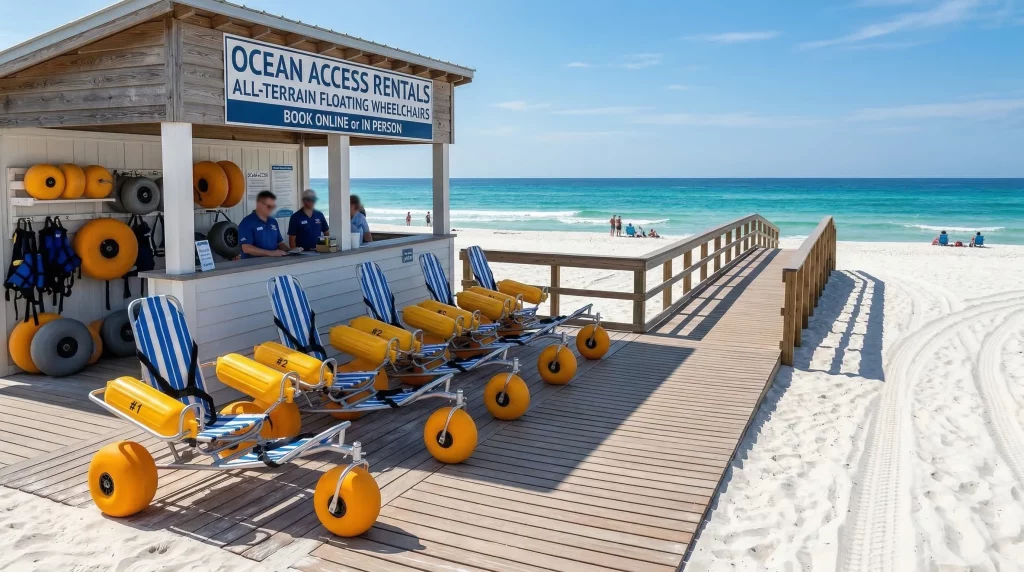
Finding a floating beach wheelchair rental is easier than ever as municipalities and resorts prioritize inclusion. Many popular tourist destinations now offer these chairs at lifeguard stations or through dedicated beachfront kiosks. It is always recommended to call ahead or check the city’s parks and recreation website.
For businesses like hotels or beach clubs, providing these chairs is a significant value-add for guests. Many organizations partner with manufacturers to provide high-quality fleets for seasonal use.
Common Rental Locations
- Lifeguard Stations: Often provide chairs on a first-come, first-served basis.
- Resort Concierges: High-end hotels frequently keep a fleet for guest use.
- Specialized Rental Shops: Private companies that deliver equipment to your location.
How to Secure a Rental
Here is the deal: planning ahead is your best strategy.
- Book at least 24 hours in advance during the peak summer season.
- Ask about delivery and pickup options to save time.
- Verify if the rental includes any necessary accessories like sunshades.
Key Takeaway: Early booking and checking with local lifeguard stations are the best ways to ensure equipment availability.
| Service Type | Typical Cost | Availability |
|---|---|---|
| City-Managed | Free / Low Cost | First-Come, First-Served |
| Private Rental | 50−100 per day | Reservation Recommended |
| Resort Amenity | Included in Stay | High (Guest Only) |
Knowing where to look ensures you spend more time in the water and less time searching for equipment.
Frequently Asked Questions
Can I take a floating wheelchair into deep water?No, floating wheelchairs are designed for shallow-water access and supervised swimming. They should never be taken into deep water or areas with strong riptides without a trained assistant.
What is the best way to transport the chair to the beach?Most professional models are designed to be collapsible or quick-release. They can typically fit into the trunk of a large SUV or on a standard hitch-mounted rack.
Can I use the chair on standard sidewalks?While possible, the balloon tires are optimized for soft surfaces. Prolonged use on concrete or asphalt can cause premature wear on the rubber.
What should I do if the tire goes flat?Most balloon tires can be easily repaired with a standard bike patch kit or replaced through a mobility equipment dealer. Always check the pressure before heading to the sand.
Is a life jacket required while using the chair?While the chair provides buoyancy, we highly recommend that users—especially non-swimmers—wear a Coast Guard-approved life jacket for maximum safety in moving water.
Experience Unmatched Coastal Freedom
Inclusive beach access is no longer a luxury; it is a standard for professional resorts and municipalities. By integrating advanced buoyancy engineering with all-terrain mobility, we help people reclaim their connection to the sea. Whether you are a resort manager looking to upgrade your guest experience or an individual planning a family trip, the right equipment is the key to success.
Don’t let the sand stop your journey. Contact us today to discover how our specialized mobility solutions can transform your beachfront experience.
Our vision is to make every beach in the world accessible for everyone, ensuring that the joy of the ocean is shared by all.